
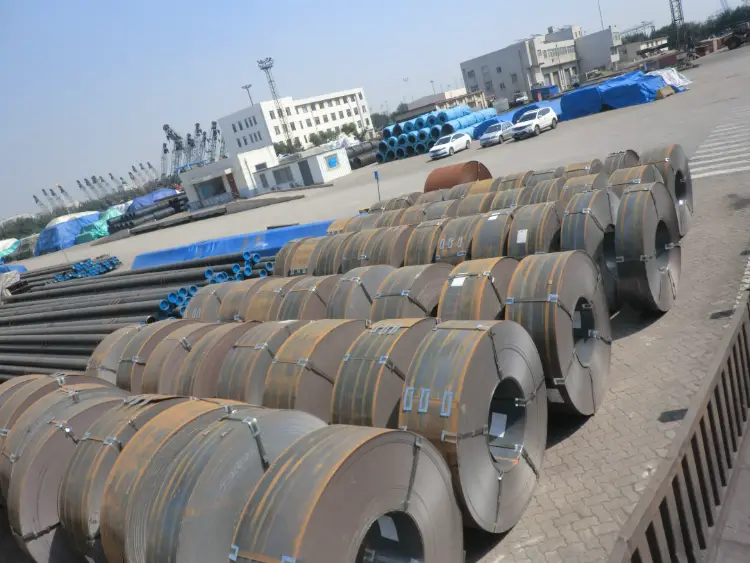
RINA D40 Shipbuilding Steel Coil
RINA D40 Shipbuilding Steel Coil - High-Strength Hull Structural Material
Comprehensive material data for RINA D40 shipbuilding steel including chemical composition, mechanical and physical properties, equivalent grades, and application guidance.
Hot rolling, normalising rolling, thermomechanical controlled processing (TMCP), accelerated cooling
- Phone : +8618037372205
- Email : [email protected]
- WhatsApp: Contact via Whtsapp
- WeChat: +8618037372205
RINA D40 Shipbuilding Steel Coil Introduction
RINA D40 steel is a high-strength hull structural steel grade certified by the Registro Italiano Navale (RINA), equivalent to DH40 under the IACS (International Association of Classification Societies) unified requirement UR W11. It belongs to the group of normalised or thermomechanically rolled weldable fine-grain structural steels with a specified minimum yield strength of 390 MPa and a tensile strength range of 510–650 MPa. The 'D' designation indicates impact toughness testing at -20°C, making it suitable for ship hulls operating in low-temperature environments. Supplied in coil form, it is used for longitudinal profiles, plates, and structural members in shipbuilding and marine engineering. The steel exhibits good weldability, excellent notch toughness, and consistent through-thickness properties when produced under strict controlled rolling and accelerated cooling processes.
RINA D40 Shipbuilding Steel Coil Chemical Composition
The chemical composition complies with IACS UR W11 (Rev.8) and the corresponding RINA specifications. The values represent ladle analysis limits. Fine-grain elements (Nb, V, Al) are added to achieve grain refinement and improve toughness. Carbon equivalent Ceq = C + Mn/6 + (Cr+Mo+V)/5 + (Ni+Cu)/15 is controlled to ensure weldability.
| Element | Standard Value | Remarks |
|---|---|---|
| Carbon (C) | ≤ 0.18 | - |
| Manganese (Mn) | 0.90 – 1.60 | - |
| Silicon (Si) | 0.10 – 0.50 | Generally ≤ 0.50 acceptable |
| Phosphorus (P) | ≤ 0.035 | - |
| Sulfur (S) | ≤ 0.035 | - |
| Aluminium (Al, acid soluble) | ≥ 0.015 | Minimum for grain refinement |
| Niobium (Nb) | 0.02 – 0.05 | Optional grain refiner |
| Vanadium (V) | 0.05 – 0.10 | Optional grain refiner |
| Titanium (Ti) | ≤ 0.02 | - |
| Copper (Cu) | ≤ 0.35 | - |
| Chromium (Cr) | ≤ 0.20 | - |
| Nickel (Ni) | ≤ 0.40 | - |
| Molybdenum (Mo) | ≤ 0.08 | - |
| Nitrogen (N) | ≤ 0.012 | If present; for aluminium-treated steels |
| Carbon equivalent (Ceq) | ≤ 0.40 | For thickness ≤ 50 mm |
RINA D40 Shipbuilding Steel Coil Thermal and Electrical Physical Properties
Physical properties are typical values for carbon-manganese structural steels and are not specified by RINA but are provided for engineering design reference. Properties may vary slightly depending on exact chemical composition and processing route.
| Property | Standard Reference Value | Unit | Test Condition |
|---|---|---|---|
| Density (ρ) | 7850 | kg/m³ | Room temperature |
| Modulus of Elasticity (E) | 210 | GPa | Room temperature |
| Shear Modulus (G) | 80 | GPa | Room temperature |
| Poisson's Ratio (ν) | 0.3 | - | Room temperature |
| Thermal Expansion Coefficient (α) | 11.7 | 10⁻⁶/K | 20°C – 100°C |
| Thermal Conductivity (λ) | 51.9 | W/(m·K) | at 20°C |
| Specific Heat Capacity (cp) | 486 | J/(kg·K) | Room temperature |
| Electrical Resistivity (ρe) | 0.17 | µΩ·m | Room temperature |
RINA D40 Shipbuilding Steel Coil Mechanical Properties
Mechanical property requirements according to IACS UR W11 and RINA Rules. Values are for transverse test pieces unless otherwise stated. Impact test temperature for D40 is -20°C. Elongation is measured on a gauge length of L0 = 5.65√So (50 mm standard). For thicknesses over 50 mm, minimum elongation and impact energy requirements are slightly reduced.
| Property | Standard Required Value | Unit | Test Condition |
|---|---|---|---|
| Yield Strength (ReH) | ≥ 390 | MPa | Transverse, thickness ≤ 100 mm |
| Tensile Strength (Rm) | 510 – 650 | MPa | Transverse, all thicknesses |
| Elongation (A) | ≥ 20 | % | L0 = 5.65√So (50 mm gauge), thickness ≤ 50 mm |
| Elongation (A) | ≥ 19 | % | Thickness > 50 to 70 mm |
| Elongation (A) | ≥ 18 | % | Thickness > 70 to 100 mm |
| Charpy V-notch Impact (KV) | ≥ 31 (longitudinal) / ≥ 24 (transverse) | J | -20°C, thickness ≤ 50 mm |
| Charpy V-notch Impact (KV) | ≥ 27 (longitudinal) / ≥ 20 (transverse) | J | -20°C, thickness > 50 to 70 mm |
| Bend Test (180°) | No cracks | - | Bend diameter = 3t (t ≤ 50 mm), 4t (t > 50 mm) |
RINA D40 Shipbuilding Steel Coil Completely Equivalent Material Standards & Substitutable Grade Recommendations
The following classification society grades are direct equivalents to RINA D40 (DH40) and are accepted as substitutes under IACS unified requirements. They share identical chemical and mechanical property limits.
| Country/Region | Standard | Grade | Remarks |
|---|---|---|---|
| USA | ABS Rules | DH40 | Identical to IACS UR W11 |
| France | BV Rules | DH40 | Bureau Veritas equivalent |
| China | CCS Rules | DH40 | China Classification Society equivalent |
| Norway/Germany | DNV GL Rules | DH40 | Legacy DNV and GL grade |
| South Korea | KR Rules | DH40 | Korean Register equivalent |
| UK | LR Rules | LR DH40 | Lloyd's Register equivalent |
| Japan | NK Rules | NK DH40 | Nippon Kaiji Kyokai grade |
| Russia | RS Rules | RS D40 | Russian Maritime Register of Shipping |
RINA D40 Shipbuilding Steel Coil Application Introduction
RINA D40 steel coils are primarily used in the construction of ship hulls and marine structures where high strength, good weldability, and reliable low‑temperature toughness are required. The material is suitable for both longitudinal and transversal structural members. Typical applications are outlined below.
Product Applications: Rolled coils, cut‑to‑length sheets, hot‑rolled plates, wide strips, Structural profiles (bulb flats, angles, channels), Pre‑fabricated ship sections and panel blocks, Welded beams and built‑up girders
Processed into products: Main deck plates and stiffeners, Bottom shell and inner bottom plating, Side shell and longitudinal bulkheads, Transverse bulkheads and web frames, Hatch coaming and coaming stays, Engine room girders and foundations, Helideck support structures
Application industries: Shipbuilding (cargo ships, tankers, bulk carriers, container vessels, passenger ships), Offshore engineering (jack‑up rigs, semi‑submersibles, FPSO modules), Marine and coastal infrastructure (quay walls, lock gates, breakwaters), Port equipment and heavy‑duty machinery
RINA D40 Shipbuilding Steel Coil Similar/Alternative Material Recommendations
These materials belong to the same high-strength shipbuilding steel family but differ in impact test temperature. They can be considered for service conditions requiring different low‑temperature toughness. Non‑classification structural steels like EN 10025‑4 S420M/ML are roughly similar in strength but are not certified for ship hull construction.
| Country/Region | Standard | Grade | Remarks |
|---|---|---|---|
| International (IACS) | IACS UR W11 | AH40 | Impact test at 0°C; otherwise identical chemistry and strength |
| International (IACS) | IACS UR W11 | EH40 | Impact test at -40°C; higher low‑temperature toughness |
| International (IACS) | IACS UR W11 | FH40 | Impact test at -60°C; for arctic applications |
| European Union | EN 10025-4 | S420M/ML | Comparable minimum yield strength 420 MPa, not ship‑certified |
Notes:
Welding procedures should follow classification society guidelines; preheat may be required for thick sections. The steel may be supplied with an epoxy or zinc‑silicate shop primer for temporary corrosion protection. The impact test values are mandatory and must be verified by third‑party surveyors. For arctic service, consider using EH40 or FH40 instead of D40 due to lower test temperatures. Dimensional tolerances for coils conform to EN 10051 or equivalent standard.
- Share



