
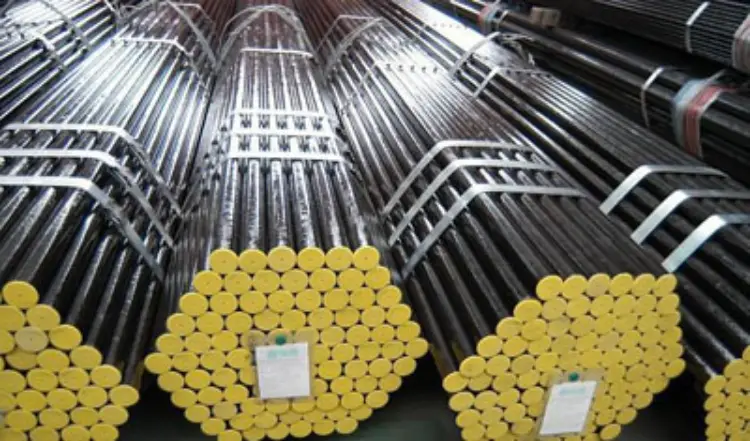
ASTM A511 MT347 Stainless Steel Seamless Mechanical Tube
ASTM A511 MT347 Stainless Steel Pipe: High-Temperature Seamless Tubing for Critical Applications
Comprehensive data sheet for ASTM A511 MT347 seamless mechanical tubing. Includes chemical composition, mechanical properties, thermal conductivity, and international equivalent standards. Ideal for superheaters, chemical plants, and corrosive high-temperature service.
Hot finished or cold finished, annealed, pickled, bright annealed
- Phone : +8618037372205
- Email : [email protected]
- WhatsApp: Contact via Whtsapp
- WeChat: +8618037372205
ASTM A511 MT347 Stainless Steel Seamless Mechanical Tube Introduction
ASTM A511 MT347 is a seamless austenitic stainless steel mechanical tubing grade produced in accordance with ASTM A511/A511M. The material corresponds to UNS S34700 and is stabilized with niobium (columbium) to counteract chromium carbide precipitation. This stabilization provides superior resistance to intergranular corrosion after exposure to temperatures in the sensitization range (427–816 °C). Compared with non-stabilized grades such as 304 or 304L, MT347 maintains better strength and corrosion resistance in high-temperature environments and can be used for continuous service up to approximately 800 °C. The alloy exhibits good weldability, formability, and toughness in both the as-welded and annealed conditions.
- Excellent resistance to intergranular corrosion
- High-temperature strength and oxidation resistance
- Readily fabricated by standard methods
- Supplied in annealed and descaled condition
Typical delivery condition is annealed, pickled, or bright annealed, ensuring maximum ductility and cleanliness. MT347 is widely employed in chemical processing, power generation, and heat exchanger manufacturing where reliability under thermal cycling and corrosive media is essential.
ASTM A511 MT347 Stainless Steel Seamless Mechanical Tube Chemical Composition
The chemical composition of ASTM A511 MT347 conforms to the requirements for UNS S34700. The niobium plus tantalum content is carefully controlled to ensure stabilization against sensitization. Carbon is kept below 0.08 wt% while chromium and nickel provide austenitic structure and corrosion resistance.
- Niobium (columbium) addition: 10 × C min to prevent chromium carbide formation.
- Low sulfur and phosphorus for improved cleanliness.
| Element | Standard Value (wt%) | Remarks |
|---|---|---|
| Carbon (C) | ≤ 0.08 | Austenite stabilizer |
| Manganese (Mn) | ≤ 2.00 | Deoxidizer |
| Phosphorus (P) | ≤ 0.045 | Impurity |
| Sulfur (S) | ≤ 0.030 | Impurity |
| Silicon (Si) | ≤ 1.00 | Deoxidizer |
| Chromium (Cr) | 17.0 – 19.0 | Corrosion resistance |
| Nickel (Ni) | 9.0 – 13.0 | Austenite former |
| Niobium + Tantalum (Nb+Ta) | 10 × C min; ≤ 1.00 | Stabilizing element |
| Iron (Fe) | Balance | Base element |
ASTM A511 MT347 Stainless Steel Seamless Mechanical Tube Thermal and Electrical Physical Properties
The physical properties of ASTM A511 MT347 (UNS S34700) are characteristic of fully austenitic stainless steels. These values are influenced by temperature and the annealing treatment. The data provided below represent typical values for material in the annealed condition and may vary slightly depending on product form and processing history.
- Density is slightly lower than some high-nickel alloys.
- Thermal expansion is relatively high; allowances must be made in design.
- Electrical resistivity is moderate, making the alloy suitable for certain electrical resistance applications.
| Property | Typical Value | Unit | Test Condition |
|---|---|---|---|
| Density (ρ) | 8.0 | g/cm³ | Room temperature |
| Modulus of Elasticity (E) | 193 | GPa | Room temperature |
| Modulus of Elasticity (E) | 172 | GPa | 200 °C |
| Shear Modulus (G) | 77 | GPa | Room temperature |
| Poisson's Ratio (ν) | 0.30 | – | Ambient |
| Thermal Expansion Coefficient (α) | 16.6 | ×10⁻⁶/K | 20–100 °C |
| Thermal Expansion Coefficient (α) | 17.2 | ×10⁻⁶/K | 20–300 °C |
| Thermal Expansion Coefficient (α) | 18.0 | ×10⁻⁶/K | 20–500 °C |
| Thermal Conductivity (λ) | 16.2 | W/(m·K) | at 100 °C |
| Thermal Conductivity (λ) | 21.5 | W/(m·K) | at 500 °C |
| Specific Heat Capacity (cₚ) | 500 | J/(kg·K) | 20–100 °C |
| Electrical Resistivity (ρₑ) | 72 | μΩ·cm | Room temperature |
ASTM A511 MT347 Stainless Steel Seamless Mechanical Tube Mechanical Properties
Mechanical properties are based on room temperature tensile testing of annealed seamless tubing in accordance with ASTM A511. The required minimum values ensure adequate strength and ductility for forming and service. Hardness limits are often specified for quality control.
- Tensile and yield properties are valid for wall thicknesses up to the specified limits.
- Elongation is measured on a standard gauge length of 50 mm (2 in.).
| Property | Standard Requirement | Unit | Test Condition |
|---|---|---|---|
| Tensile Strength (Rm) | ≥ 515 (75) | MPa (ksi) | Room temperature; annealed |
| Yield Strength (ReH, 0.2% offset) | ≥ 205 (30) | MPa (ksi) | Room temperature; annealed |
| Elongation (A) in 50 mm | ≥ 35 | % | Longitudinal; standard specimen |
| Hardness (HRB) | ≤ 90 | – | Annealed condition |
| Hardness (HBW) | ≤ 200 | – | Alternative; annealed condition |
ASTM A511 MT347 Stainless Steel Seamless Mechanical Tube Completely Equivalent Material Standards and Replaceable Grades
| Country / Region | Standard | Grade | Remarks |
|---|---|---|---|
| USA | ASTM A213/A213M | TP347 | Seamless ferritic and austenitic boiler tubes; identical UNS S34700 |
| USA | ASTM A312/A312M | TP347 | Seamless and welded pipe; same chemical composition and mechanical properties |
| USA | ASME SA-213 | SA-213 TP347 | ASME Boiler & Pressure Vessel Code adoption |
| Europe | EN 10216-5 | 1.4550 (X6CrNiNb18-10) | Seamless steel tubes for pressure purposes; fully equivalent stabilized grade |
| Japan | JIS G3463 | SUS 347 TB | Boiler and heat exchanger tubes; equivalent austenitic grade |
| China | GB/T 14976 | 06Cr18Ni11Nb | Seamless stainless steel pipes for fluid transport; equivalent composition |
ASTM A511 MT347 Stainless Steel Seamless Mechanical Tube Application Introduction
ASTM A511 MT347 is especially suited for demanding elevated-temperature and corrosive environments where resistance to intergranular corrosion after welding or thermal cycling is critical. The stabilized grade avoids the need for post-weld heat treatment in many situations. These characteristics make it a preferred material in heat exchanger, boiler, and chemical process equipment construction.
- Excellent oxidation resistance up to 800 °C in air.
- Retains good ductility after long-term aging.
- Can be used in both aqueous corrosion and high-temperature gas environments.
- Weldable by all common fusion and resistance methods.
Product Applications: Superheater and Reheater Tubing, Heat Exchanger Tubes, Boiler Tubes, Process Piping and Instrumentation Tubing, Thermowell and Protection Tubes, High-Temperature Structural Hollow Sections
Processed into products: Welded tube bundles for shell-and-tube heat exchangers, Coiled tubing for steam generators, Expansion joints and bellows, High-temperature flanges and fittings, Furnace components such as burner tubes and recuperator tubes, Chemical injection lances, Thermocouple protection sleeves
Application industries: Chemical Processing, Petrochemical and Refining, Power Generation (fossil and nuclear), Oil and Gas, Food and Beverage, Pharmaceutical, Aerospace (auxiliary components)
ASTM A511 MT347 Stainless Steel Seamless Mechanical Tube Similar or Alternative Materials with Comparable Performance
| Country / Region | Standard | Grade | Remarks |
|---|---|---|---|
| USA | ASTM A213 | TP321 | Titanium-stabilized austenitic stainless steel; similar corrosion resistance but better strength in crevice environments. Not suitable for temperatures increasing niobium carbide solubility. |
| USA | ASTM A213 | TP347H | High-carbon (0.04–0.10 %) version of 347; higher creep strength for elevated temperature service, often used in superheaters. |
| USA | ASTM A213 | TP304H | Higher carbon 304 for high-temperature strength; lacks stabilization and may suffer sensitization after long-term elevated temperature exposure. |
| Europe | EN 10216-5 | 1.4948 (X6CrNiNb18-10) | Essentially the same as 1.4550, may appear in some national standards with slightly different designation; interchangeable. |
| Japan | JIS G3459 | SUS 347 | Similar stabilization; used in chemical plant and heat exchanger piping; close but not seamless mechanical tubing standard. |
Notes:
- Welding: MT347 can be welded using matching filler metal (AWS ER347) or a low carbon 308L filler if post-weld heat treatment is performed. Stabilization minimizes the risk of knife-line attack near the weld zone.
- Heat treatment: Full annealing is typically carried out at 980–1065 °C followed by rapid cooling (water quench or air cool). Stress relief should be performed carefully to avoid sensitization.
- Machining: The alloy work-hardens; sharp tools, positive feeds, and rigid setups are required. Sulfurized cutting oils may improve machinability.
- Certification: Tubing is typically supplied with material test reports (MTR) showing chemical analysis, tensile results, and any supplementary testing as per ASTM A511/A511M requirements.
- Share



