
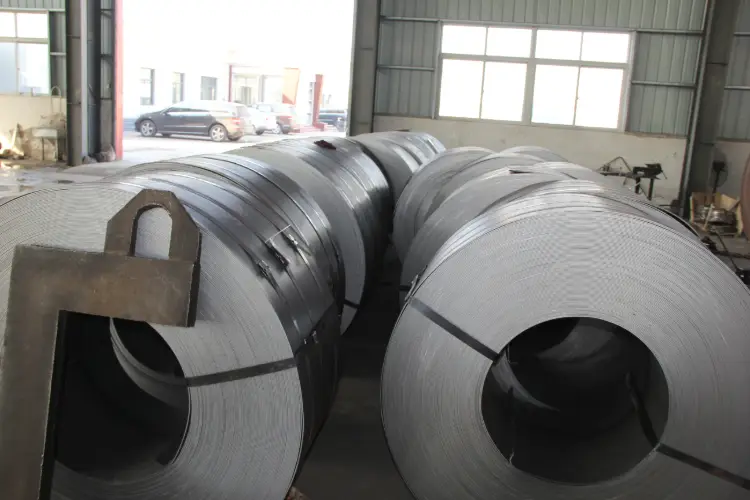
RINA AH500 Shipbuilding Steel Coil
RINA AH500 Shipbuilding Steel Coil: High-Strength Marine Structural Steel for Extreme Conditions
Comprehensive material data for RINA AH500 shipbuilding steel coil, including chemical composition, mechanical and physical properties, international equivalents, and application guidelines.
Thermomechanical rolling (TMCP), normalizing (N), or quenching and tempering (Q+T) depending on thickness and purchaser requirements
- Phone : +8618037372205
- Email : [email protected]
- WhatsApp: Contact via Whtsapp
- WeChat: +8618037372205
RINA AH500 Shipbuilding Steel Coil Introduction
RINA AH500 is an extra high-strength shipbuilding structural steel grade certified by the Registro Italiano Navale (RINA), conforming to the IACS UR W11 unified requirements. It is supplied in hot-rolled coil form and is designed for critical hull and offshore structures that demand a minimum yield strength of 500 MPa combined with reliable impact toughness at 0°C (Class A). The steel achieves its properties through thermomechanical controlled processing (TMCP), normalizing, or quenching and tempering, ensuring excellent weldability and crack resistance. Typical applications include heavy-duty plating, stiffeners, and built-up sections in container ships, bulk carriers, naval vessels, and offshore platforms, where weight savings together with high load-bearing capacity are essential.
RINA AH500 Shipbuilding Steel Coil Chemical Composition
The composition below follows the IACS UR W11 specification for extra high strength shipbuilding steels with minimum yield 500 MPa. Elements not listed are kept at residual levels. The addition of niobium, vanadium, and titanium is often used for grain refinement and precipitation strengthening. Carbon equivalent (Ceq) is controlled to ensure good weldability, typically ≤ 0.43 for TMCP and ≤ 0.45 for N or Q+T conditions. Specific values may be adjusted by the manufacturer within the permitted range.
| Element | Standard Value (max or range) | Remarks |
|---|---|---|
| C | ≤ 0.20 | Typical 0.08–0.18 for TMCP |
| Mn | 0.90–1.60 | May be increased up to 1.70 by agreement |
| Si | 0.10–0.55 | Deoxidizing element |
| P | ≤ 0.025 | Strictly controlled for toughness |
| S | ≤ 0.025 | Strictly controlled for lamellar tearing resistance |
| Altot | ≥ 0.015 | Total aluminium, fine grain practice |
| Nb | ≤ 0.05 | Microalloying for grain refinement |
| V | ≤ 0.10 | Microalloying for strength |
| Ti | ≤ 0.05 | Grain refinement, if Al not used then Ti ≤ 0.02 |
| Cr | ≤ 0.25 | Residual alloying element |
| Ni | ≤ 0.40 | May be higher by agreement for improved toughness |
| Cu | ≤ 0.35 | Residual, can be higher by agreement |
| Mo | ≤ 0.08 | Residual element |
| N | ≤ 0.012 | Free nitrogen controlled |
| Ceq (IIW) | ≤ 0.43 (typical) | Ceq = C + Mn/6 + (Cr+Mo+V)/5 + (Ni+Cu)/15 |
RINA AH500 Shipbuilding Steel Coil Thermal and Electrical Physical Properties
The physical constants below are typical for high-strength low-alloy steels in the quenched & tempered or TMCP condition. They are not part of the IACS UR W11 mandatory certification but are frequently used in design calculations. Variations may occur depending on exact composition and heat treatment. Data are valid for ambient temperature unless otherwise noted.
| Property | Typical Value | Unit | Remarks |
|---|---|---|---|
| Density (ρ) | 7.85 | g/cm³ | At 20°C |
| Melting Point | ~1520 | °C | Approximate range 1500–1535°C |
| Specific Heat Capacity (cp) | 450–500 | J/(kg·K) | At 20°C; increases with temperature |
| Thermal Conductivity (λ) | 42 – 48 | W/(m·K) | At 20°C; lower at elevated temperatures |
| Thermal Expansion Coefficient (α) | 11.7 | ×10⁻⁶ /K | 20–100°C range |
| Thermal Expansion Coefficient (α) | 12.5 | ×10⁻⁶ /K | 20–200°C range |
| Thermal Expansion Coefficient (α) | 13.0 | ×10⁻⁶ /K | 20–300°C range |
| Young's Modulus (E) | 205 – 210 | GPa | At 20°C |
| Shear Modulus (G) | 80 | GPa | At 20°C |
| Poisson's Ratio (ν) | 0.28 – 0.30 | - | Elastic range |
| Electrical Resistivity (ρe) | 0.18 – 0.25 | µΩ·m | At 20°C; depends on alloy content |
RINA AH500 Shipbuilding Steel Coil Mechanical Properties
Mechanical tests are carried out on specimens taken from the material in its delivery condition. The yield strength (ReH) and tensile strength (Rm) must meet the tabulated values. Elongation A5 is measured on a gauge length of 200 mm for plate thickness ≤ 40 mm. The Charpy V-notch impact test is performed at 0°C for the AH500 grade, with minimum average absorbed energy of 34 J. Transverse bending tests are required for all grades: the specimen must withstand 180° bending without cracking. If multiple thickness ranges apply, the most stringent requirements are shown.
| Property | Standard Requirement | Unit | Test Condition / Remarks |
|---|---|---|---|
| Yield Strength (ReH) | ≥ 500 | MPa | Applicable for thickness ≤ 100 mm |
| Tensile Strength (Rm) | 610 – 770 | MPa | For t ≤ 100 mm |
| Elongation (A) | ≥ 16 | % | t ≤ 40 mm, gauge length 5.65√S0 |
| Elongation (A) | ≥ 15 | % | 40 < t ≤ 63 mm |
| Elongation (A) | ≥ 14 | % | 63 < t ≤ 100 mm |
| Impact Energy (KV) at 0°C | ≥ 34 (average of 3) | J | Minimum single value 24 J; Class A |
| Bend Test (180°) | No cracks | – | Mandrel diameter 3t for t ≤ 25 mm, 4t for t > 25 mm |
RINA AH500 Shipbuilding Steel Coil Fully Equivalent Grades and International Standards
| Country/Region | Standard | Grade | Remarks |
|---|---|---|---|
| Italy / International | RINA Rules for Ships | AH500 | Original certification body |
| United Kingdom | Lloyd's Register Rules | AH500 | LR AH500 |
| Norway / Germany | DNV Rules for Ships | AH500 | DNV AH500 |
| USA | ABS Rules for Building and Classing Steel Vessels | AH500 | American Bureau of Shipping |
| France | Bureau Veritas Rules | AH500 | BV AH500 |
| China | CCS Rules for Materials and Welding | AH500 | China Classification Society |
| Japan | Nippon Kaiji Kyokai Rules | AH500 | NK AH500 |
| South Korea | Korean Register Rules | AH500 | KR AH500 |
| India | IRS Rules for Construction and Classification of Steel Ships | AH500 | Indian Register of Shipping |
| Poland | PRS Rules | AH500 | Polish Register of Shipping |
| Croatia | CRS Rules | AH500 | Croatian Register of Shipping |
| Russia | RS Rules for Classification and Construction of Sea-Going Ships | AH500 | RMRS |
RINA AH500 Shipbuilding Steel Coil Application Introduction
RINA AH500 steel coil offers an outstanding strength-to-weight ratio, making it ideal for weight-critical marine structures. The material is specifically designed for welded fabrication and can be cold formed to moderate extents. Its 0°C impact guarantee ensures reliable service in temperate climates, while the advanced TMCP route provides low carbon equivalent for trouble-free welding without excessive preheating. Typical applications emphasize heavy-loaded hull components and offshore topside structures.
Product Applications: Shell and deck plating for large container vessels (up to 24,000 TEU), Bottom, side, and strength deck plating of VLCC and ULCC tankers, Transverse bulkheads and inner bottom plates in bulk carriers, Leg sections and rack plates of self-elevating offshore platforms, Heavy lifting crane booms and pedestals on offshore support vessels, Mega-yacht hull stiffeners and keel plates, Ice-strengthened hulls for polar supply vessels (in AH500 quality, sometimes with supplementary modulus testing)
Processed into products: Hull shell plates (side, bottom, deck), Stiffeners and stringers (flat bars, bulb flats, angles, tees), Web frames and deep girders, Floor plates and keel riders, Bulkhead plates and corrugated bulkhead webs, Offshore module main beams and columns, Winch foundations and heavy machinery seats
Application industries: Commercial shipbuilding (container ships, bulk carriers, tankers, Ro-Ro ferries), Naval shipbuilding (frigates, patrol vessels, auxiliary ships), Offshore oil & gas (jack-up rigs, semi-submersibles, fixed platform modules), Renewable offshore energy (wind turbine substructures, floating solar platforms), Port and harbour construction (heavy crane structures, ship loaders), Bridge and infrastructure (moveable bridges, marine terminal structures)
RINA AH500 Shipbuilding Steel Coil Similar Materials with Comparable Strength Level
| Country/Region | Standard | Grade | Remarks |
|---|---|---|---|
| International | IACS UR W11 | AH620 | Higher strength (min 620 MPa yield), same toughness class |
| International | IACS UR W11 | AH460 | Slightly lower strength (min 460 MPa yield), may be used with increased thickness |
| Europe | EN 10025-6 | S500Q/QL/QL1 | Quenched and tempered structural steel, not specifically marine certified but similar mechanical requirements |
| Europe | EN 10225 | S500G2+M/Q | Weldable structural steel for fixed offshore structures, good alternative with marine notch toughness |
| USA | ASTM A514/A514M | Grade Q | High-strength quenched & tempered plate, min yield 690 MPa, can be used if marine certification not mandatory |
| USA | API 2W | Grade 50 (with supplement) | Steel plates for offshore structures, TMCP, yield 345–517 MPa but with high toughness; higher grades available |
| Japan | JIS G 3106 | SM570 | High-strength rolled steel for welded structures, min tensile 570 MPa, comparable but not fully equivalent |
Notes:
Welding recommendations: Due to controlled carbon equivalent, RINA AH500 can be welded with low-hydrogen processes (SMAW, GMAW, SAW) using matching strength electrodes (e.g., AWS E11018-M, or equivalents) with minimal or no preheat for moderate thicknesses. Post-weld heat treatment (PWHT) is generally not required but may be applied for thick sections if stress relief is needed, always within the tempering temperature window to avoid strength degradation. Corrosion protection: As with all carbon-manganese structural steels, the material requires coating or cathodic protection in seawater immersion zones. Supply format: Coils are typically slit into strips or cut to length plates; edge milling and shot blasting can be arranged. Certification: Material is supplied with a RINA inspection certificate 3.1 or 3.2, including all mandatory test results.
- Share



