
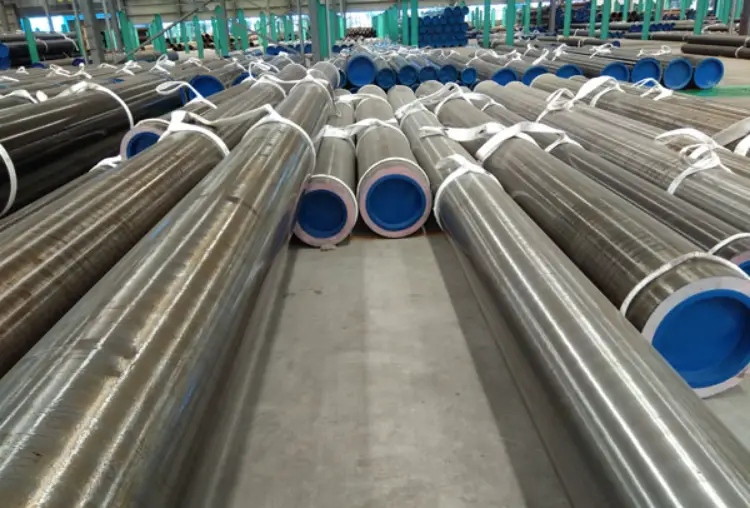
DIN 17400 1.4477 Duplex Stainless Steel Pipe
DIN 17400 1.4477 Duplex Stainless Steel Pipe - Properties, Equivalents & Applications
Complete technical data for 1.4477 duplex stainless steel pipe according to DIN 17400: chemical composition, mechanical and physical properties, international equivalents, and application guide.
Hot forming, cold forming, machining, welding (with appropriate procedures)
- Phone : +8618037372205
- Email : [email protected]
- WhatsApp: Contact via Whtsapp
- WeChat: +8618037372205
DIN 17400 1.4477 Duplex Stainless Steel Pipe Introduction
DIN 17400 grade 1.4477 is a duplex (austenitic-ferritic) stainless steel, equivalent to EN 1.4462 / X2CrNiMoN22-5-3 and commonly known as 2205 (UNS S32205/S31803). It delivers a combination of high mechanical strength and outstanding resistance to pitting, crevice corrosion, and stress corrosion cracking, especially in chloride-containing environments. With a balanced microstructure of roughly 50% ferrite and 50% austenite, the material offers good weldability and toughness. It is typically supplied in the solution-annealed and quenched condition, suitable for fabrication into pipes, fittings, and pressure vessel components.
DIN 17400 1.4477 Duplex Stainless Steel Pipe Chemical Composition of DIN 1.4477 / X2CrNiMoN22-5-3
Chemical composition according to EN 10088-1 for the equivalent grade X2CrNiMoN22-5-3 (1.4462), which is fully consistent with the former DIN 17400 designation 1.4477. The duplex structure is achieved primarily through balanced Cr, Ni, Mo, and N additions. All values are maximum unless a range is indicated.
| Element | Content (wt%) | Remarks |
|---|---|---|
| C | ≤ 0.03 | |
| Si | ≤ 1.00 | |
| Mn | ≤ 2.00 | |
| P | ≤ 0.035 | |
| S | ≤ 0.015 | |
| Cr | 21.0 – 23.0 | |
| Ni | 4.5 – 6.5 | |
| Mo | 2.5 – 3.5 | |
| N | 0.10 – 0.22 | |
| Fe | Balance |
DIN 17400 1.4477 Duplex Stainless Steel Pipe Thermal and Electrical Physical Properties
Typical physical property data for wrought duplex stainless steel 1.4477 (2205) at ambient and elevated temperatures. Properties are representative for the solution-annealed condition and serve as design guides. Actual values may slightly vary depending on product form and processing history.
| Property | Typical Value | Unit | Test Condition / Temperature |
|---|---|---|---|
| Density, ρ | 7.80 | g/cm³ | at 20 °C |
| Modulus of elasticity, E | 200 | GPa | at 20 °C |
| Shear modulus, G | 80 | GPa | at 20 °C |
| Poisson's ratio, ν | 0.3 | - | at 20 °C |
| Thermal expansion coefficient, α | 13.0 | 10⁻⁶/K | 20 – 100 °C |
| Thermal expansion coefficient, α | 13.5 | 10⁻⁶/K | 20 – 200 °C |
| Thermal expansion coefficient, α | 14.0 | 10⁻⁶/K | 20 – 300 °C |
| Thermal conductivity, λ | 15 | W/(m·K) | at 20 °C |
| Specific heat capacity, cp | 500 | J/(kg·K) | at 20 °C |
| Electrical resistivity, ρe | 0.80 | μΩ·m | at 20 °C |
DIN 17400 1.4477 Duplex Stainless Steel Pipe Mechanical Properties at Room Temperature
Minimum mechanical properties for solution-annealed 1.4477 (2205) pipe products as specified in EN 10216-5 (seamless) and EN 10217-7 (welded) for wall thickness ≤ 50 mm. Bend test required for pipes OD ≥ 14 mm: 180° bend around a mandrel of diameter 3 × wall thickness without cracking. Impact toughness is measured on Charpy V-notch specimens.
| Property | Standard Requirement | Unit | Test Condition |
|---|---|---|---|
| Yield strength, Rp0.2 | ≥ 450 | MPa | Room temperature, longitudinal/transverse |
| Tensile strength, Rm | 650 – 880 | MPa | Room temperature |
| Elongation, A5 | ≥ 25 (longitudinal), ≥ 20 (transverse) | % | Gauge length L₀ = 5.65√S₀ |
| Bend test (mandrel diameter) | 3 × wall thickness | mm | 180° bend, no cracks |
| Impact energy, KV₂ | ≥ 100 (longitudinal), ≥ 60 (transverse) | J | Room temperature, Charpy V-notch |
| Hardness | ≤ 270 HBW / ≤ 28 HRC | - | As per ISO 6506 / ISO 6508 |
DIN 17400 1.4477 Duplex Stainless Steel Pipe Fully Equivalent Grades – International Standards & Direct Substitutions
| Country/Region | Standard | Grade / Designation | Remarks |
|---|---|---|---|
| EU | EN 10088-2 / EN 10088-3 | 1.4462 / X2CrNiMoN22-5-3 | Direct replacement; identical composition and properties |
| USA | ASTM A240 / A789 / A790 | UNS S32205 (also UNS S31803, with slightly lower N) | Widely accepted duplex stainless steel 2205 |
| Japan | JIS G4304 / G4305 | SUS329J3L | Ferritic-austenitic stainless steel with equivalent corrosion resistance |
| China | GB/T 20878 / GB/T 4237 | S22253 / 022Cr22Ni5Mo3N | National standard equivalent to 2205 |
| International | ISO 15510 | X2CrNiMoN22-5-3 / 4462-2205-03-I | ISO designation matching EN 1.4462 |
DIN 17400 1.4477 Duplex Stainless Steel Pipe Application Introduction
1.4477 (2205) duplex stainless steel is extensively used where high resistance to chloride stress corrosion cracking combined with elevated mechanical strength is required. The material performs well in marine and chemical environments and is often selected as a cost-effective alternative to super austenitic or nickel-base alloys.
Common end-user industries:
Product Applications: Seamless and welded pipes for corrosive fluid transport, Heat exchanger tubes and tube sheets, Pressure vessels and reactors, Storage tanks and process columns, Structural sections for marine environments, Flanges, fittings, and forgings
Processed into products: Valves and pump bodies, Centrifugal pump shafts, Flanges and weld-neck forgings, Bolts, nuts, and fasteners for critical service, Agitator blades and impellers, Desalination brine heater tubes, Cooling water pipes and headers
Application industries: Oil & Gas (offshore and onshore), Chemical and petrochemical processing, Marine and shipbuilding, Pulp and paper bleaching equipment, Desalination plants, Heat exchangers and condensers, Food and beverage processing, Water treatment and distribution
DIN 17400 1.4477 Duplex Stainless Steel Pipe Similar / Alternative Materials – Performance Overview
| Country/Region | Standard | Grade / Designation | Remarks |
|---|---|---|---|
| EU | EN 10088 | 1.4410 / X2CrNiMoN25-7-4 (SAF 2507) | Super duplex; higher strength and better pitting resistance (PREN ≥ 40); more expensive |
| EU | EN 10088 | 1.4362 / X2CrNiN23-4 (SAF 2304) | Lean duplex; lower Ni and Mo content, suitable for less aggressive environments, cost-effective |
| USA | ASTM A240 | UNS S32750 (2507) | Super duplex analog to 1.4410, PREN ~42.5 |
| USA | ASTM A240 | UNS S32304 (2304) | Lean duplex analog to 1.4362, PREN ~24-25 |
| Japan | JIS G4304 | SUS329J4L (255) | Higher alloy duplex (25Cr-6Ni-3Mo), intermediate between 2205 and 2507 |
Notes:
Welding considerations: Matching filler metals (e.g., 22 9 3 N L) should be used; post-weld solution annealing is recommended to restore full corrosion resistance. Avoid long-term exposure in the temperature range 280–1000 °C to prevent precipitation of sigma phase and 475 °C embrittlement. Certification: Products can be supplied with EN 10204 3.1 or 3.2 certificates upon request. The material conforms to NACE MR0175/ISO 15156 for sour service up to certain hardness limits.
- Share



