
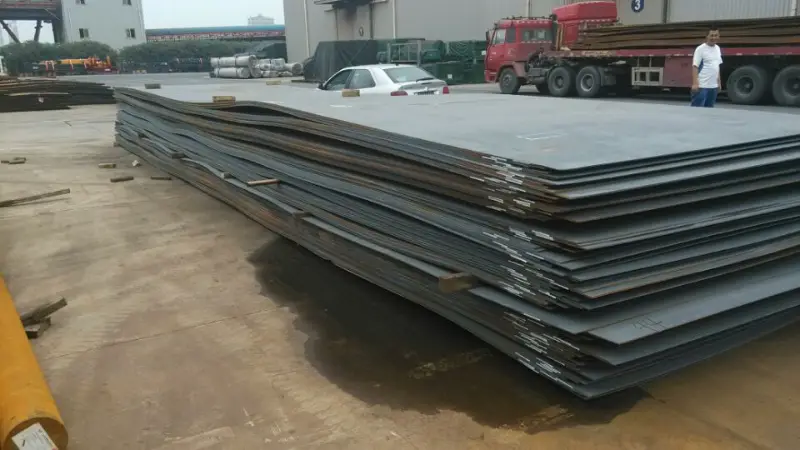
QStE380N Automotive Structural Steel - SEW092
QStE380N Automotive Structural Steel - SEW092 | Fine-Grained High-Strength Low-Alloy Material
Detailed material properties and application data for QStE380N automobile structure steel plate per SEW092 standard, covering chemical composition, mechanical behavior, thermal and electrical physical performance, international equivalents, and typical uses.
Cold forming, bending, stamping, welding, punching, riveting
- Phone : +8618037372205
- Email : [email protected]
- WhatsApp: Contact via Whtsapp
- WeChat: +8618037372205
QStE380N Automotive Structural Steel - SEW092 Introduction
QStE380N is a hot-rolled, fine-grained structural steel with a minimum yield strength of 380 MPa, specifically designed for cold forming and automotive structural applications according to the German SEW092 standard. This material belongs to the family of thermomechanically rolled high-strength low-alloy (HSLA) steels, where microalloying elements such as niobium, titanium, and vanadium provide grain refinement and precipitation strengthening. The grade offers an excellent combination of high strength, good weldability, and sufficient formability for chassis and suspension components. With the withdrawal of SEW092, the material is now covered by EN 10149-2 under the designation S380MC, ensuring its continued availability and specification in European and international markets. Typical delivery conditions include thermomechanical rolling (M condition), often accompanied by pickling and oiling to improve surface quality and corrosion resistance during further processing.
QStE380N Automotive Structural Steel - SEW092 Chemical Composition
The chemical composition is specified according to SEW092 for QStE380N. All values are maximum limits unless otherwise indicated. The material is microalloyed with Nb, Ti, and V to achieve the required strength and grain refinement. The total sum of these elements is restricted to maintain weldability and formability.
| Chemical Element | Standard Value (max %) | Remarks |
|---|---|---|
| C (Carbon) | ≤0.12 | |
| Si (Silicon) | ≤0.50 | |
| Mn (Manganese) | ≤1.30 | |
| P (Phosphorus) | ≤0.025 | |
| S (Sulfur) | ≤0.020 | |
| Al (Aluminum) | ≥0.015 | Total aluminum |
| Nb (Niobium) | ≤0.09 | Microalloying element |
| Ti (Titanium) | ≤0.15 | Microalloying element |
| V (Vanadium) | ≤0.10 | Microalloying element |
| Nb+Ti+V | ≤0.22 | Combined microalloying elements |
QStE380N Automotive Structural Steel - SEW092 Thermal and Electrical Physical Properties
The following physical properties are typical values for low-carbon high-strength structural steels and can be used for general calculations. Slight variations may occur depending on the actual chemical composition and processing route. Measurements are taken at room temperature unless stated otherwise.
| Property | Typical Value | Unit | Test Condition |
|---|---|---|---|
| Density (ρ) | 7.85 | g/cm³ | at 20°C |
| Modulus of Elasticity (E) | 210 | GPa | at 20°C |
| Shear Modulus (G) | 81 | GPa | at 20°C |
| Poisson's Ratio (ν) | 0.30 | — | at 20°C |
| Thermal Expansion Coefficient (α) | 11.5 × 10⁻⁶ | K⁻¹ | between 20°C and 200°C |
| Thermal Conductivity (λ) | 52 | W/(m·K) | at 20°C |
| Specific Heat Capacity | 500 | J/(kg·K) | at 20°C |
| Electrical Resistivity (ρ_e) | 0.14 – 0.20 | μΩ·m | at 20°C |
QStE380N Automotive Structural Steel - SEW092 Mechanical Properties
Mechanical properties for QStE380N (converted according to EN 10149-2 grade S380MC, the direct equivalent) in thermomechanically rolled condition. Values are valid for longitudinal test pieces and depend on the nominal thickness. The bend test mandrel diameter is expressed as a multiple of the specimen thickness (t).
| Property | Standard Required Value | Unit | Test Condition |
|---|---|---|---|
| Yield Strength (ReH) | ≥380 | MPa | Nominal thickness ≤3 mm |
| Yield Strength (ReH) | ≥360 | MPa | Nominal thickness >3 mm ≤6 mm |
| Yield Strength (ReH) | ≥330 | MPa | Nominal thickness >6 mm ≤12 mm |
| Tensile Strength (Rm) | 450 – 590 | MPa | Thickness ≤6 mm |
| Tensile Strength (Rm) | 430 – 570 | MPa | Thickness >6 mm ≤12 mm |
| Elongation after fracture (A80) | ≥23 | % | Thickness ≤3 mm |
| Elongation after fracture (A80) | ≥22 | % | Thickness >3 mm ≤6 mm |
| Elongation after fracture (A5) | ≥24 | % | Thickness >6 mm ≤12 mm |
| Bend test (mandrel diameter) | 0t | — | 180°, thickness <3 mm |
| Bend test (mandrel diameter) | 0.5t | — | 180°, thickness 3 mm ≤ t ≤6 mm |
| Bend test (mandrel diameter) | 1.0t | — | 180°, thickness >6 mm ≤12 mm |
QStE380N Automotive Structural Steel - SEW092 Exact Equivalent Material Standards and Substitute Grades
| Country/Region | Standard | Designation | Remarks |
|---|---|---|---|
| Europe | EN 10149-2 | S380MC | Direct replacement; identical chemical and mechanical requirements |
| International | ISO 6930-2 | FeE380 | Equivalent to S380MC and QStE380N |
| Germany | DIN EN 10149-2 (successor of SEW092) | S380MC | Current German standard replacing SEW 092 |
QStE380N Automotive Structural Steel - SEW092 Application Introduction
QStE380N is specially developed for automotive structural components where high strength, good cold formability, and reliable weldability are required. It is commonly used in areas that benefit from weight reduction while maintaining crash performance and fatigue resistance. Typical processing routes include laser cutting, press braking, and robotic welding. The material is suitable for both exposed and unexposed applications after appropriate surface treatment.
Product Applications: Chassis frames and subframes, Cross members and longitudinal beams, Suspension arms and brackets, Bumper reinforcement beams, Door impact beams, Seat structures and backrest frames, Engine cradles
Processed into products: Cold-formed and stamped structural brackets, Welded assemblies for body-in-white, Bent tube and profile reinforcements, Punched and riveted parts, Laser-cut blanks for further forming
Application industries: Automotive manufacturing, Commercial vehicle production, Agricultural and construction machinery, General mechanical engineering
QStE380N Automotive Structural Steel - SEW092 Similar or Closely Related Substitute Materials
| Country/Region | Standard | Designation | Remarks |
|---|---|---|---|
| Japan | JIS G 3134 | SPFH540 | Higher yield/tensile strength, similar formability for automotive frames |
| China | GB/T 20887.2 (based on EN 10149-2) | HR380F | HSLA steel for cold forming; yield ≥380 MPa, close match |
| USA | ASTM A1011 / A1011M | HSLAS Grade 55 Class 1 | Yield 380 MPa, tensile 480 MPa min, for structural applications |
| USA | SAE J1392 | 050XLK | HSLA grade with similar formability and strength for automotive use |
Notes:
SEW092 has been officially withdrawn and replaced by EN 10149-2. The designation QStE380N is now covered under S380MC in the European system. When ordering to EN 10149-2, the delivery condition is typically +M (thermomechanically rolled). Consider specifying supplementary requirements for impact toughness if sub-zero service is intended. Surface quality categories A or B may be selected according to the intended use.
- Share



