
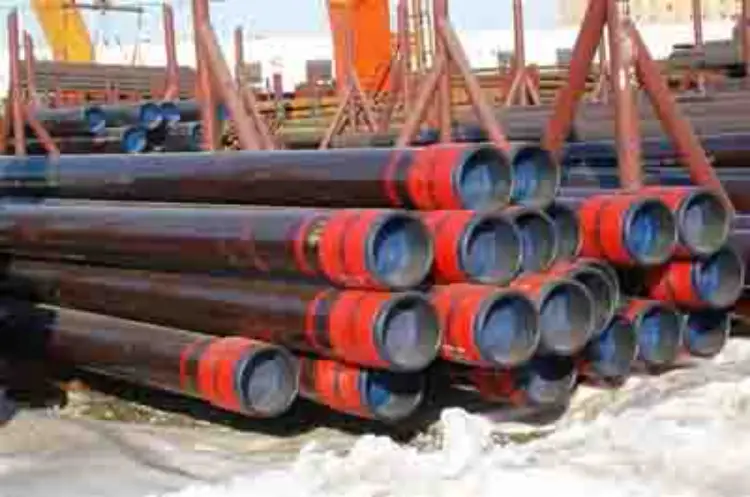
Q420C Low Alloy Structural Steel for LSAW Pipe
Q420C Low Alloy Structural Steel for LSAW Pipe - GB/T 1591 Data & Equivalents
Complete material data for Q420C steel per GB/T 1591, used for longitudinally submerged arc welded (LSAW) pipes. Chemical composition, tensile strength, impact toughness, physical properties, and international equivalents.
Hot rolling, controlled rolling, normalizing, cold forming, welding (submerged arc welding for pipe)
- Phone : +8618037372205
- Email : [email protected]
- WhatsApp: Contact via Whtsapp
- WeChat: +8618037372205
Q420C Low Alloy Structural Steel for LSAW Pipe Introduction
Q420C is a Chinese standard low alloy high strength structural steel with a minimum yield strength of 420 MPa. It offers good weldability, moderate toughness (0°C impact test), and is widely produced as hot-rolled or normalized plates and coils.
- Used for heavy welded structures such as bridges, buildings, offshore platforms, and LSAW (longitudinally submerged arc welded) pipes for oil/gas transmission.
- Fine grain practice with microalloying (Nb, V, Ti) ensures consistent mechanical properties across thicknesses up to 150 mm.
- Grade C guarantees longitudinal Charpy impact energy ≥34 J at 0°C, making it suitable for moderate low-temperature service.
Q420C Low Alloy Structural Steel for LSAW Pipe Chemical Composition
Chemical requirements as per GB/T 1591-2018 for grade Q420. All values are maximum unless stated otherwise. The steel is typically microalloyed with Nb, V, Ti, and may use Al for grain refinement. Low phosphorus and sulfur ensure good toughness and weldability.
| Element | Standard Value | Remarks |
|---|---|---|
| C | ≤0.20 | |
| Si | ≤0.50 | |
| Mn | ≤1.70 | |
| P | ≤0.030 | |
| S | ≤0.030 | |
| Nb | ≤0.07 | |
| V | ≤0.20 | |
| Ti | ≤0.20 | |
| Cr | ≤0.30 | |
| Ni | ≤0.80 | |
| Cu | ≤0.55 | |
| Mo | ≤0.20 | |
| N | ≤0.015 | |
| Al (total) | ≥0.020 | If grain refinement with Al is applied |
Q420C Low Alloy Structural Steel for LSAW Pipe Thermal and Electrical Physical Properties
Physical properties are typical values for low alloy structural steel of this grade at room temperature. These values are not mandatory in GB/T 1591 but are useful for engineering calculations. Slight variations may occur depending on actual composition and heat treatment condition.
| Property | Typical Value | Unit | Test Condition |
|---|---|---|---|
| Density (ρ) | 7.85 | g/cm³ | 20°C |
| Modulus of elasticity (E) | 206 | GPa | 20°C |
| Shear modulus (G) | 80 | GPa | 20°C |
| Poisson's ratio (ν) | 0.3 | – | 20°C |
| Thermal expansion coefficient (α) | 12 × 10⁻⁶ | 1/K | 20°C – 200°C |
| Thermal conductivity (λ) | 48 | W/(m·K) | 20°C |
| Specific heat capacity (c) | 460 | J/(kg·K) | 20°C |
| Electrical resistivity (ρe) | 0.23 × 10⁻⁶ | Ω·m | 20°C |
Q420C Low Alloy Structural Steel for LSAW Pipe Mechanical Properties
Mechanical properties according to GB/T 1591-2018 for Q420C, based on tensile and impact tests at room temperature and 0°C respectively. Yield and tensile strengths depend on plate thickness. Elongation is measured with proportional gauge length L0=5.65√S0. Bending test requires no cracks when bending 180° around a prescribed mandrel diameter.
| Property | Required Value | Unit | Test Condition / Thickness |
|---|---|---|---|
| Yield strength (ReH) | ≥420 | MPa | t ≤ 16 mm |
| Yield strength (ReH) | ≥400 | MPa | 16 mm < t ≤ 40 mm |
| Yield strength (ReH) | ≥380 | MPa | 40 mm < t ≤ 63 mm |
| Yield strength (ReH) | ≥370 | MPa | 63 mm < t ≤ 80 mm |
| Yield strength (ReH) | ≥360 | MPa | 80 mm < t ≤ 100 mm |
| Tensile strength (Rm) | 520 – 680 | MPa | t ≤ 100 mm |
| Elongation after fracture (A) | ≥19 | % | t ≤ 40 mm, 5.65√S0 |
| Elongation after fracture (A) | ≥18 | % | 40 mm < t ≤ 100 mm, 5.65√S0 |
| Bend test (mandrel diameter) | d=2a | – | t ≤ 16 mm, 180° bending |
| Bend test (mandrel diameter) | d=3a | – | 16 mm < t ≤ 100 mm, 180° bending |
| Charpy impact energy (KV2, longitudinal) | ≥34 | J | 0°C, 10×10 mm specimen |
Q420C Low Alloy Structural Steel for LSAW Pipe Completely Equivalent Material Standards & Substitute Grades
| Country/Region | Standard | Grade | Remarks |
|---|---|---|---|
| European Union | EN 10025-3 | S420N | Normalized fine-grain steel; 0°C impact option available, mechanical properties match Q420C |
| European Union | EN 10025-4 | S420M | Thermomechanical rolled fine-grain steel; 0°C impact grade can substitute Q420C |
| International | ISO 4950-2 | E420CC | Yield strength 420 MPa, Charpy at 0°C, equivalent for structural applications |
| USA | ASTM A572 / A572M | Grade 60 [415] (Type 2) | Yield ≥415 MPa; no mandatory impact requirement – supplementary Charpy test must be negotiated |
Q420C Low Alloy Structural Steel for LSAW Pipe Application Introduction
Q420C is particularly suitable for welded structures that require a combination of high strength, good toughness at moderate low temperatures, and reliable weldability. Its main form for LSAW pipes is heavy plate manufactured into large-diameter longitudinally welded pipes used extensively in energy and infrastructure projects.
Product Applications: LSAW line pipe for onshore/offshore pipelines, Structural hollow sections and tubular columns, Pressure vessels and storage tanks, Offshore wind turbine monopile foundations, Bridge box girders and arch ribs
Processed into products: Pipe spools and fittings (elbows, reducers, flanges), Transition joints between pipe and equipment, Support rings and stiffeners for large-diameter pipe, Pile sleeves and connectors for offshore structures, Custom welded beams and box sections
Application industries: Oil & Gas (transmission pipelines, risers), Construction (high-rise building columns, trusses), Bridge engineering (deck plates, girders), Shipbuilding & offshore platforms (jack-up legs, hull stiffeners), Power generation (penstocks, pressure vessels), Mining & heavy machinery (crane booms, excavator arms)
Q420C Low Alloy Structural Steel for LSAW Pipe Similar / Alternative Materials Recommendation
| Country/Region | Standard | Grade | Remarks |
|---|---|---|---|
| China | GB/T 1591 | Q420D | Higher toughness grade: impact at -20°C ≥34 J, otherwise similar chemistry and strength |
| European Union | EN 10025-4 | S420ML | TMCP with guaranteed impact at -50°C, can be used where lower temperature toughness is needed |
| USA | API 5L | X60 (L415) | Pipe line steel with yield ≥415 MPa, designed for LSAW pipes but specific to oil & gas transport |
| Japan | JIS G 3106 | SM490B | Yield 325 MPa, lower strength; increase thickness to achieve similar load capacity |
| International | ISO 3183 | L415M (X60M) | Line pipe grade for welded pipes, mechanical properties close to Q420C with TMCP delivery |
Notes:
- For LSAW pipe fabrication, Q420C plate is formed into a cylinder and welded using submerged arc welding (inside and outside).
- Preheating before welding is recommended when plate thickness exceeds 30 mm or ambient temperature is low; interpass temperature should be controlled to avoid embrittlement.
- Post-weld heat treatment (PWHT) may be applied to relieve residual stresses in critical pipe systems.
- The material is typically supplied in normalized or hot-rolled condition; ultrasonic testing of the plate is often required to ensure Z-direction properties if used for structural purposes.
- Typical delivery for LSAW pipe: weld reinforcement removed, ends bevelled, hydrostatic test performed per purchasing specification.
- Share



