
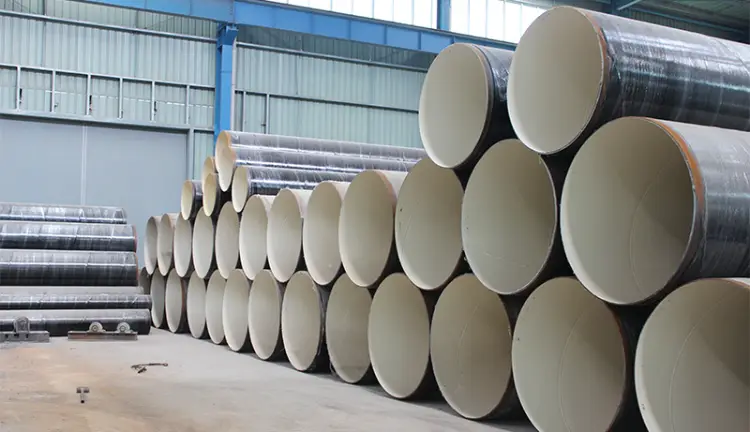
Q390E SSAW Pipe Steel under GB/T 1591
Q390E SSAW Pipe Steel under GB/T 1591: High-Strength Low-Alloy for Welded Structures
Detailed material data for Q390E low-alloy structural steel used in spiral submerged arc welded (SSAW) pipe production, including chemical composition, mechanical and physical properties, and equivalent grades.
Hot rolling, cold forming, spiral forming and submerged arc welding (for SSAW pipes), cutting, bending
- Phone : +8618037372205
- Email : [email protected]
- WhatsApp: Contact via Whtsapp
- WeChat: +8618037372205
Q390E SSAW Pipe Steel under GB/T 1591 Introduction
Q390E is a high-strength low-alloy (HSLA) structural steel grade standardized in GB/T 1591-2018, designed for welded structures requiring high toughness at low temperatures. The 'E' designation indicates guaranteed impact energy at -40°C. This grade is widely supplied as hot-rolled plates and coils for manufacturing SSAW (spiral submerged arc welded) pipes used in oil & gas transmission, water pipelines, structural piling, and pressure vessels. Key features include:
- Minimum yield strength of 390 MPa (thickness ≤16 mm) with good weldability
- Excellent low-temperature toughness (KV₂ ≥ 34 J at -40°C)
- Controlled carbon equivalent for improved weldability and formability
- Available in various thicknesses with normalized or as-rolled delivery condition
Q390E SSAW Pipe Steel under GB/T 1591 Chemical Composition
Chemical composition requirements according to GB/T 1591-2018 for Q390E. Elements are listed as maximum weight percentages unless a range is specified. Fine grain practice is achieved through additions of Nb, V, Ti, Al, and controlled nitrogen.
| Element | Standard Value (max, %) | Remarks |
|---|---|---|
| C | 0.20 | CEV typically ≤0.44 (thickness ≤40 mm) |
| Si | 0.50 | |
| Mn | 1.70 | Higher Mn improves strength and toughness |
| P | 0.025 | For quality grade E |
| S | 0.020 | For quality grade E |
| Nb | 0.07 | Grain refiner; can be partially replaced by V/Ti |
| V | 0.15 | |
| Ti | 0.20 | |
| Cr | 0.30 | Residual or added for corrosion resistance |
| Ni | 0.50 | |
| Cu | 0.30 | |
| Mo | 0.10 | |
| N | 0.015 | Bound by Al and V to form nitrides |
| Als | ≥0.015 | Acid-soluble aluminum for deoxidation and grain refinement |
Q390E SSAW Pipe Steel under GB/T 1591 Thermal and Electrical Physical Properties
These physical data represent typical values for Q390E as a carbon-manganese low-alloy steel. They are useful for engineering calculations related to heat transfer, thermal expansion, and electrical resistivity. Values are valid at room temperature unless otherwise noted.
| Property | Typical Value | Unit | Test Condition |
|---|---|---|---|
| Density (ρ) | 7.85 | g/cm³ | 20°C |
| Modulus of Elasticity (E) | 206 | GPa | 20°C, static |
| Shear Modulus (G) | 79 | GPa | 20°C, calculated from E and ν |
| Poisson's Ratio (ν) | 0.30 | - | 20°C, elastic range |
| Thermal Expansion Coefficient (α) | 12.0 × 10⁻⁶ | K⁻¹ | 20 – 100°C |
| Thermal Conductivity (λ) | 50 | W/(m·K) | 20°C |
| Specific Heat Capacity (cₚ) | 460 | J/(kg·K) | 20°C |
| Electrical Resistivity (ρₑ) | 0.23 × 10⁻⁶ | Ω·m | 20°C |
Q390E SSAW Pipe Steel under GB/T 1591 Mechanical Properties
Tensile and impact properties according to GB/T 1591-2018 for Q390E (transverse or longitudinal, as specified). Impact test temperature is -40°C (Charpy V-notch, longitudinal specimen). Bend test mandrel diameter depends on thickness and yield strength. Data are presented for commonly supplied thickness ranges.
| Property | Specified Value | Unit | Test Condition / Thickness |
|---|---|---|---|
| Yield Strength (ReH) - lower yield | ≥390 | MPa | t ≤ 16 mm |
| Yield Strength (ReH) | ≥380 | MPa | 16 mm < t ≤ 40 mm |
| Yield Strength (ReH) | ≥370 | MPa | 40 mm < t ≤ 63 mm |
| Yield Strength (ReH) | ≥350 | MPa | 63 mm < t ≤ 80 mm |
| Yield Strength (ReH) | ≥330 | MPa | 80 mm < t ≤ 100 mm |
| Tensile Strength (Rm) | 490 – 650 | MPa | t ≤ 16 mm |
| Tensile Strength (Rm) | 470 – 630 | MPa | 16 mm < t ≤ 40 mm |
| Tensile Strength (Rm) | 470 – 630 | MPa | 40 mm < t ≤ 63 mm |
| Tensile Strength (Rm) | 470 – 630 | MPa | 63 mm < t ≤ 80 mm |
| Tensile Strength (Rm) | 470 – 630 | MPa | 80 mm < t ≤ 100 mm |
| Elongation after Fracture (A5) | ≥20 | % | t ≤ 16 mm |
| Elongation after Fracture (A5) | ≥20 | % | 16 mm < t ≤ 40 mm |
| Elongation after Fracture (A5) | ≥19 | % | 40 mm < t ≤ 63 mm |
| Elongation after Fracture (A5) | ≥19 | % | 63 mm < t ≤ 100 mm |
| Impact Energy (KV₂) | ≥34 | J | Longitudinal, -40°C, 10×10 mm specimen |
| Bend Test (180° bend) | D = 2a | - | t ≤ 16 mm, D = mandrel diameter, a = thickness |
| Bend Test (180° bend) | D = 3a | - | 16 mm < t ≤ 100 mm |
Q390E SSAW Pipe Steel under GB/T 1591 Fully Equivalent Material Standards and Replaceable Grade Recommendations
| Country/Region | Standard | Grade | Remarks |
|---|---|---|---|
| China | GB/T 1591-2018 | Q390E | Original designation, SSAW pipe material |
| International | ISO 4950-2 (withdrawn) | E390DD | Historical high-yield structural flat products; not identical chemical composition but similar mechanical requirements |
| European Union | EN 10149-2 | S390MC | Cold-rolled or hot-rolled high yield strength steel for cold forming; yield comparable, but impact property specifications may differ; not fully equivalent due to processing route |
| USA | ASTM A572/A572M | Grade 60 [415] | Yield ≥415 MPa; requires supplementary requirement S5 for notch toughness at -40°C to approach Q390E; chemical composition ranges differ |
Q390E SSAW Pipe Steel under GB/T 1591 Application Introduction
Q390E SSAW pipe combines high strength with excellent low-temperature toughness, making it suitable for demanding welded structures. The spiral submerged arc welding (SSAW) process allows production of large-diameter pipes with a wide range of wall thicknesses, often used in infrastructure and energy sectors. Proper preheating and post-weld heat treatment are recommended based on thickness.
Product Applications: Spiral submerged arc welded (SSAW) pipes from 219 mm to over 3000 mm diameter, Longitudinally welded pipes (LSAW) when plates are used, Structural hollow sections (circular, square, rectangular), Pressure vessels and storage tanks (when additional PWHT is applied), Bridge girders and truss members (fabricated from plate)
Processed into products: Pipeline segments, bends, and fittings (tees, reducers), Steel pipe piles and foundation pipes for buildings, Offshore platform legs and braces, Tubular joints and nodes in space frames, High-strength welded flanges and blind flanges, Crane rails, booms, and mast sections
Application industries: Oil and gas transmission (onshore and offshore pipelines), Water transport and distribution (large diameter mains), Civil engineering and construction (structural columns, piling), Marine and offshore engineering (jackets, risers, conductors), Machinery manufacturing (heavy equipment, crane booms)
Q390E SSAW Pipe Steel under GB/T 1591 Similar/Comparable Substitute Material Recommendations
| Country/Region | Standard | Grade | Remarks |
|---|---|---|---|
| China | GB/T 1591-2018 | Q390D | Same strength, impact test temperature -20°C; suitable if -40°C toughness not required |
| China | GB/T 1591-2018 | Q420E | Higher yield (420 MPa), same -40°C toughness; may require welding procedure adjustment due to higher strength |
| China | GB/T 1591-2018 | Q355NE | Normalized delivery, yield ≥355 MPa, -40°C toughness; lower strength but widely available for SSAW pipe |
| European Union | EN 10025-4 | S355ML | Thermomechanically rolled, fine grain steel with minimum yield 355 MPa, impact -50°C; a close alternative for structural tubes |
| USA | ASTM A709/A709M | Grade 50W [345W] with Charpy at -40°C | Weathering steel with improved atmospheric corrosion resistance; yield ~345 MPa, toughness can be specified; suitable for certain SSAW pipe applications |
| Japan | JIS G 3106 | SM490A/B/C | Welded structural steel with yield ≥325-365 MPa; impact options available; lower strength but common for pipes |
Notes:
- CEV (carbon equivalent) should be kept within limits for weldability; typical max CEV for Q390E is ≤0.44% for thickness ≤40 mm.
- For SSAW pipe production, the hot-rolled coil edges are milled and formed into a spiral, then welded with submerged arc process; normalizing or stress relieving may be applied after welding depending on service requirements.
- Supplementary testing such as ultrasonic inspection, hydrostatic testing, and drop-weight tear test (DWTT) may be specified for pipe applications.
- When replacing Q390E with other grades, ensure that the design code (e.g., API 5L, EN 10219, ASTM A252) allows substitution and that toughness and weldability are re-evaluated.
- Share



