
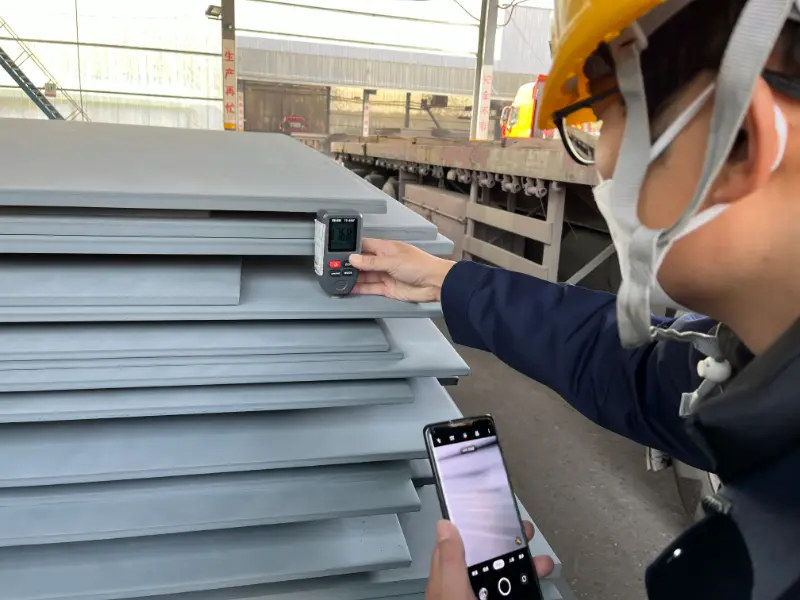
Q390D Low-Alloy High-Strength Structural Steel
Q390D Low-Alloy High-Strength Structural Steel - LSAW Pipe & General Engineering
Detailed material data for Q390D steel according to GB/T 1591, including chemical composition, mechanical properties, and physical characteristics for LSAW pipe applications.
Hot rolling, controlled rolling, normalizing, thermo-mechanical controlled processing (TMCP), welding, forming
- Phone : +8618037372205
- Email : [email protected]
- WhatsApp: Contact via Whtsapp
- WeChat: +8618037372205
Q390D Low-Alloy High-Strength Structural Steel Introduction
Q390D is a low-alloy high-strength structural steel defined in GB/T 1591-2018. With a minimum yield strength of 390 MPa, it offers excellent weldability, good toughness at -20 °C, and reliable performance for welded structures such as LSAW pipes. The steel is normalized or thermo-mechanically rolled and is widely used in bridges, buildings, pressure vessels, and offshore platforms. Its balanced chemistry with microalloying elements (Nb, V, Ti) ensures fine grain size and consistent mechanical properties across thicknesses up to 150 mm. The D suffix indicates guaranteed impact energy of at least 34 J at -20 °C.
Q390D Low-Alloy High-Strength Structural Steel Chemical Composition
The chemical composition of Q390D according to GB/T 1591-2018 ensures a fine-grained microstructure and good weldability. Microalloying elements (Nb, V, Ti) provide precipitation strengthening and grain refinement. Phosphorus and sulfur are tightly controlled for toughness. Carbon equivalent (CEV) is typically limited for good weldability.
| Chemical Element | Standard Value (max, unless range) | Remarks |
|---|---|---|
| Carbon (C) | ≤ 0.20 | Higher carbon reduces weldability; low level maintained |
| Silicon (Si) | ≤ 0.50 | Deoxidizer; contributes to strength |
| Manganese (Mn) | ≤ 1.70 | Increases strength and hardenability |
| Phosphorus (P) | ≤ 0.030 | Controlled for toughness and avoidance of cold shortness |
| Sulfur (S) | ≤ 0.025 | Controlled for ductility and impact properties |
| Niobium (Nb) | ≤ 0.07 | Grain refiner and precipitation strengthener |
| Vanadium (V) | ≤ 0.20 | Precipitation hardening and grain refinement |
| Titanium (Ti) | ≤ 0.20 | Grain refinement and nitrogen fixation |
| Chromium (Cr) | ≤ 0.30 | Optional addition; improves hardenability |
| Nickel (Ni) | ≤ 0.50 | Improves toughness; residual element |
| Copper (Cu) | ≤ 0.30 | Residual element; can affect hot shortness |
| Molybdenum (Mo) | ≤ 0.10 | Residual element |
| Nitrogen (N) | ≤ 0.015 | Controlled to avoid strain aging |
| Aluminum (Al, total) | ≥ 0.015 | Grain refinement and deoxidation; minimum specified |
Q390D Low-Alloy High-Strength Structural Steel Thermal and Electrical Physical Properties
The following physical properties are typical for low-alloy structural steel grades similar to Q390D. They are not mandatory requirements of GB/T 1591 but are representative for engineering calculations. Properties may vary slightly with exact composition and heat treatment.
| Property Item | Standard Reference Value | Unit | Test Condition |
|---|---|---|---|
| Density (ρ) | 7.85 | g/cm³ | At 20 °C |
| Elastic Modulus (E) | 200 – 210 | GPa | At 20 °C |
| Shear Modulus (G) | 79 – 81 | GPa | At 20 °C |
| Poisson's Ratio (ν) | 0.28 – 0.30 | — | At 20 °C |
| Thermal Expansion Coefficient (α) | 11.5 – 12.5 | 10⁻⁶/K | 20 – 100 °C |
| Thermal Expansion Coefficient (α) | 12.5 – 13.5 | 10⁻⁶/K | 20 – 200 °C |
| Thermal Conductivity (λ) | 42 – 48 | W/(m·K) | At 100 °C |
| Specific Heat Capacity | 460 – 500 | J/(kg·K) | At 20 °C |
| Electrical Resistivity (ρₑ) | 0.20 – 0.25 | 10⁻⁶ Ω·m | At 20 °C |
Q390D Low-Alloy High-Strength Structural Steel Mechanical Properties
Mechanical properties for Q390D per GB/T 1591-2018 depend on product thickness. Yield strength decreases with increasing thickness. Impact energy is guaranteed at -20 °C. Bending test is performed to a bend angle of 180° with specified mandrel diameters. For LSAW pipes, the pipe properties may also comply with GB/T 9711 or other pipeline standards, which typically reference the base metal properties.
| Property Item | Standard Requirement Value | Unit | Test Condition / Thickness |
|---|---|---|---|
| Yield Strength (ReH) | ≥ 390 | MPa | Thickness ≤ 16 mm |
| Yield Strength (ReH) | ≥ 370 | MPa | 16 mm < thickness ≤ 40 mm |
| Yield Strength (ReH) | ≥ 350 | MPa | 40 mm < thickness ≤ 63 mm |
| Yield Strength (ReH) | ≥ 330 | MPa | 63 mm < thickness ≤ 80 mm |
| Yield Strength (ReH) | ≥ 310 | MPa | 80 mm < thickness ≤ 100 mm |
| Yield Strength (ReH) | ≥ 290 | MPa | 100 mm < thickness ≤ 150 mm |
| Tensile Strength (Rm) | 490 – 650 | MPa | All thicknesses |
| Elongation (A) | ≥ 20 | % | Thickness ≤ 40 mm; gauge length 5.65√S₀ |
| Elongation (A) | ≥ 19 | % | 40 mm < thickness ≤ 63 mm |
| Elongation (A) | ≥ 19 | % | 63 mm < thickness ≤ 100 mm |
| Elongation (A) | ≥ 18 | % | 100 mm < thickness ≤ 150 mm |
| Impact Energy (KV₂) | ≥ 34 | J | -20 °C, longitudinal direction, standard V-notch |
| Bend Test (d = mandrel diameter, a = specimen thickness) | d = 3a | — | Thickness ≤ 16 mm, 180° bend |
| Bend Test | d = 4a | — | 16 mm < thickness ≤ 40 mm |
| Bend Test | d = 5a | — | 40 mm < thickness ≤ 63 mm |
| Bend Test | d = 6a | — | 63 mm < thickness ≤ 100 mm |
| Bend Test | d = 7a | — | 100 mm < thickness ≤ 150 mm |
Q390D Low-Alloy High-Strength Structural Steel Fully Equivalent Material Standards and Replacement Grades
| Country/Region | Standard | Grade | Remarks |
|---|---|---|---|
| China | GB/T 1591-2018 | Q390D | Original specification; -20 °C impact requirement |
| China | GB/T 19879-2015 | Q390D | Steel plates for building structures; same tensile properties |
| China | GB/T 16270-2009 | Q390D | High strength structural steel plates for bridge construction |
| International (ISO) | ISO 4950-2:1995 (withdrawn) | FeE390 | Predecessor standard; similar yield and impact class at -20 °C; now replaced by EN 10025 series |
| Europe | EN 10025-3:2019 | S420N | Closest European grade; ReH ≥ 420 MPa, Rm 520–680 MPa; KV at -20 °C ≥ 40 J; not identical but widely considered equivalent in many design codes |
Q390D Low-Alloy High-Strength Structural Steel Application Introduction
Q390D is ideally suited for welded structures requiring high strength, good low-temperature toughness, and reliable weldability. Main applications cover oil and gas transportation (LSAW pipes), civil engineering, heavy machinery, and shipbuilding. Its manufacturability allows forming into plates, sections, and pipes, which are then fabricated into complex assemblies.
Product Applications: Longitudinally Submerged Arc Welded (LSAW) pipes, Steel plates for structural fabrication, Welded H-beams and box columns, Boiler and pressure vessel shells, Crane booms and heavy-duty chassis, Offshore platform decks and legs
Processed into products: LSAW pipe bodies and flanges, Node connections in tubular structures, Bridge girders and trusses, Column base plates and stiffeners, Ship hull frames and bulkheads, Pressure vessel shells and heads, Gear rings and support structures in wind turbines
Application industries: Oil & gas (transmission pipelines, risers), Bridge construction, High-rise building structures, Offshore and marine engineering, Pressure vessels and boilers, Heavy machinery and mining equipment, Wind turbine towers
Q390D Low-Alloy High-Strength Structural Steel Similar / Alternative Materials with Comparable Performance
| Country/Region | Standard | Grade | Remarks |
|---|---|---|---|
| Europe | EN 10025-3 | S420NL | Higher impact toughness at -50 °C; otherwise similar strength level |
| USA | ASTM A572/A572M | Grade 65 [450] | Yield 450 MPa, tensile 550 MPa min; typical for structural shapes; impact test not mandatory, available by supplementary requirement |
| USA | ASTM A709/A709M | Grade 50W [345W] | Weathering steel with lower yield but improved corrosion resistance; not direct substitute for strength |
| Japan | JIS G3106 | SM490B/C | Yield 325–365 MPa, tensile 490–610 MPa; impact 0 °C or -10 °C; lower strength than Q390D |
| South Korea | KS D 3515 | SM490B | Similar to JIS SM490; lower strength |
| Russia | GOST 19281 | 14G2AFD or 16G2AF | Yield ~390 MPa at limited thicknesses; contains similar microalloying; toughness at -40 °C may differ |
Notes:
- All mechanical property values are for transverse test pieces except impact which is longitudinal, unless otherwise agreed.
- For thicknesses >150 mm, properties shall be agreed between purchaser and manufacturer.
- Carbon equivalent (CEV) is usually limited to ≤0.45–0.47% for good weldability; often calculated as CEV = C + Mn/6 + (Cr+Mo+V)/5 + (Ni+Cu)/15.
- Ultrasonic testing and stricter sulfur/phosphorus limits may be required for LSAW pipe grades per supplementary specifications (e.g., GB/T 9711).
- Share



