
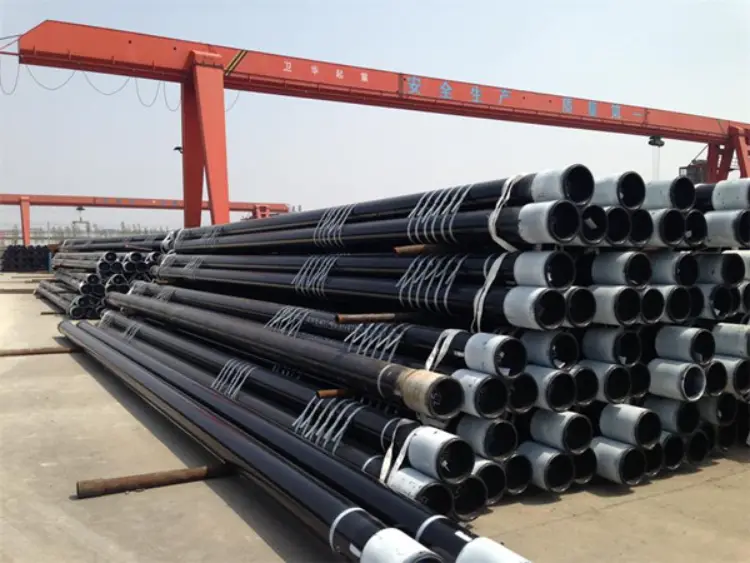
Q345B Steel for SSAW Pipe: Properties, Equivalents & Applications
Q345B SSAW Pipe Steel – GB/T 1591 Low-Alloy Structural Steel | Chemical & Mechanical Properties
Comprehensive technical data for Q345B spiral submerged arc welded (SSAW) pipe steel according to GB/T 1591, including chemical composition, mechanical properties, thermal and electrical physical properties, international equivalents, similar materials, and application guidelines.
Hot rolling, controlled rolling, normalizing; suitable for cold forming, welding (SMAW, SAW, GMAW), and machining
- Phone : +8618037372205
- Email : [email protected]
- WhatsApp: Contact via Whtsapp
- WeChat: +8618037372205
Q345B Steel for SSAW Pipe: Properties, Equivalents & Applications Introduction
Q345B is a low-alloy high-strength structural steel widely utilized in welded pipes, especially spiral submerged arc welded (SSAW) pipes, for oil, gas, and water transmission as well as structural applications. The material is specified under Chinese standard GB/T 1591 (currently updated to Q355B in the 2018 edition, but Q345B is still commonly referenced). It offers good weldability, moderate strength, and excellent toughness at room temperature. Typical delivery condition is hot-rolled or normalized. Its balanced composition with microalloying elements such as Nb, V, and Ti provides fine grain strengthening, ensuring reliable performance in pressure piping and heavy structural components.
Q345B Steel for SSAW Pipe: Properties, Equivalents & Applications Chemical Composition according to GB/T 1591
The chemical composition of Q345B steel is designed to achieve the required mechanical properties while maintaining good weldability. Microalloying elements Nb, V, and Ti are added for grain refinement and precipitation strengthening. Note: For SSAW pipe base metal, composition is verified per heat analysis; product analysis tolerances apply per GB/T 222. Maximum carbon equivalent (CEV) is typically ≤0.45% for weldability.
| Element | Specified Value (wt%) | Remarks |
|---|---|---|
| Carbon (C) | ≤0.20 | Ladle analysis |
| Silicon (Si) | ≤0.55 | Ladle analysis |
| Manganese (Mn) | 1.00 – 1.60 | Ladle analysis |
| Phosphorus (P) | ≤0.035 | Ladle analysis |
| Sulfur (S) | ≤0.035 | Ladle analysis |
| Vanadium (V) | 0.02 – 0.15 | When added; grain refiner |
| Niobium (Nb) | 0.015 – 0.060 | When added; grain refiner |
| Titanium (Ti) | 0.02 – 0.20 | When added; deoxidation & grain refinement |
| Chromium (Cr) | ≤0.30 | Residual element |
| Nickel (Ni) | ≤0.30 | Residual element |
| Copper (Cu) | ≤0.40 | Residual element |
| Molybdenum (Mo) | ≤0.10 | Residual element |
| Nitrogen (N) | ≤0.012 | Ladle analysis; higher N must be bound by Al or V |
| Aluminium (Al) | ≥0.015 (acid-soluble) | Required for fine grain practice and deoxidation |
Q345B Steel for SSAW Pipe: Properties, Equivalents & Applications Thermal and Electrical Physical Properties
The following physical properties are typical for low-carbon low-alloy steel similar to Q345B. They are not mandatory per GB/T 1591 but are provided as engineering reference data at room temperature unless otherwise noted. Note: Property values may vary slightly depending on exact composition and heat treatment condition. Thermal conductivity decreases with increasing temperature.
| Property | Typical Value | Unit | Test Condition / Remarks |
|---|---|---|---|
| Density (ρ) | 7.85 | g/cm³ | At 20 °C |
| Elastic Modulus (E) | 200 – 210 | GPa | At 20 °C, tension |
| Shear Modulus (G) | 80 – 81 | GPa | Derived from E and ν |
| Poisson's Ratio (ν) | 0.3 | — | In elastic range |
| Thermal Expansion Coefficient (α) | 11.5 – 12.5 | 10⁻⁶/K | 20–100 °C average |
| Thermal Expansion Coefficient (α) | 12.8 – 13.5 | 10⁻⁶/K | 20–200 °C |
| Thermal Expansion Coefficient (α) | 13.5 – 14.2 | 10⁻⁶/K | 20–300 °C |
| Thermal Conductivity (λ) | ~50 | W/(m·K) | At 20 °C |
| Thermal Conductivity (λ) | ~45 | W/(m·K) | At 200 °C |
| Thermal Conductivity (λ) | ~38 | W/(m·K) | At 400 °C |
| Specific Heat Capacity (c_p) | 460 – 500 | J/(kg·K) | At 20–100 °C |
| Electrical Resistivity (ρ_e) | 0.17 – 0.22 | μΩ·m | At 20 °C |
Q345B Steel for SSAW Pipe: Properties, Equivalents & Applications Mechanical Properties
Mechanical properties are determined on longitudinal test pieces taken from the base metal (plate/strip) used for SSAW pipes. Pipe body properties may differ slightly due to forming and welding. Tensile and impact tests are mandatory. Conditions: Room temperature unless stated otherwise.
- For thickness >400 mm, properties shall be agreed.
- Yield strength values apply to transverse test pieces; for longitudinal test pieces, values may be reduced by 15 MPa.
| Property | Required Value | Unit | Test Condition / Thickness (mm) |
|---|---|---|---|
| Yield Strength (ReH) | ≥345 | MPa | t ≤ 16 |
| Yield Strength (ReH) | ≥335 | MPa | 16 < t ≤ 40 |
| Yield Strength (ReH) | ≥325 | MPa | 40 < t ≤ 63 |
| Yield Strength (ReH) | ≥315 | MPa | 63 < t ≤ 80 |
| Yield Strength (ReH) | ≥305 | MPa | 80 < t ≤ 100 |
| Yield Strength (ReH) | ≥295 | MPa | 100 < t ≤ 150 |
| Yield Strength (ReH) | ≥275 | MPa | 150 < t ≤ 200 |
| Yield Strength (ReH) | ≥265 | MPa | 200 < t ≤ 250 |
| Tensile Strength (Rm) | 470 – 630 | MPa | t ≤ 100 |
| Tensile Strength (Rm) | 470 – 630 | MPa | 100 < t ≤ 250 |
| Elongation (A) | ≥20 | % | t ≤ 40 (gauge 5.65√So) |
| Elongation (A) | ≥19 | % | 40 < t ≤ 63 |
| Elongation (A) | ≥18 | % | 63 < t ≤ 100 |
| Elongation (A) | ≥17 | % | 100 < t ≤ 200 |
| Bend Test (d = bend diameter, a = thickness) | d = 2a | — | t ≤ 16, 180° bend |
| Bend Test | d = 3a | — | t > 16 to 100, 180° bend |
| Charpy V-notch Impact (KV₂, longitudinal) | ≥34 (average) | J | Test temperature: 20 °C |
| Charpy V-notch Impact (KV₂, transverse) | ≥27 (average) | J | Test temperature: 20 °C |
| Hardness | Not specified | HBW | Informative; typically 130–170 HBW |
Q345B Steel for SSAW Pipe: Properties, Equivalents & Applications Fully Equivalent Material Standards and Substitutable Grades
The following international standards specify grades that can be considered complete substitutes for Q345B in terms of chemical composition and mechanical properties when applied to structural steel plates and strips for welded pipes. However, procurement must verify specific requirements (e.g., impact test temperature, CEV limits).
| Country/Region | Standard | Grade | Remarks |
|---|---|---|---|
| China (updated) | GB/T 1591-2018 | Q355B | Successor grade to Q345B; min. yield 355 MPa for t≤16 mm; same chemistry philosophy. |
| Europe | EN 10025-2:2019 | S355JR | Min. yield 355 MPa; JR quality requires KV≥27J at +20°C. Same strength and weldability class. |
| International | ISO 630-2:2011 | S355B | B quality with impact test at +20°C, min. 27J. Fully equivalent chemical and mechanical requirements. |
| Japan | JIS G3106:2008 | SM490B | Min. yield 325 MPa (t≤16), tensile 490–610 MPa; 0°C impact test. Chemistry slightly different but performance equivalent. |
| USA | ASTM A572/A572M | Grade 50 [345] | Min. yield 345 MPa (50 ksi); type 1 or 2. No specified impact test unless supplementary. Can be ordered with CVN. |
Q345B Steel for SSAW Pipe: Properties, Equivalents & Applications Application Introduction
Q345B steel is extensively used in SSAW (spiral submerged arc welded) pipes for long-distance transmission of oil, natural gas, water, and slurry. Its balanced strength-toughness-weldability profile also makes it a preferred material for structural frameworks, piling, and heavy machinery. Typical service temperature not lower than -20°C for the base material. Key applications include:
Product Applications: Spiral submerged arc welded (SSAW) pipes and tubes, Longitudinally submerged arc welded (LSAW) pipes, Structural hollow sections (circular, square, rectangular), Steel pipe piles and casing pipes, Pressure vessel shells (when certified to relevant standards), Offshore platform legs and bracing members
Processed into products: Mainline pipe sections for oil and gas transmission, Tubular truss members in bridges and stadium roofs, Foundation caissons and monopiles for offshore wind turbines, Cutter suction dredge pipes and mining slurry pipelines, Compressor station and pumping station interconnecting piping, Fire water system ring mains in industrial plants
Application industries: Oil & Gas (onshore/offshore transmission pipelines), Water supply and sewage treatment (large-diameter water mains), Civil engineering and construction (structural columns, bridge piers, foundation piles), Shipbuilding and marine structures (deck support, jacket legs), Mining and slurry transport (abrasion-resistant piping systems when lined), Renewable energy (wind turbine tower internals, monopile foundations)
Q345B Steel for SSAW Pipe: Properties, Equivalents & Applications Similar / Comparable Alternative Materials
These materials offer similar mechanical strength and can be used in many of the same applications, though slight differences exist in impact test temperature, microalloying, or delivery condition. Engineering assessment is recommended before substitution.
| Country/Region | Standard | Grade | Remarks |
|---|---|---|---|
| China | GB/T 1591 | Q345C / Q345D / Q345E | Higher toughness grades with impact test at 0°C, -20°C, -40°C respectively. Chemistry similar to Q345B. |
| Europe | EN 10025-2 | S355J0 (+N) | Impact test at 0°C; min. 27J. Suitable for lower temperature applications. |
| Europe | EN 10025-2 | S355J2 (+N) | Impact test at -20°C; fine grain practice. Widely used for SSAW pipes in EU projects. |
| USA | ASTM A572/A572M | Grade 55 [380] | Slightly higher strength (380 MPa yield). Weldability and chemistry similar; may require adjustment of forming parameters. |
| USA | ASTM A709/A709M | Grade 50 | Structural steel for bridges; chemistry and mechanicals equivalent to A572 Gr.50, with optional fracture critical requirements. |
| Russia | GOST 19281 | 09G2S | Low-alloy steel with 345 MPa yield class; widely used for welded structures and pipes in CIS countries. |
Notes:
Q345B is classified as a fine grain steel when produced with sufficient aluminum content. For SSAW pipe manufacturing, the base steel must meet requirements for forming and welding. The carbon equivalent (CE) is often controlled below 0.43% for cold cracking resistance. Pitting corrosion resistance is similar to plain carbon steel; coating or cathodic protection is required for buried/submerged service. SSAW pipes are typically supplied with a mill test certificate (EN 10204 3.1). For sour service (H₂S-containing environments), additional HIC/SSC testing per NACE MR0175 is mandatory and a special variant (e.g., Q345B-HIC) must be ordered.
- Share



