
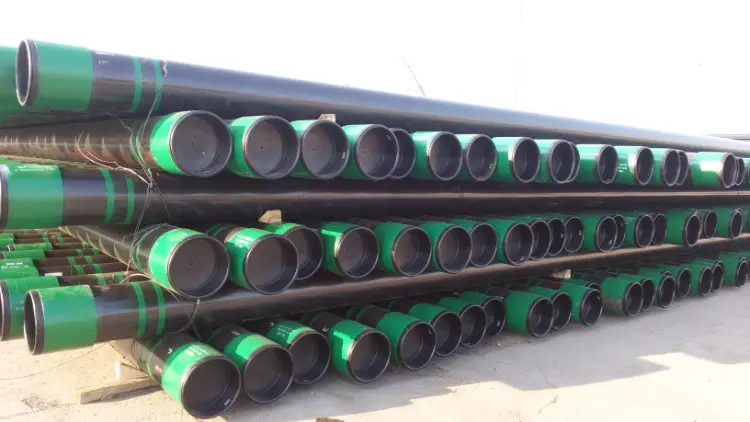
Q295A Fluid Seamless Pipe
Q295A Fluid Seamless Pipe: Low-Alloy High-Strength Steel for Pressure Applications
Comprehensive material data for Q295A fluid seamless steel pipe per GB/T 8163 standard. Includes chemical composition, mechanical and physical properties, international equivalents, similar materials, and application guidance for pressure fluid transport systems.
Hot-rolling, cold-drawing, welding, bending, cutting, machining
- Phone : +8618037372205
- Email : [email protected]
- WhatsApp: Contact via Whtsapp
- WeChat: +8618037372205
Q295A Fluid Seamless Pipe Introduction
Q295A is a low-alloy high-strength structural steel specified in Chinese standard GB/T 8163 for seamless steel tubes used in fluid transport. It belongs to the Q295 strength category with a minimum yield strength of 295 MPa. The material offers a favorable balance of strength, toughness, and weldability, making it suitable for transporting fluids such as water, oil, and gas under moderate pressure and temperature conditions. Key features include:
- Good comprehensive mechanical properties
- Excellent formability during tube manufacturing processes
- Reliable performance in welded structures
- Cost-effective solution for general fluid piping systems
The 'A' suffix indicates quality grade with specific impact energy requirements at +20°C. This steel is widely utilized in mechanical engineering, construction, and energy industries for manufacturing pipelines and hollow structural components.
Q295A Fluid Seamless Pipe Chemical Composition
The chemical composition of Q295A steel as specified in GB/T 8163 for fluid seamless pipes. This low-alloy steel contains controlled amounts of carbon, manganese, and silicon to achieve the required strength and toughness. Residual elements such as phosphorus and sulfur are strictly limited to ensure good weldability and ductility. The composition is designed for a good balance between strength and formability during pipe manufacturing.
| Element | Standard Value (≤, %) | Remarks |
|---|---|---|
| Carbon (C) | ≤0.16 | Core strength contributor |
| Silicon (Si) | ≤0.55 | Deoxidizer, strengthens ferrite |
| Manganese (Mn) | 0.80~1.50 | Primary strengthener, improves hardenability |
| Phosphorus (P) | ≤0.045 | Impurity, controlled for ductility |
| Sulfur (S) | ≤0.045 | Impurity, minimized for toughness |
| Niobium (Nb) | 0.015~0.060 | Microalloying for grain refinement |
| Vanadium (V) | 0.02~0.15 | Optional microalloying for strength |
| Titanium (Ti) | 0.02~0.20 | Optional microalloying element |
Q295A Fluid Seamless Pipe Thermal, Electrical & Physical Properties
Representative physical properties for low-alloy Q295A grade steel. These values are typical for carbon-manganese structural steels at room temperature unless specified otherwise. Actual values may exhibit minor fluctuations due to variations in exact chemical composition and manufacturing process. This data serves as a reliable reference for design calculations involving heat transfer, thermal stress analysis, or weight estimation.
| Property | Typical Value | Unit | Test Condition |
|---|---|---|---|
| Density (ρ) | 7.85 | g/cm³ | At 20°C |
| Elastic Modulus (E) | 210 | GPa | At 20°C, tensile |
| Shear Modulus (G) | 81 | GPa | At 20°C, calculated |
| Poisson's Ratio (ν) | 0.3 | — | At 20°C, elastic range |
| Thermal Expansion Coefficient (α) | 12.0 | 10⁻⁶/K | 20~100°C |
| Thermal Expansion Coefficient (α) | 12.5 | 10⁻⁶/K | 20~200°C |
| Thermal Expansion Coefficient (α) | 13.0 | 10⁻⁶/K | 20~300°C |
| Thermal Conductivity (λ) | 48 | W/(m·K) | At 20°C |
| Thermal Conductivity (λ) | 46 | W/(m·K) | At 100°C |
| Specific Heat Capacity | 480 | J/(kg·K) | 20~100°C |
| Electrical Resistivity (ρ_e) | 0.22 | Ω·mm²/m | At 20°C |
Q295A Fluid Seamless Pipe Mechanical Properties
Mechanical properties for Q295A seamless steel pipes according to GB/T 8163. These values are guaranteed for pipes in the hot-rolled or normalized delivery condition at room temperature. The properties demonstrate good ductility and toughness suitable for fluid transport and structural applications under static and dynamic loads. The yield and tensile values vary slightly depending on tube wall thickness, with thicker sections generally exhibiting slightly lower strengths.
| Property | Standard Requirement | Unit | Test Condition |
|---|---|---|---|
| Yield Strength (ReH) | ≥295 | MPa | t≤16mm; Upper yield or 0.2% proof |
| Yield Strength (ReH) | ≥275 | MPa | 16 mm < t ≤35 mm |
| Yield Strength (ReH) | ≥255 | MPa | 35 mm < t ≤50 mm |
| Yield Strength (ReH) | ≥235 | MPa | 50 mm < t ≤100 mm |
| Tensile Strength (Rm) | 390~570 | MPa | Room temperature, longitudinal specimen |
| Elongation after Fracture (A) | ≥23 | % | Longitudinal, proportional gauge length L0=5.65√S0 |
| Impact Energy (KV2) | ≥27 | J | Longitudinal, +20°C, 10×10 mm specimen |
| Bend Test (Mandrel Diameter) | d=2a | — | 180° bend; a=specimen thickness; ≤60 mm |
| Bend Test (Mandrel Diameter) | d=3a | — | 180° bend; a=specimen thickness; >60~100 mm |
Q295A Fluid Seamless Pipe Fully Equivalent Material Standards & Replaceable Grades
| Country/Region | Standard | Grade | Remarks |
|---|---|---|---|
| China | GB/T 8163 | Q295A | Original designation for fluid seamless pipe |
| China | GB/T 1591 | Q295A | Low-alloy structural steel plate/strip; similar chemistry, different product form |
| International (ISO) | ISO 630-2 | Fe430B | Comparable strength and chemistry for structural steel |
| European Union | EN 10025-2 | S275J0 | Similar yield strength (275 MPa) and impact class J0 (+20°C); widely used structural equivalent |
| Germany | DIN EN 10025-2 | S275J0 | Adopted European standard, direct substitute |
| Japan | JIS G3101 | SS400 | General structural steel; slight difference in guaranteed yield strength but common practical substitute |
| USA | ASTM A500 | Grade B | Cold-formed welded/seamless structural tubing with 290 MPa yield; functionally similar |
| Russia | GOST 380 | St3ps | General purpose structural carbon steel; approximate strength class |
Q295A Fluid Seamless Pipe Application Introduction
Q295A fluid seamless pipe according to GB/T 8163 is widely utilized in industries requiring reliable and cost-effective fluid transport solutions. Its balanced mechanical properties and good weldability make it a preferred material for moderate-pressure systems. The pipe can be easily formed, bent, and joined using conventional welding techniques. Key application sectors include:
- Petrochemical and natural gas transmission
- Water supply and drainage infrastructure
- Heating, ventilation, and air conditioning (HVAC) systems
- Mechanical and structural engineering
- Agricultural irrigation networks
Product Applications: Fluid transport steel pipelines (water, oil, gas, steam), Pressure piping systems, Boiler and heat exchanger tubes (moderate temperature), Engineering structural hollow sections, Automotive transmission and fluid lines, Roller conveyor tubes, Furniture and architectural tubular frames
Processed into products: Pipe couplings, flanges, and fittings (welded or threaded), Pump housings and compressor parts, Hydraulic cylinder bodies, Bridge drainage tubes, Tunnel support arches, Dredging pipeline sections, Process plant spools and headers
Application industries: Oil & Gas (transmission pipelines, gathering lines), Water Treatment & Supply (municipal water mains, sewage pipes), Chemical Processing (low-to-medium pressure process piping), Power Generation (cooling water lines, steam condensate return), Construction & Infrastructure (structural columns, scaffolding, piling), Machinery Manufacturing (hydraulic cylinder barrels, hollow shafts), Agriculture (irrigation systems, well casings), Fire Protection (sprinkler system pipes, fire water mains)
Q295A Fluid Seamless Pipe Similar / Alternative Material Recommendations
| Country/Region | Standard | Grade | Remarks |
|---|---|---|---|
| China | GB/T 8163 | Q345B | Higher strength (345 MPa yield); common upgrade for demanding fluid and structural services |
| China | GB/T 8163 | 20# steel | Carbon steel; lower strength but excellent weldability and ductility; widely used for general fluid pipes |
| European Union | EN 10210-1 | S275J0H | Hot-finished structural hollow section; 275 MPa yield; suitable for fluid and structural use |
| USA | ASTM A53 | Grade B | Seamless/welded pipe for pressure and mechanical applications; 240 MPa yield |
| USA | ASTM A106 | Grade B | Seamless carbon steel pipe for high-temperature fluid service |
| Japan | JIS G3454 | STPG370 | Pressure service carbon steel pipe; 215 MPa yield |
| India | IS 1239 | Medium Class | Steel tubes for water, gas, and sewage; lower strength but similar application |
Notes:
Additional technical considerations:
- Q295A pipes may be subjected to hydrostatic pressure testing or non-destructive examination (ultrasonic, eddy current) as agreed upon order.
- For low-temperature applications below -10°C, special impact testing and stricter chemistry (lower P, S) should be specified.
- Post-weld heat treatment (PWHT) is generally not required for wall thicknesses below 30 mm.
- Surface protection (varnish, galvanizing, 3LPE coating) can be applied for corrosion resistance in aggressive environments.
- Always verify the latest version of GB/T 8163 for any updates to technical delivery conditions.
- Share



