
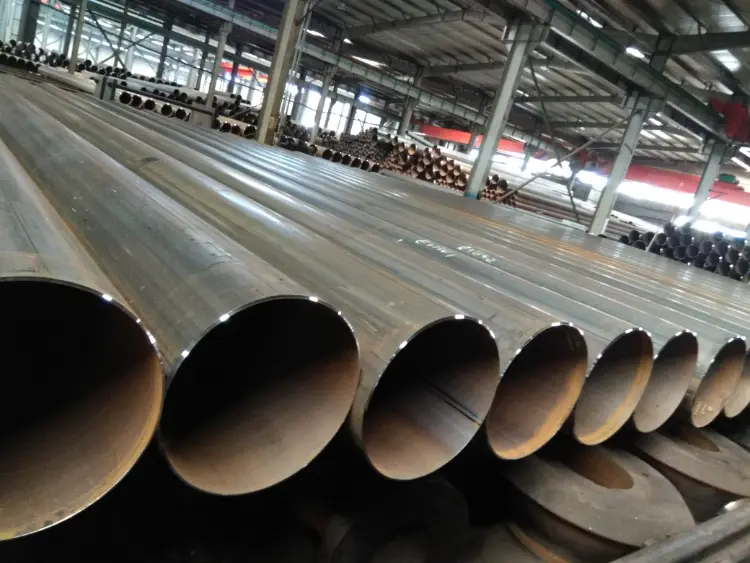
Q275 Carbon Structural Steel for ERW Pipe
Q275 Carbon Structural Steel for ERW Pipe - GB/T 700 Composition & Properties
Comprehensive technical data for Q275 carbon steel used in electric resistance welded (ERW) pipes: chemical composition, mechanical and physical properties, international equivalents, and typical applications.
Electric Resistance Welding (ERW), cold roll forming, bending, cutting, welding
- Phone : +8618037372205
- Email : [email protected]
- WhatsApp: Contact via Whtsapp
- WeChat: +8618037372205
Q275 Carbon Structural Steel for ERW Pipe Introduction
Q275 is a carbon structural steel grade specified in China standard GB/T 700-2006. It is extensively used for manufacturing electric resistance welded (ERW) pipes due to its balanced combination of moderate strength, good weldability, and formability. This steel belongs to the general-purpose structural steel category and is comparable to international grades such as S275 in EN 10025. Typical applications include structural tubing, mechanical components, scaffolding, and low-pressure fluid conveyance. Q275 is supplied as hot-rolled strip or plate, formed and welded into pipes. Depending on the quality grade (A, B, C, or D), it can offer guaranteed impact toughness at various temperatures. The steel offers a minimum yield strength of 275 MPa for thickness up to 16 mm, making it suitable for cost-effective structural frameworks and mechanical parts. Its chemical composition ensures reliable welding performance, and it can be processed by standard cold bending and cutting operations.
Q275 Carbon Structural Steel for ERW Pipe Chemical Composition
The chemical composition of Q275 steel is defined by GB/T 700-2006. The table lists maximum allowable percentages. Phosphorus and sulfur limits are tighter for quality grades B, C, and D. Residual elements (Cr, Ni, Cu) are optionally limited but not mandatory in the base standard.
| Element | Nominal Value (wt%) | Notes |
|---|---|---|
| Carbon (C) | ≤0.24 | Maximum for all grades |
| Silicon (Si) | ≤0.35 | Maximum |
| Manganese (Mn) | ≤1.50 | Maximum |
| Phosphorus (P) | ≤0.045 | For Q275A; ≤0.040 for Q275B; ≤0.035 for Q275C/D |
| Sulfur (S) | ≤0.045 | For Q275A; ≤0.040 for Q275B; ≤0.035 for Q275C/D |
| Residual elements (Cr, Ni, Cu) | ≤0.30 each | Optional requirement; not mandatory |
Q275 Carbon Structural Steel for ERW Pipe Thermal & Electrical Physical Properties
Representative physical properties for Q275 carbon steel. These values are typical of low-carbon structural steels and are intended for general reference. Actual values may vary slightly with specific composition and processing. Thermal expansion is given for 20–100°C; conductivity and resistivity are at room temperature.
| Property | Nominal Value | Unit | Conditions/Notes |
|---|---|---|---|
| Density (ρ) | 7.85 | g/cm³ | At 20°C |
| Modulus of elasticity (E) | 200 | GPa | At room temperature |
| Shear modulus (G) | 79.3 | GPa | Calculated from E and ν ≈0.3 |
| Poisson's ratio (ν) | 0.3 | - | Typical for structural carbon steel |
| Thermal expansion coefficient (α) | 11.7 | 10⁻⁶/°C | 20–100°C |
| Thermal conductivity (λ) | 53 | W/(m·K) | At 20°C |
| Specific heat capacity | 486 | J/(kg·K) | At 20°C |
| Electrical resistivity (ρ_e) | 0.15 | Ω·mm²/m | At 20°C |
Q275 Carbon Structural Steel for ERW Pipe Mechanical Properties
Mechanical properties of Q275 per GB/T 700-2006. Yield strength depends on material thickness. Impact energy is guaranteed only for quality grades B, C, D at the indicated temperatures. The bend test is performed with a mandrel diameter equal to the specimen thickness (1a); for thickness above 60 mm, the test may be adjusted as agreed.
| Property | Value | Unit | Test Condition |
|---|---|---|---|
| Yield strength (ReH) | ≥275 | MPa | Thickness ≤16 mm |
| Yield strength (ReH) | ≥265 | MPa | Thickness 16–40 mm |
| Yield strength (ReH) | ≥255 | MPa | Thickness 40–60 mm |
| Yield strength (ReH) | ≥245 | MPa | Thickness 60–100 mm |
| Yield strength (ReH) | ≥235 | MPa | Thickness 100–150 mm |
| Tensile strength (Rm) | 410–560 | MPa | All thicknesses |
| Elongation after fracture (A) | ≥22 | % | Thickness ≤40 mm, longitudinal |
| Elongation after fracture (A) | ≥21 | % | Thickness 40–60 mm |
| Elongation after fracture (A) | ≥20 | % | Thickness 60–100 mm |
| Elongation after fracture (A) | ≥19 | % | Thickness 100–150 mm |
| Bend test (mandrel diameter) | 1a (thickness a) | 180° bend, no cracks; for thickness ≤60 mm | |
| Impact energy (KV2) | ≥27 | J | Q275B at +20°C, longitudinal |
| Impact energy (KV2) | ≥27 | J | Q275C at 0°C |
| Impact energy (KV2) | ≥27 | J | Q275D at -20°C |
Q275 Carbon Structural Steel for ERW Pipe Fully Equivalent Grades & Possible Replacements
| Country/Region | Standard | Grade | Remarks |
|---|---|---|---|
| Europe | EN 10025-2 | S275JR | Closest match: yield 275 MPa, tensile 410-560 MPa; similar carbon content and weldability |
| Europe | EN 10025-2 | S275J0 | Impact at 0°C, comparable to Q275C |
| Europe | EN 10025-2 | S275J2 | Impact at -20°C, comparable to Q275D |
| International | ISO 630 | Fe430B | Earlier designation; replaced by EN 10025 S275 |
| USA | ASTM A529 | Gr. 50 | Nominal yield 345 MPa, but used as functional substitute for structural tubes |
| Japan | JIS G3101 | SS490 | Tensile 490-610 MPa, yield typically ~285 MPa; often considered equivalent for structural pipes |
Q275 Carbon Structural Steel for ERW Pipe Application Introduction
Q275 steel ERW pipes are versatile structural materials utilized in various industries. Their good balance of strength, formability, and weldability makes them suitable for structural and mechanical applications. Typical sectors, end products, and specific components where Q275-based pipes are employed are listed below. The pipes can be used as-received or further processed by galvanizing, painting, or powder coating for corrosion protection.
Product Applications: ERW structural pipes (circular, square, rectangular), Scaffolding tubes and frames, Mechanical tubing for shafts and housings, Low-pressure fluid pipes (water, gas), Conveyor rollers, Furniture frames and legs, Agricultural spray booms and greenhouse structures
Processed into products: Pipe columns, beams, and truss members, Telescopic legs for scaffolding, Hollow sections for machine frames, Roller and pulley housings, Tubular axles and sleeves, Guard rails and handrails, Gate and fence posts
Application industries: Construction & infrastructure, Automotive & transportation, Mechanical engineering, Furniture manufacturing, Agricultural equipment, Fencing & scaffolding
Q275 Carbon Structural Steel for ERW Pipe Similar & Alternative Materials
| Country/Region | Standard | Grade | Remarks |
|---|---|---|---|
| China | GB/T 700 | Q235B/C | Lower yield strength (235 MPa); suitable when loads are reduced |
| China | GB/T 1591 | Q345B (now Q355B) | Higher strength low-alloy steel; yield 345/355 MPa; better for heavy loads but higher cost |
| International | ASTM A36 | Yield 250 MPa; widely used structural steel; slightly lower strength but easily available | |
| Europe | EN 10025-2 | S235JR | Yield 235 MPa; for less demanding applications |
| Japan | JIS G3101 | SS400 | Tensile 400-510 MPa, yield ~245 MPa; popular in Asian markets for general structural tubing |
Notes:
Standard references: GB/T 700-2006 for base steel; ERW pipe dimensions may follow GB/T 3091 or GB/T 13793 depending on application. Galvanized versions may require additional standards. No additional special requirements unless specified by the purchaser.
- Share



