
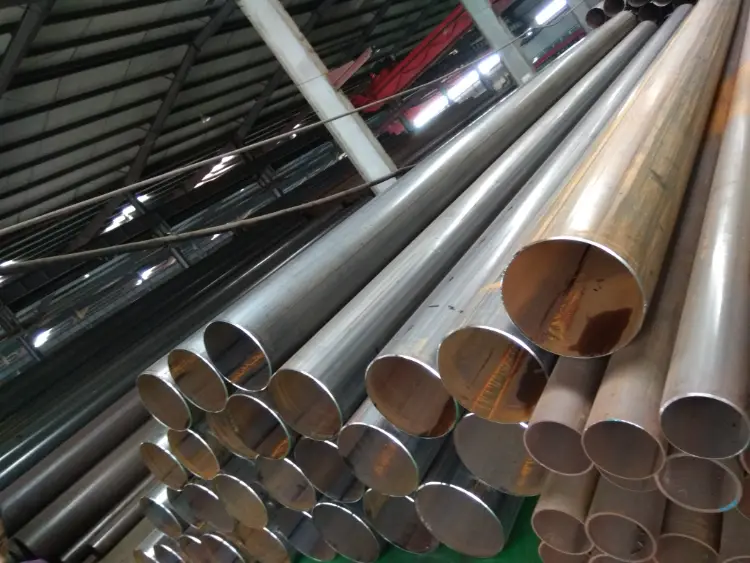
Q235D Carbon Structural Steel for ERW Pipe
Q235D Carbon Structural Steel for ERW Pipe - Properties, Equivalents and Applications
Detailed material data for Q235D carbon structural steel under GB/T 700, commonly used for ERW pipes. Includes chemical composition, mechanical and physical properties, international equivalents, and industrial applications.
Hot rolling, cold rolling, electric resistance welding (ERW), normalizing (optional)
- Phone : +8618037372205
- Email : [email protected]
- WhatsApp: Contact via Whtsapp
- WeChat: +8618037372205
Q235D Carbon Structural Steel for ERW Pipe Introduction
Q235D is a Chinese carbon structural steel grade specified in GB/T 700-2006, characterized by its good weldability, moderate strength, and guaranteed impact toughness at -20°C (≥27 J). The "D" designation indicates enhanced low-temperature performance, making it suitable for structural applications and welded pipes operating in cold climates. It is widely supplied as hot-rolled plates, strips, and sections, and is a preferred material for manufacturing ERW (Electric Resistance Welded) pipes used in low-pressure fluid transport and general structural frameworks. Compared to Q235A/B/C, Q235D offers stricter control of sulfur and phosphorus and reliable impact resistance, ensuring safe service under dynamic loading.
Q235D Carbon Structural Steel for ERW Pipe Chemical Composition (Mass fraction %)
The chemical composition of Q235D is defined by GB/T 700-2006. Residual elements (Cr, Ni, Cu) are allowed within limits but are not intentionally added. Sulfur and phosphorus are tightly controlled to ensure good weldability and low-temperature toughness.
| Chemical Element | Standard Value (wt%) | Remarks |
|---|---|---|
| Carbon (C) | ≤ 0.17 | |
| Silicon (Si) | ≤ 0.35 | |
| Manganese (Mn) | ≤ 1.40 | |
| Phosphorus (P) | ≤ 0.035 | |
| Sulfur (S) | ≤ 0.035 | |
| Chromium (Cr) | ≤ 0.30 | Residual element |
| Nickel (Ni) | ≤ 0.30 | Residual element |
| Copper (Cu) | ≤ 0.30 | Residual element |
Q235D Carbon Structural Steel for ERW Pipe Thermal, Electrical and Physical Properties (Typical reference values)
Physical properties are typical for low-carbon steel and may vary slightly with processing condition. These values are suitable for general engineering calculations and are not mandatory per GB/T 700.
| Property | Typical Value | Unit | Condition / Temperature |
|---|---|---|---|
| Density (ρ) | 7.85 | g/cm³ | Room temperature |
| Modulus of elasticity (E) | 200 – 210 | GPa | Room temperature |
| Shear modulus (G) | ≈ 80 | GPa | Estimated from E and ν |
| Poisson's ratio (ν) | 0.3 | — | Room temperature |
| Thermal expansion coefficient (α) | 12.0 × 10⁻⁶ | 1/K | 20 – 300 °C |
| Thermal conductivity (λ) | 51.9 | W/(m·K) | At 100 °C |
| Specific heat capacity (cp) | 486 | J/(kg·K) | At 20 – 100 °C |
| Electrical resistivity (ρe) | 0.15 – 0.25 | Ω·mm²/m | Room temperature |
Q235D Carbon Structural Steel for ERW Pipe Mechanical Properties (Typical and Required Values)
Mechanical properties are tested on samples taken from flat products or as agreed. Values depend on product thickness. For ERW pipes made from Q235D strips, the base metal should meet these requirements, while the weld zone is tested according to the relevant pipe standard (e.g., GB/T 3091).
| Property | Required Value | Unit | Test Condition / Thickness |
|---|---|---|---|
| Yield strength (ReH) | ≥ 235 | MPa | Thickness ≤ 16 mm |
| Yield strength (ReH) | ≥ 225 | MPa | 16 mm < Thickness ≤ 40 mm |
| Yield strength (ReH) | ≥ 215 | MPa | 40 mm < Thickness ≤ 60 mm |
| Tensile strength (Rm) | 370 – 500 | MPa | Thickness ≤ 100 mm |
| Elongation (A) | ≥ 26 | % | Thickness ≤ 40 mm, longitudinal |
| Elongation (A) | ≥ 25 | % | 40 mm < Thickness ≤ 60 mm |
| Elongation (A) | ≥ 24 | % | 60 mm < Thickness ≤ 100 mm |
| Impact energy (KV₂) | ≥ 27 | J | -20 °C, longitudinal, Charpy V-notch |
| Bend test (bend angle 180°) | d = 0.5a (thickness ≤ 16 mm) | - | Specimen width = 2a (a = thickness) |
| Bend test | d = 1.5a (16 < thickness ≤ 100 mm) | - | Specimen width = 2a |
Q235D Carbon Structural Steel for ERW Pipe International Equivalent Grades (with matched -20°C impact)
| Country/Region | Standard | Grade | Remark |
|---|---|---|---|
| China | GB/T 700-2006 | Q235D | Base grade for comparison |
| International | ISO 630-2:2011 | E235D | Similar -20°C impact, S ≤ 0.035 |
| European Union | EN 10025-2:2004 | S235J2 (+N or +AR) | J2 guarantees 27 J at -20°C |
| Germany | DIN EN 10025-2 | S235J2 | Identical to EN 10025-2 |
| United Kingdom | BS EN 10025-2 | S235J2 | Identical to EN 10025-2 |
| Japan | JIS G 3106 | SM400C | Impact 0°C min. 47 J, not fully equivalent |
| USA | ASTM A36 / A36M | — | No guaranteed impact toughness, only comparable in strength |
Q235D Carbon Structural Steel for ERW Pipe Application Introduction
Q235D is a cost-effective structural steel with reliable low-temperature toughness. It is extensively used for ERW (Electric Resistance Welded) pipes because its good formability and weldability allow for high-speed tube production without preheating. Typical applications include:
Product Applications: ERW steel pipes for fluid transmission, Structural hollow sections, Scaffolding pipes, Sprinkler system pipes, Oil casing and tubing (limited to low-grade), Greenhouse frames
Processed into products: Pipe spools and fittings, Tube-to-tube welded joints, Structural columns and beams, Bicycle and motorcycle frames, Transmission tower legs, Machine support structures
Application industries: Construction and infrastructure, Water and gas distribution (low-pressure), Agricultural machinery, Automotive and transportation, Civil engineering, Furniture and storage systems
Q235D Carbon Structural Steel for ERW Pipe Similar Structural Steels (with different impact or regional grades)
| Country/Region | Standard | Grade | Remark |
|---|---|---|---|
| China | GB/T 700 | Q235C | 0°C impact, otherwise similar chemistry |
| China | GB/T 700 | Q235B | 20°C impact, lower toughness requirement |
| European Union | EN 10025-2 | S235J0 | Impact 0°C, less suitable for cold service |
| European Union | EN 10025-2 | S235JR | Room-temperature impact, lower cost |
| Japan | JIS G 3101 | SS400 | No impact guarantee, but widely used |
| USA | ASTM A283 | Grade D | Tensile similar, no impact specification |
| Russia | GOST 380 | St3sp | 0°C impact, not -20°C |
Notes:
Q235D for ERW pipes: The final pipe quality must also comply with the applicable product standard (e.g., GB/T 3091 for welded steel pipes for low-pressure liquid delivery). The weld seam should be fully fused and free of cracks; supplementary non-destructive testing may be required. Normalizing after welding can improve toughness in the heat-affected zone. For corrosive environments, consider galvanizing or coating the pipe surface.
- Share



