
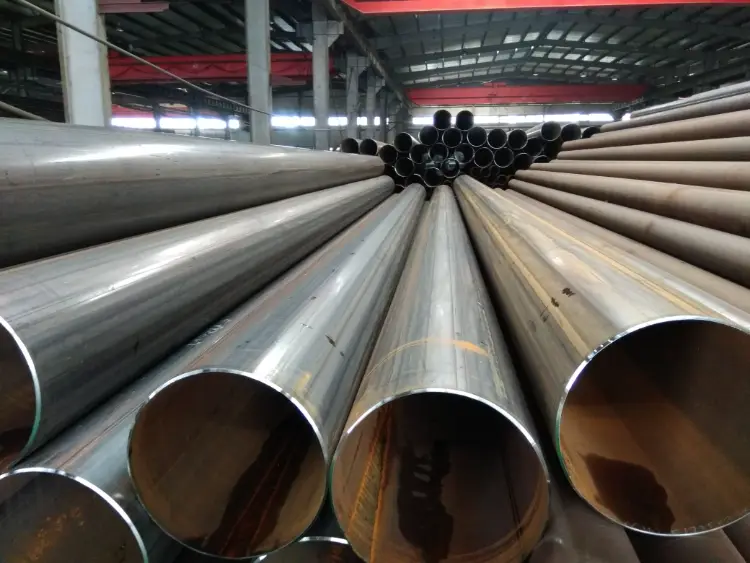
GB/T 700 Q235C Steel for ERW Pipe
GB/T 700 Q235C Steel for ERW Pipe: Composition, Properties & Equivalents
Comprehensive material data for Q235C carbon structural steel per GB/T 700, specifically for electric resistance welded (ERW) pipe applications. Includes chemical composition, mechanical and thermal properties, international equivalents, and application guidance.
Hot rolling, cold forming, welding (ERW, arc welding), bending, drilling, cutting
- Phone : +8618037372205
- Email : [email protected]
- WhatsApp: Contact via Whtsapp
- WeChat: +8618037372205
GB/T 700 Q235C Steel for ERW Pipe Introduction
Q235C is a Chinese carbon structural steel grade specified in GB/T 700. It belongs to the Q235 series with a minimum yield strength of 235 MPa and quality grade C, ensuring Charpy impact toughness at 0 °C. Widely used in welded structures, it is particularly suited for ERW (electric resistance welded) pipe manufacturing due to its balanced strength, ductility, and weldability. The material exhibits reliable mechanical performance across a range of thicknesses and is delivered in hot-rolled condition. Its chemistry is tightly controlled—lower carbon and phosphorus/sulfur levels compared to grades A and B—making it a preferred choice for dynamic and low-temperature service within structural frameworks.
GB/T 700 Q235C Steel for ERW Pipe Chemical Composition
The chemical composition of Q235C conforms to GB/T 700-2006. Key elements are closely controlled to ensure weldability and toughness. The manganese range varies with product thickness; for ERW pipe (typically wall ≤16 mm), the lower range applies. Residual elements (Cr, Ni, Cu) are limited to ≤0.30% each and total ≤0.60% unless otherwise agreed.
| Chemical Element | Standard Value | Remarks |
|---|---|---|
| Carbon (C) | ≤0.17% | Maximum allowable content |
| Silicon (Si) | ≤0.35% | For deoxidation; typical range 0.12–0.30% |
| Manganese (Mn) | 0.30–0.80% | For thickness ≤40 mm; for 40–100 mm: 0.30–1.00%; >100 mm: consult standard |
| Phosphorus (P) | ≤0.040% | Controlled for toughness |
| Sulfur (S) | ≤0.040% | Higher limit than grade D but suitable for general use |
| Nitrogen (N) | Not specified | Typically ≤0.012% in practice |
GB/T 700 Q235C Steel for ERW Pipe Thermal and Electrical Physical Properties
The following physical properties are typical for carbon steel at ambient temperature unless otherwise noted. They may vary slightly with heat treatment and exact composition. Values are not mandatory from GB/T 700 but are representative for Q235C used in engineering design.
| Property | Reference Value | Unit | Test Conditions |
|---|---|---|---|
| Density (ρ) | 7.85 | g/cm³ | 20 °C |
| Elastic Modulus (E) | 200–210 | GPa | 20 °C |
| Shear Modulus (G) | ~80 | GPa | 20 °C |
| Poisson's Ratio (ν) | 0.28–0.30 | — | 20 °C |
| Thermal Expansion (α) | 12.0 | 10⁻⁶/K | 20–100 °C |
| Thermal Expansion (α) | 12.8 | 10⁻⁶/K | 20–200 °C |
| Thermal Expansion (α) | 13.5 | 10⁻⁶/K | 20–300 °C |
| Thermal Conductivity (λ) | ~50 | W/(m·K) | 100 °C |
| Specific Heat Capacity | ~460 | J/(kg·K) | 20 °C |
| Electrical Resistivity (ρ_e) | ~0.18 | µΩ·m | 20 °C |
GB/T 700 Q235C Steel for ERW Pipe Mechanical Properties
Mechanical properties are determined in accordance with GB/T 228.1 for tensile testing and GB/T 229 for impact testing. Values depend on product thickness. ERW pipe mechanical testing often uses the strip base metal or pipe samples; below are base material requirements from the standard. The impact test is mandatory for Q235C at 0 °C.
| Property | Standard Requirement | Unit | Test Conditions |
|---|---|---|---|
| Yield Strength (ReH) | ≥235 | MPa | Thickness ≤16 mm |
| Yield Strength (ReH) | ≥225 | MPa | Thickness 16–40 mm |
| Yield Strength (ReH) | ≥215 | MPa | Thickness 40–60 mm |
| Tensile Strength (Rm) | 370–500 | MPa | All thicknesses |
| Elongation (A) | ≥26 | % | Thickness ≤40 mm, longitudinal, gauge length 5.65√S0 |
| Elongation (A) | ≥25 | % | Thickness 40–60 mm, longitudinal |
| Elongation (A) | ≥24 | % | Thickness 60–100 mm, longitudinal |
| Charpy Impact (KV) | ≥27 | J | 0 °C, longitudinal, V-notch |
| Bend Test | d = a | — | 180° bend, thickness ≤60 mm, mandrel diameter equals thickness |
| Bend Test | d = 2a | — | 180° bend, thickness 60–100 mm |
GB/T 700 Q235C Steel for ERW Pipe Fully Equivalent Material Standards and Replaceable Grades
| Country/Region | Standard | Grade | Remarks |
|---|---|---|---|
| Europe | EN 10025-2:2004 | S235J0 | Identical 0 °C impact requirement, C ≤0.17%, P ≤0.035, S ≤0.035 |
| International | ISO 630-2:2011 | E235B | Matching strength and impact grade at 0 °C |
| China | GB/T 700-2006 | Q235C | Original designation; used as reference for equivalence |
GB/T 700 Q235C Steel for ERW Pipe Application Introduction
Q235C steel, especially in ERW pipe form, is extensively used in structural and industrial applications. Its good weldability, formability, and reliable low-temperature toughness make it suitable for both static and dynamic loaded components. Typical industries and products are listed below.
Product Applications: Electric resistance welded (ERW) pipes for water, gas, and structural conveying, Structural hollow sections (square, rectangular, round), Steel frameworks, columns, and beams, Bridges (secondary members) and pedestrian walkways, Scaffolding and formwork components, Storage tanks and silos (low-to-medium capacity), Rolled steel sections for machinery bases
Processed into products: Tube and pipe fittings (elbows, tees, reducers, flanges), Welded joints and connectors, Chassis parts for agricultural and light vehicles, Support brackets, clips, and mounting plates, Handrails, guardrails, and fencing elements, Heat exchanger shells and pressure vessel components (within design limits), Drill pipe and casing for shallow wells (non-sour service)
Application industries: Construction and building infrastructure, Machinery and equipment manufacturing, Automotive and transportation (non-critical structural parts), Energy and pipeline systems, Agricultural equipment, General fabrication and metalworking
GB/T 700 Q235C Steel for ERW Pipe Similar/Comparable Substitute Materials
| Country/Region | Standard | Grade | Remarks |
|---|---|---|---|
| USA | ASTM A36/A36M | A36 | Similar strength; no impact guarantee unless supplementary requirement; used for structural plates and shapes |
| Japan | JIS G3101 | SS400 | Close tensile properties; no explicit impact requirement; widely used for general structures |
| USA | ASTM A283/A283M | Grade C | Slightly lower carbon; used for low-to-moderate strength applications |
| Germany (historical) | DIN 17100 | St37-2 (RSt37-2) | Obsolete but comparable; replaced by S235JR/S235J0 in EN standards |
Notes:
For ERW pipe products, additional standards such as GB/T 3091 (welded steel pipes for low-pressure fluid) or GB/T 13793 (straight seam welded pipe) may apply. The pipe manufacturing process (welding, sizing, possible galvanizing) should be considered in service. Q235C is not intended for highly stressed or critical pressure parts without thorough evaluation. When replacing with international grades ensure equivalent notched bar impact requirements at 0 °C and full lot traceability. Delivery condition can be agreed as normalized to homogenize mechanical properties, especially for thicker sections.
- Share



