
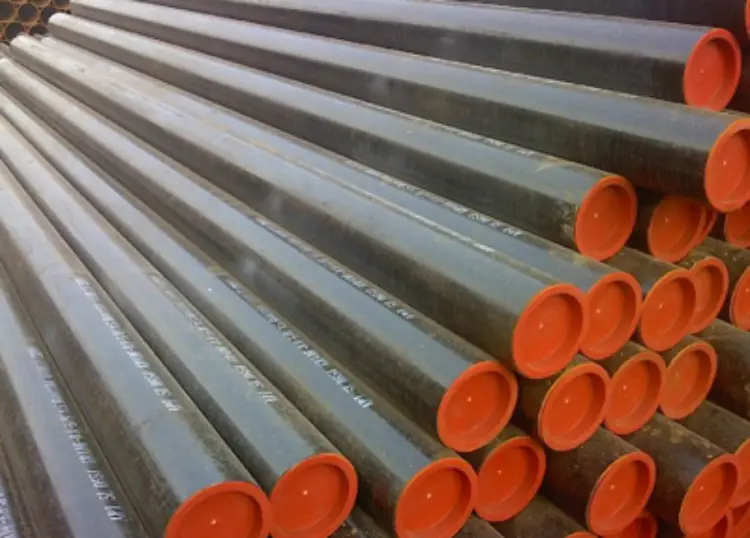
Q235B Carbon Structural Steel for ERW Pipe
Q235B Carbon Structural Steel for ERW Pipe - GB/T 700 Grade
Comprehensive technical data for Q235B steel according to GB/T 700-2006, commonly used for electric resistance welded (ERW) pipes. Includes chemical composition, mechanical and thermal properties, international equivalents, and application guidance.
Hot rolling, cold forming, electric resistance welding (ERW), cutting, bending, welding fabrication
- Phone : +8618037372205
- Email : [email protected]
- WhatsApp: Contact via Whtsapp
- WeChat: +8618037372205
Q235B Carbon Structural Steel for ERW Pipe Introduction
Q235B is a widely used carbon structural steel grade specified in GB/T 700-2006. It exhibits good strength, excellent weldability, and moderate ductility, making it suitable for general structural applications. In the form of ERW (Electric Resistance Welded) pipe, Q235B steel strip or coil is cold-formed and high-frequency welded into tubular sections. The material is typically supplied in the hot-rolled condition and can be normalized as required. Q235B pipes are extensively used for fluid conveyance (water, low-pressure gas), structural tubing, scaffolding, and various mechanical parts. The grade is characterized by a minimum yield strength of 235 MPa and guaranteed impact energy at 20°C, ensuring reliable toughness for ambient-temperature service.
Q235B Carbon Structural Steel for ERW Pipe Chemical Composition
Chemical composition according to GB/T 700-2006 for Q235B. The elements listed are ladle analysis values. Residual elements (Cr, Ni, Cu) are limited to ensure consistent weldability and formability.
| Element | Standard Value (max, %) | Remarks |
|---|---|---|
| Carbon (C) | ≤0.20 | |
| Silicon (Si) | ≤0.35 | |
| Manganese (Mn) | ≤1.40 | |
| Phosphorus (P) | ≤0.045 | |
| Sulfur (S) | ≤0.045 | |
| Residual Cr, Ni, Cu (each) | ≤0.30 | Permissible maximum |
Q235B Carbon Structural Steel for ERW Pipe Thermal and Electrical Physical Properties
Typical physical properties of low-carbon steel like Q235B. These values are not specified in the standard but are representative for engineering calculations and material comparisons.
| Property | Reference Value | Unit | Test Conditions / Remarks |
|---|---|---|---|
| Density (ρ) | 7.85 | g/cm³ | 20°C |
| Modulus of Elasticity (E) | 200 – 210 | GPa | Room temperature (typical 205 GPa) |
| Shear Modulus (G) | ~79.3 | GPa | Calculated (E=205 GPa, ν=0.3) |
| Poisson's Ratio (ν) | 0.3 | Typical for structural steel | |
| Thermal Expansion Coefficient (α) | 11.5 – 12.5 | 10⁻⁶/K | 20-100°C |
| Thermal Conductivity (λ) | ~50 | W/(m·K) | 20°C |
| Specific Heat Capacity (c) | ~460 | J/(kg·K) | 20°C |
| Electrical Resistivity (ρ_e) | ~0.15 | Ω·mm²/m | 20°C |
Q235B Carbon Structural Steel for ERW Pipe Mechanical Properties
Mechanical properties as per GB/T 700-2006 for Q235B. The values depend on thickness. Tensile testing is performed on longitudinal specimens. Impact test uses V-notch Charpy specimens (KV2) at 20°C.
| Property | Specified Value | Unit | Condition / Thickness Range |
|---|---|---|---|
| Yield Strength (ReH) | ≥235 | MPa | Thickness ≤ 16 mm |
| Yield Strength (ReH) | ≥225 | MPa | 16 mm < thickness ≤ 40 mm |
| Yield Strength (ReH) | ≥215 | MPa | 40 mm < thickness ≤ 60 mm |
| Yield Strength (ReH) | ≥205 | MPa | 60 mm < thickness ≤ 100 mm |
| Yield Strength (ReH) | ≥195 | MPa | 100 mm < thickness ≤ 150 mm |
| Yield Strength (ReH) | ≥185 | MPa | 150 mm < thickness ≤ 200 mm |
| Tensile Strength (Rm) | 370 – 500 | MPa | All thicknesses |
| Elongation (A) | ≥26 | % | Thickness ≤ 40 mm, longitudinal |
| Elongation (A) | ≥25 | % | 40 mm < thickness ≤ 60 mm |
| Elongation (A) | ≥24 | % | 60 mm < thickness ≤ 100 mm |
| Elongation (A) | ≥22 | % | 100 mm < thickness ≤ 150 mm |
| Elongation (A) | ≥21 | % | 150 mm < thickness ≤ 200 mm |
| Impact Energy (KV2, 20°C) | ≥27 | J | Longitudinal, V-notch |
| Bend Test (180° bending) | d = a | - | Thickness ≤ 60 mm (d - mandrel diameter, a - thickness) |
| Bend Test (180° bending) | d = 2a | - | 60 mm < thickness ≤ 100 mm |
| Bend Test (180° bending) | d = 2.5a | - | 100 mm < thickness ≤ 200 mm |
Q235B Carbon Structural Steel for ERW Pipe Completely Equivalent Standards and Replaceable Grades
| Country/Region | Standard | Grade | Remarks |
|---|---|---|---|
| China | GB/T 700-2006 | Q235B | Original grade |
| Europe | EN 10025-2:2019 | S235JR | Direct equivalent (JR = +20°C impact) |
| USA | ASTM A36/A36M | A36 | Closest match; minor differences in Mn content |
| Japan | JIS G3101:2015 | SS400 | Similar general structural steel; impact not guaranteed |
| International | ISO 630-2:2011 | S235B | Comparable grade (B = 20°C impact) |
Q235B Carbon Structural Steel for ERW Pipe Application Introduction
Q235B ERW pipes are versatile and cost-effective tubular products. Their good formability, weldability, and adequate strength make them suitable for a wide range of applications. Common industries and usage forms are listed below.
Product Applications: ERW steel pipes for fluid conveyance (water, air, steam, gas), Structural tubes for scaffolding, props, and supports, Fence posts, handrails, and guardrails, Greenhouse frames and agricultural tubing, Street lighting poles and sign structures, Conveyor rollers and mechanical tubing
Processed into products: Pipe fittings (elbows, tees, reducers), Brackets and mounting frames, Automotive exhaust pipes and mufflers (low-cost), Machine bases and support legs, Light-duty structural members and trusses, Decoration pipes and furniture frames
Application industries: Construction and infrastructure, Water supply and drainage systems, Low-pressure oil and gas transmission, Machinery and equipment manufacturing, Furniture and decoration, Agriculture and greenhouses, Transportation (structural parts)
Q235B Carbon Structural Steel for ERW Pipe Near/Alternative Substitute Materials Recommendations
| Country/Region | Standard | Grade | Remarks |
|---|---|---|---|
| China | GB/T 700-2006 | Q235A | Lower impact toughness (no guaranteed impact value) |
| China | GB/T 700-2006 | Q235C | Higher toughness (0°C impact energy ≥27 J) |
| China | GB/T 1591-2018 | Q345B | Higher strength low-alloy structural steel |
| Europe | EN 10025-2:2019 | S275JR | Higher yield strength (275 MPa min.) |
| USA | ASTM A283/A283M | Grade C | Lower strength carbon steel |
Notes:
ERW pipe specifics: Q235B ERW pipes are manufactured from hot-rolled coils that are slit to width, cold-formed, and then high-frequency electrically welded along the longitudinal seam. Post-weld heat treatment (normalizing) can be applied to relieve residual stresses and improve toughness. Pipes are available in various dimensions (OD 21.3–660 mm, wall thickness 1.0–20 mm) as per GB/T 3091, GB/T 9711, or custom specifications. Welding of Q235B: The steel exhibits excellent weldability with all standard methods (SMAW, GMAW, SAW). Preheating is generally not required for thicknesses below 30 mm, but may be advisable for thicker sections or when ambient temperature is below 0°C. Corrosion protection: Uncoated pipes can be galvanized, painted, or epoxy-coated for enhanced service life in corrosive environments.
- Share



