
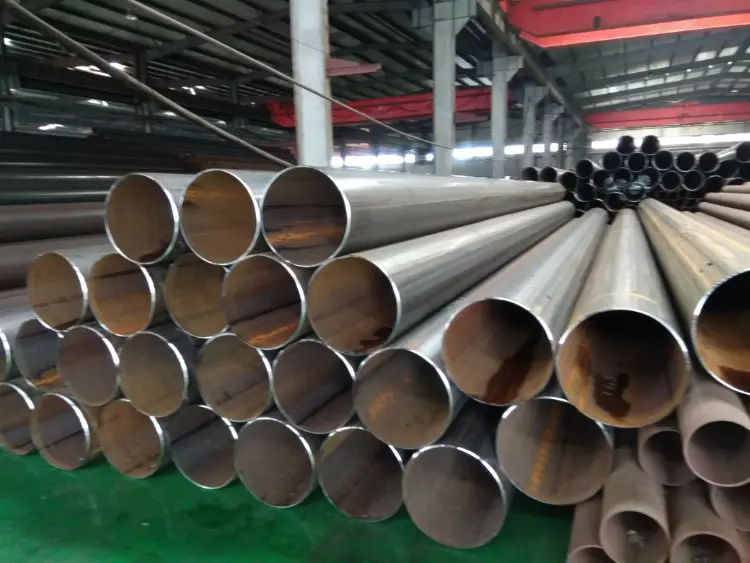
Q235A Carbon Structural Steel for ERW Pipe
Q235A Carbon Structural Steel for ERW Pipe - GB/T 700 Overview & Properties
Comprehensive technical data of Q235A steel according to GB/T 700, including chemical composition, mechanical properties, thermal and electrical properties, international equivalent grades, and application guide for ERW pipe manufacturing.
Electric resistance welding (ERW), bending, forming, cutting, welding
- Phone : +8618037372205
- Email : [email protected]
- WhatsApp: Contact via Whtsapp
- WeChat: +8618037372205
Q235A Carbon Structural Steel for ERW Pipe Introduction
Q235A is a Chinese carbon structural steel defined by GB/T 700, widely employed for the production of Electric Resistance Welded (ERW) pipes. As a mild steel grade, it exhibits a nominal minimum yield strength of 235 MPa for thicknesses up to 16 mm. Q235A offers good weldability, formability, and versatility, making it suitable for general structural and non-critical piping applications.
- Quality level A: no impact energy requirement, thus typically used at ambient temperatures.
- Supplied primarily as hot-rolled strip or plate for subsequent tube forming and welding.
- Available in various product forms such as coils, sheets, and ERW pipes in welded condition.
It is essential to note that Q235A is not intended for stringent low-temperature service due to the absence of Charpy impact guarantees. However, for standard structural purposes and low-pressure fluid transport in moderate climates, it remains a cost-effective and reliable choice.
Q235A Carbon Structural Steel for ERW Pipe Chemical Composition
The chemical composition of Q235A as per GB/T 700 is designed to provide good weldability and adequate strength for general structural purposes. The standard specifies maximum permissible levels for the main elements, with no imposed lower limits for carbon and manganese.
- Phosphorus and sulfur are controlled to minimize brittleness and hot cracking.
- Residual elements such as chromium, nickel, and copper are typically at low levels derived from raw materials.
| Element | Standard Value (max, %) | Remarks |
|---|---|---|
| Carbon (C) | ≤0.22 | Melts and cast analysis |
| Silicon (Si) | ≤0.35 | Deoxidation residual |
| Manganese (Mn) | ≤1.40 | Enhances strength and hardenability |
| Phosphorus (P) | ≤0.045 | Controlled for ductility |
| Sulfur (S) | ≤0.050 | To avoid hot shortness |
| Chromium (Cr) | ≤0.30 | Residual element |
| Nickel (Ni) | ≤0.30 | Residual element |
| Copper (Cu) | ≤0.30 | Residual element |
Q235A Carbon Structural Steel for ERW Pipe Thermal and Electrical Properties
The following physical properties are representative of low-carbon structural steel such as Q235A. These are not part of the GB/T 700 standard but are commonly used for design calculations.
- Values are valid at ambient temperature unless otherwise noted.
- Thermal conductivity decreases with increasing temperature; the listed value is an average around 20–100°C.
| Property | Value | Unit | Test Condition |
|---|---|---|---|
| Density (ρ) | 7.85 | g/cm³ | Room temperature |
| Elastic Modulus (E) | 200 – 210 | GPa | Room temperature |
| Shear Modulus (G) | 80 | GPa | Room temperature |
| Poisson's Ratio (ν) | 0.3 | – | Room temperature |
| Thermal Expansion Coefficient (α) | 12.0 | µm/m·K | 20–100°C |
| Thermal Conductivity (λ) | 50 | W/m·K | Room temperature |
| Specific Heat Capacity | 460 | J/kg·K | Room temperature |
| Electrical Resistivity (ρ_e) | 0.15 | µΩ·m | Room temperature |
Q235A Carbon Structural Steel for ERW Pipe Mechanical Properties
Mechanical properties of Q235A are thickness-dependent, as defined by GB/T 700. The tensile test is performed on flat specimens with longitudinal direction. Since ERW pipes are formed from strip material, the applicable thickness corresponds to the original strip.
- Elongation is gauged on a proportion of L0=5.65√S0.
- Cold bend test requires 180° bending without cracking on the outside surface.
- Q235A does not mandate impact testing; Charpy V-notch values are not applicable.
| Property | Value | Unit | Test Condition / Thickness Range |
|---|---|---|---|
| Yield Strength (ReH) | 235 (min) | MPa | t ≤ 16 mm |
| Yield Strength (ReH) | 225 (min) | MPa | 16 mm < t ≤ 40 mm |
| Yield Strength (ReH) | 215 (min) | MPa | 40 mm < t ≤ 60 mm |
| Yield Strength (ReH) | 205 (min) | MPa | 60 mm < t ≤ 100 mm |
| Yield Strength (ReH) | 195 (min) | MPa | 100 mm < t ≤ 150 mm |
| Yield Strength (ReH) | 185 (min) | MPa | 150 mm < t ≤ 200 mm |
| Tensile Strength (Rm) | 370 – 500 | MPa | All thicknesses |
| Elongation (A) | 26 (min) | % | t ≤ 40 mm |
| Elongation (A) | 25 (min) | % | 40 mm < t ≤ 60 mm |
| Elongation (A) | 24 (min) | % | 60 mm < t ≤ 100 mm |
| Elongation (A) | 22 (min) | % | 100 mm < t ≤ 150 mm |
| Elongation (A) | 21 (min) | % | 150 mm < t ≤ 200 mm |
| Bend Test (180°) | No cracks | – | Mandrel diameter d = 1.5a for t ≤ 60 mm (a = specimen thickness) |
Q235A Carbon Structural Steel for ERW Pipe Complete Equivalent Material Standards and Replaceable Grades
| Region | Standard | Grade | Remarks |
|---|---|---|---|
| China | GB/T 700 | Q235A | Original material |
| USA | ASTM A36/A36M | A36 | Slightly lower strength for thin gauges; comparable general structural steel |
| Japan | JIS G3101 | SS400 | Similar chemical and mechanical properties; widely interchangeable |
| Europe | EN 10025-2 | S235JR | Close in strength; lower max S and P; may require additional testing for CE marking |
| International | ISO 630 | Fe360A | Broad equivalence; discontinued but historically aligned |
Q235A Carbon Structural Steel for ERW Pipe Application Introduction
Q235A as a general-purpose carbon structural steel, when fabricated into ERW pipes, serves a wide range of industries. Its combination of acceptable strength, excellent weldability, and low cost makes it ideal for construction, infrastructure, and industrial manufacturing. Below are typical application areas and product examples:
Product Applications: Scaffolding tubes, Structural hollow sections (square, rectangular, circular), Low-pressure fluid transport pipes (water, gas, oil), Fence posts and handrails, Greenhouse frames, Conveyor rollers
Processed into products: Weldments and brackets, Chassis and frame parts for light vehicles, Pipe fittings (elbows, tees, reducers) after additional forming, Machine bases and support structures, Stamped parts (after blanking from strip before pipe production)
Application industries: Construction and civil engineering, Water supply and drainage systems, HVAC and fire protection piping, Automotive and machinery manufacturing, Agricultural equipment, Furniture and appliance frames
Q235A Carbon Structural Steel for ERW Pipe Similar or Alternative Material Recommendations
| Region | Standard | Grade | Remarks |
|---|---|---|---|
| China | GB/T 700 | Q235B | Q235A with guaranteed Charpy impact at +20°C (27 J) |
| China | GB/T 700 | Q235C | Better toughness, impact at 0°C |
| Europe | EN 10025-2 | S235J0 | Higher toughness at 0°C; may replace Q235A where impact properties are needed |
| Japan | JIS G3452 | SGP | Carbon steel for ordinary piping; similar in ERW pipe applications |
| USA | ASTM A53 Gr. A | Gr. A | Seamless or welded pipe; comparable to Q235A in fluid transport tubes |
Notes:
Important considerations when using Q235A ERW pipe:
- Quality level A lacks impact toughness guarantee; avoid use in low-temperature (-20°C and below) critical applications without supplementary impact testing.
- Welded pipe mill certification typically includes hydrostatic test or non-destructive testing per relevant GB/T 3091 or product-specific standards. Verify supplementary tests if required.
- For pressure piping, ensure that the pipe production standard (e.g., GB/T 3091 for welded steel pipe for low pressure fluid transport) is followed, which may reference Q235A as a base material.
- Galvanizing is common for corrosion protection when used outdoors.
- Consult the specific delivery specification for dimensional tolerances and end finish; ERW pipe is often supplied with plain ends or threaded and coupled.
- Share



