
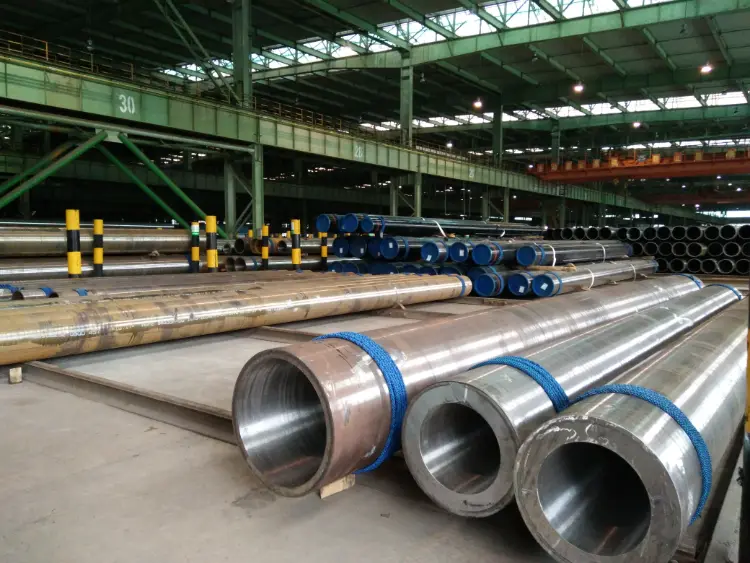
EN10219 S460MLH ERW Pipe
EN10219 S460MLH ERW Pipe - High-Strength Low-Temperature Structural Hollow Section
Comprehensive material data for EN10219 S460MLH electric resistance welded (ERW) pipe, covering chemical composition, mechanical properties, thermal properties, international equivalents, and application guidance.
Cold forming, electric resistance welding, cutting, machining, drilling, bending
- Phone : +8618037372205
- Email : [email protected]
- WhatsApp: Contact via Whtsapp
- WeChat: +8618037372205
EN10219 S460MLH ERW Pipe Introduction
S460MLH is a thermomechanically rolled fine-grain structural steel grade for cold-formed welded hollow sections according to EN 10219-1. It delivers a minimum yield strength of 460 MPa and is specifically designed for reliable performance at low temperatures, with impact testing at -50°C. The ERW (Electric Resistance Welded) manufacturing process provides consistent weld quality, tight dimensional tolerances, and cost-efficiency. Key features:
- High strength-to-weight ratio for heavy-duty structures
- Excellent notch toughness down to -50°C
- Good weldability and formability
- Available in round, square, and rectangular sections
EN10219 S460MLH ERW Pipe Chemical Composition
Chemical composition as specified in EN 10219-1 for grade S460MLH. Values are maximum unless a range or minimum is indicated.
- Fine-grain practice is ensured by the minimum aluminium content and controlled additions of niobium, vanadium, and titanium.
- The carbon equivalent value (CEV) is controlled to guarantee good weldability.
- All listed elements are those typically restricted in the standard; residual elements are at low levels.
| Element | Value (wt. %) | Note |
|---|---|---|
| Carbon (C) | 0.16 max | |
| Silicon (Si) | 0.60 max | |
| Manganese (Mn) | 1.70 max | |
| Phosphorus (P) | 0.030 max | |
| Sulfur (S) | 0.025 max | |
| Aluminium (Al) | 0.020 min | Total aluminium, for grain refinement |
| Niobium (Nb) | 0.05 max | |
| Vanadium (V) | 0.12 max | |
| Titanium (Ti) | 0.05 max | |
| Nickel (Ni) | 0.80 max | |
| Molybdenum (Mo) | 0.20 max | |
| Chromium (Cr) | 0.30 max | |
| Copper (Cu) | 0.35 max | |
| Nitrogen (N) | 0.025 max | |
| Carbon Equivalent (CEV) | 0.45 typical max | Based on ladle analysis, formula CEV = C + Mn/6 + (Cr+Mo+V)/5 + (Ni+Cu)/15 |
EN10219 S460MLH ERW Pipe Thermal and Electrical Physical Properties
Physical properties for a typical S460MLH type steel at room temperature. These values are not specified in EN 10219-1 but are representative for thermomechanically rolled fine-grain structural steels.
- Density, modulus, and thermal properties are similar to those of standard carbon-manganese steels.
- Values may vary slightly depending on exact composition and processing history.
- Data are suitable for general engineering calculations.
| Property | Typical Value | Unit | Condition / Temperature |
|---|---|---|---|
| Density (ρ) | 7850 | kg/m³ | At 20°C |
| Modulus of elasticity (E) | 210 | GPa | At 20°C |
| Shear modulus (G) | 81 | GPa | At 20°C |
| Poisson's ratio (ν) | 0.3 | — | At 20°C |
| Thermal expansion coefficient (α) | 12.0 | 10⁻⁶/K | 20°C to 100°C |
| Thermal conductivity (λ) | 50 | W/(m·K) | At 20°C |
| Specific heat capacity | 460 | J/(kg·K) | 20°C to 100°C |
| Electrical resistivity (ρ_e) | 0.25 | 10⁻⁶ Ω·m | At 20°C |
EN10219 S460MLH ERW Pipe Mechanical Properties
Mechanical properties for EN 10219-1 S460MLH hollow sections, measured on longitudinal test pieces from the parent metal.
- Values depend on wall thickness (t). For thicknesses beyond the ranges shown, refer to the standard.
- Bend test is performed with a 180° bend angle and a mandrel diameter related to thickness.
- Impact energy is verified at -50°C (L-quality).
| Property | Value | Unit | Condition |
|---|---|---|---|
| Yield strength (ReH) | ≥460 | MPa | Wall thickness t ≤ 16 mm |
| Yield strength (ReH) | ≥440 | MPa | 16 mm < t ≤ 40 mm |
| Tensile strength (Rm) | 540 – 720 | MPa | t ≤ 40 mm |
| Elongation after fracture (A) | ≥17 | % | Longitudinal, gauge length L₀ = 5.65√S₀; t ≤ 40 mm |
| Bend test (180°) | Mandrel diameter d = 3t | — | t ≤ 16 mm; no cracks or defects |
| Impact energy (KV₂) | ≥40 | J | At -50°C, longitudinal, 10×10 mm specimen |
| Impact energy (KV₂) | ≥27 | J | At -50°C, transverse (upon agreement) |
EN10219 S460MLH ERW Pipe Direct Equivalent Standards and Substitute Grades
| Region | Standard | Grade | Remarks |
|---|---|---|---|
| Europe | EN 10219-1 | S460MLH | Identical material – cold-formed welded hollow sections |
| Europe | EN 10025-4 | S460ML | Same chemical basis and strength but for flat products; not a hollow section |
| International | ISO 630-2 | S460M | Comparable chemistry for structural steels; does not cover hollow sections directly |
EN10219 S460MLH ERW Pipe Application Introduction
S460MLH ERW pipes are the preferred choice for demanding structural applications where high strength, low-temperature toughness, and reliable weldability are essential.
- Excellent for dynamically loaded structures and fatigue-critical components
- Can be used in exposed or harsh environments, including offshore and arctic conditions
- Efficient material usage reduces weight and fabrication costs
Product Applications: Structural hollow sections (square, rectangular, round ERW pipes), Crane booms and lattice structures, Offshore platform bracing and legs, Bridge girders and supports, Building columns and trusses, Piling pipes, Chassis and frame components
Processed into products: Welded structural nodes and joints, Boom sections for mobile and crawler cranes, Trailer frame rails and cross members, Excavator arms and booms, Wind turbine tower internals, Scaffolding and shoring posts, Agricultural sprayer booms, Conveyor gallery structures, Heavy-duty racking systems
Application industries: Construction and civil engineering, Offshore and marine, Mining and heavy equipment, Transport and automotive, Agricultural machinery
EN10219 S460MLH ERW Pipe Similar or Closely Matching Alternative Materials
| Region | Standard | Grade | Remarks |
|---|---|---|---|
| Europe | EN 10219-1 | S460MH | Same yield strength but less demanding toughness (impact at -20°C) |
| Europe | EN 10219-1 | S420MLH | Lower yield strength (420 MPa) with the same -50°C toughness |
| Europe | EN 10219-1 | S460NH | Normalized fine-grain steel, similar strength, impact tested at -20°C |
| USA | ASTM A500 | Grade C | Lower strength (345 MPa yield) and no fine-grain treatment; not directly equivalent |
Notes:
- Chemical composition is based on ladle analysis per EN 10219-1; product analysis tolerances apply as per the standard.
- Mechanical properties are derived from longitudinal test specimens taken from the hollow section parent metal. Impact tests are performed on Charpy V-notch specimens at -50°C.
- CEV is generally limited to 0.45 to ensure good field weldability without preheating for moderate thicknesses.
- ERW pipe shall be free of cracks and detrimental imperfections; the weld seam should be ultrasonically or eddy-current tested when required.
- Physical properties are typical reference values for structural steel and are not part of the mandatory specification. They may be used for initial design calculations.
- Share



