
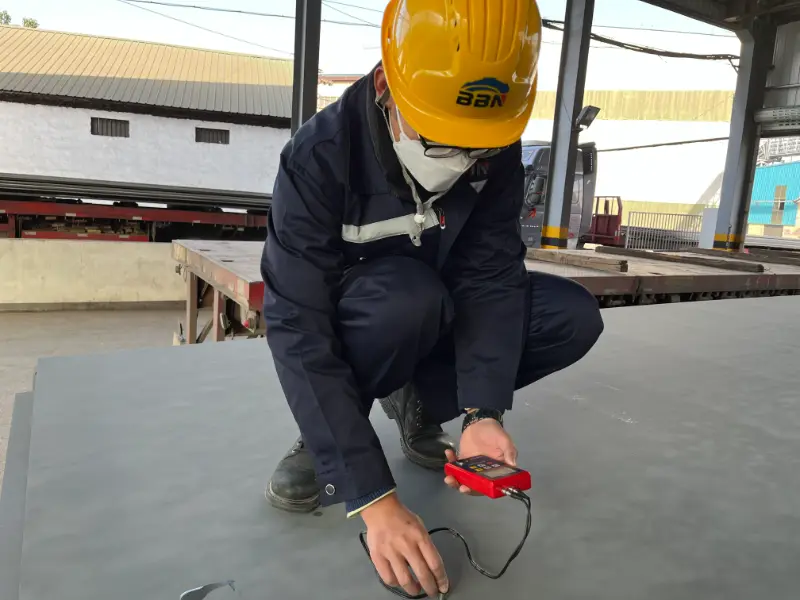
NM450 Abrasion Resistant Steel Plate Material
NM450 Abrasion Resistant Steel Plate: High Hardness Wear Solution for Construction Machinery
Comprehensive technical data for NM450 high strength abrasion resistant steel plate under GB/T 24186, including chemical composition, mechanical and physical properties, international equivalents, similar grades, and application guidance.
Flame cutting, plasma cutting, laser cutting, shearing, cold bending, hot bending, welding, machining, surface blasting
- Phone : +8618037372205
- Email : [email protected]
- WhatsApp: Contact via Whtsapp
- WeChat: +8618037372205
NM450 Abrasion Resistant Steel Plate Introduction
NM450 is a high-strength abrasion-resistant (AR) steel plate standardized under GB/T 24186, specifically developed for construction machinery and mining equipment where severe wear conditions demand exceptional surface hardness. With a nominal Brinell hardness of 450 HBW and a tailored low-alloy martensitic microstructure, NM450 provides an optimal balance of hardness, toughness, and formability.
Key features include:
- Guaranteed hardness range of 420–480 HBW through a controlled quenching and tempering (Q+T) process.
- Excellent abrasion resistance, extending service life in sliding and impact wear environments.
- Good weldability and cold bending properties when proper procedures are followed.
- Tight chemical composition control ensures consistent performance and low carbon equivalent (Ceq ≤ 0.60) to improve weldability.
- Supplied as plates from 5 mm up to 80 mm thickness, often with surface blasting and anti-corrosion oil.
NM450 is the material of choice for wear parts in construction machinery, mining, earthmoving, and recycling industries, replacing traditional mild steel and increasing component life by 3–5 times.
NM450 Abrasion Resistant Steel Plate Chemical Composition
The chemical composition of NM450 steel is carefully controlled to achieve the required hardness and toughness after quenching and tempering. The standard specifies maximum limits for most elements, with an additional carbon equivalent (Ceq) limit to ensure good weldability. Microalloying elements such as titanium and boron may be added to enhance hardenability and refine grain structure. Typical ladle analysis values are shown below.
| Element | Standard Value (wt%) | Remarks |
|---|---|---|
| Carbon (C) | ≤ 0.35 | Key strengthening element; controls hardness and martensite formation. |
| Silicon (Si) | ≤ 0.70 | Deoxidizer; contributes to strength. |
| Manganese (Mn) | ≤ 1.60 | Improves hardenability and toughness. |
| Phosphorus (P) | ≤ 0.025 | Impurity; kept low for toughness. |
| Sulfur (S) | ≤ 0.010 | Impurity; low level improves cleanliness and ductility. |
| Chromium (Cr) | ≤ 1.20 | Enhances hardenability and wear resistance. |
| Nickel (Ni) | ≤ 1.00 | Improves toughness, especially at low temperatures. |
| Molybdenum (Mo) | ≤ 0.60 | Increases hardenability and temper resistance. |
| Boron (B) | ≤ 0.004 | Strong hardenability agent, used in microalloying. |
| Titanium (Ti) | ≤ 0.050 | Grain refiner; combines with nitrogen and carbon. |
| Aluminium (Al) | ≥ 0.015 (acid-soluble) | Deoxidizer and grain refiner. |
| Carbon Equivalent (Ceq) | ≤ 0.60 | Ceq = C + Mn/6 + (Cr+Mo+V)/5 + (Ni+Cu)/15 |
NM450 Abrasion Resistant Steel Plate Thermal and Electrical Physical Properties
The following physical properties are typical values for low‑alloy martensitic wear‑resistant steels like NM450 and are not specified in GB/T 24186. They provide useful data for thermal analysis, heat treatment, and electrical applications. Values may vary slightly depending on exact composition and heat treatment condition. All measurements at room temperature (≈20°C) unless otherwise noted.
| Property | Typical Value | Unit | Test Condition / Remarks |
|---|---|---|---|
| Density (ρ) | 7.85 | g/cm³ | At 20°C |
| Modulus of Elasticity (E) | 210 | GPa | At 20°C |
| Shear Modulus (G) | 80 | GPa | Calculated from E and ν |
| Poisson's Ratio (ν) | 0.3 | - | Typical for structural steel |
| Thermal Expansion Coefficient (α) | 11.7 × 10⁻⁶ | 1/K | Temperature range 20–100°C |
| Thermal Expansion Coefficient (α) | 12.5 × 10⁻⁶ | 1/K | Temperature range 20–200°C |
| Thermal Expansion Coefficient (α) | 13.2 × 10⁻⁶ | 1/K | Temperature range 20–300°C |
| Thermal Conductivity (λ) | 42 | W/(m·K) | At 20°C |
| Specific Heat Capacity (c) | 460 | J/(kg·K) | At 20°C |
| Electrical Resistivity (ρ_e) | 0.23 × 10⁻⁶ | Ω·m | At 20°C |
NM450 Abrasion Resistant Steel Plate Mechanical Properties
The primary mechanical requirement for NM450 is surface hardness, guaranteed between 420 and 480 HBW. Additionally, the standard mandates Charpy impact toughness at -20°C and cold bending capability for certain thickness ranges. Tensile properties (yield strength, tensile strength, elongation) are not mandatory for delivery but are provided in the standard's informative annex for reference to aid design calculations. All values are based on quenched and tempered condition.
| Property | Standard Requirement / Typical Value | Unit | Test Condition / Remarks |
|---|---|---|---|
| Brinell Hardness (HBW) | 420 – 480 | HBW | On plate surface; measured after grinding 0.5 mm. Thickness typically 5–80 mm. |
| Charpy Impact Energy (KV2) | ≥ 24 | J | Longitudinal specimen, at -20°C, thickness ≤ 20 mm (for plates > 20 mm, by agreement). |
| Cold Bending (90° bend, d=3a) | No cracks | - | Thickness ≤ 12 mm, bending angle 90°, mandrel diameter = 3× thickness (d=3a). |
| Cold Bending (90° bend, d=4a) | No cracks | - | Thickness > 12 mm to ≤ 20 mm, mandrel diameter = 4× thickness. |
| Tensile Strength (Rm) (informative) | ≥ 1250 | MPa | Typical value from standard annex for reference; not a delivery requirement. |
| Yield Strength (ReH) (informative) | ≥ 1000 | MPa | Typical value from standard annex. |
| Elongation after fracture (A) (informative) | ≥ 10 | % | Gauge length L0 = 5.65√S0, thickness ≤ 20 mm; informative only. |
NM450 Abrasion Resistant Steel Plate Completely Equivalent Material Standards & Replaceable Grades
NM450 has no direct international standard because it belongs to a proprietary class of abrasion-resistant steels. However, several world‑renowned brands produce functionally equivalent grades with the same nominal 450 HBW hardness and similar mechanical properties. These can be considered direct substitutes in most applications, subject to agreement on chemical composition and supplementary tests.
| Country / Region | Standard / Brand | Grade | Remarks |
|---|---|---|---|
| Sweden | SSAB Proprietary Specification | Hardox 450 | Leading benchmark for 450 HBW AR steel; chemically and mechanically equivalent. |
| Germany | ThyssenKrupp Steel Europe (Mill Standard) | XAR 450 | Comparable 450 HBW wear-resistant steel, widely used in Europe. |
| Germany | Dillinger Hütte (Proprietary) | Dillidur 450 | Same nominal hardness, very similar composition and properties. |
| Japan | JFE Steel (Proprietary) | JFE‑EH450 | High‑hardness abrasion‑resistant plate; equivalent performance. |
| USA | Various (Proprietary, often per ASTM A6) | AR450 | Generic American grade for 450 HBW abrasion‑resistant plate. |
NM450 Abrasion Resistant Steel Plate Application Introduction
NM450 steel is extensively used in applications where abrasive wear and moderate impact are the dominant service conditions. Its excellent surface hardness significantly extends the service life of components, reducing downtime and maintenance costs. Typical industries and products include:
Product Applications: Excavator and loader buckets, Dump truck bodies and liners, Crusher jaws, cones and impact liners, Conveyor chute linings and wear plates, Bulldozer and grader blades, Hoppers and silo linings, Mixer drums and paddles, Cutting edges for scrap shears
Processed into products: Bucket wear plates and cutting edges, Crusher liner plates, jaw plates, mantles and concaves, Chute and hopper liners, Grizzly bars and scalping decks, Mixer blades and arm tips, Shredder hammers and grates, Loader bucket lips and shrouds, Wear strips and slide rails
Application industries: Mining and Quarrying, Construction Machinery, Earthmoving and Excavation, Recycling and Scrap Processing, Steel Mills and Foundries, Cement and Aggregate Production, Agricultural Machinery
NM450 Abrasion Resistant Steel Plate Recommended Similar / Alternative Materials
These grades belong to the same abrasion‑resistant family and are manufactured under GB/T 24186 or international norms. They offer a range of hardness values to suit different wear severity and impact conditions. NM400 provides better toughness and formability, while NM500 delivers higher wear resistance at the cost of reduced ductility.
| Country / Region | Standard / Specification | Grade | Remarks |
|---|---|---|---|
| China | GB/T 24186 | NM400 | Nominal 400 HBW; better bendability and impact toughness than NM450; suitable for higher impact wear. |
| China | GB/T 24186 | NM500 | Nominal 500 HBW; superior abrasion resistance but reduced ductility and weldability compared to NM450. |
| Sweden | SSAB Proprietary | Hardox 400 | International equivalent of NM400; similar lower‑hardness alternative. |
| Sweden | SSAB Proprietary | Hardox 500 | International equivalent of NM500; high‑hardness alternative for extremely abrasive conditions. |
Notes:
Welding Guidelines:
Preheat to 100–150°C for thicknesses above 30 mm; for thicknesses < 30 mm, preheating to 75–100°C is advisable. Use low-hydrogen consumables (E7018 or E11018-M type). Interpass temperature should not exceed 250°C. Avoid excessive heat input to preserve hardness in the heat‑affected zone (HAZ). Post‑weld heat treatment is normally not required, but stress relief at 500–550°C may be used when necessary.
Forming: Cold bending within the prescribed bending radii is feasible. For complex shapes, hot forming at 850–950°C followed by air cooling is recommended; re‑hardening and tempering may be required to restore full hardness.
Cutting: Plasma, laser, or water‑jet cutting under proper thermal control avoids edge hardening cracks. Slow cooling after flame cutting is recommended for thick plates.
Surface Protection: Plates are typically supplied blast‑cleaned to Sa 2.5 and can be painted with a shop primer to prevent atmospheric corrosion.
- Share



