
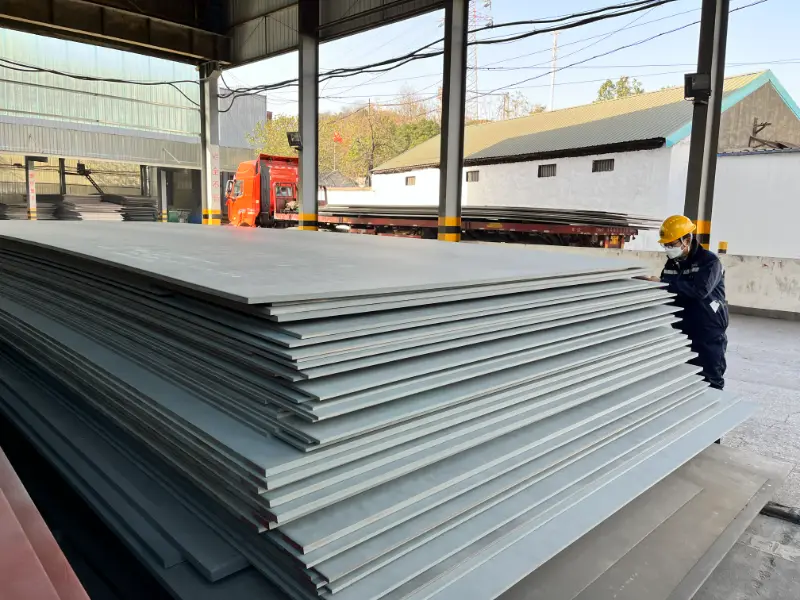
NM400 Abrasion Resistant Steel Material
NM400 Abrasion Resistant Steel - GB/T 24186 Wear Plate for Heavy Machinery
Comprehensive technical data on NM400 high-strength abrasion-resistant steel plate according to GB/T 24186, including chemical composition, mechanical and physical properties, international equivalent grades, and application guide for construction machinery.
Flame cutting, plasma cutting, waterjet cutting; welding (SMAW, GMAW, FCAW); cold forming (bending, rolling); machining
- Phone : +8618037372205
- Email : [email protected]
- WhatsApp: Contact via Whtsapp
- WeChat: +8618037372205
NM400 Abrasion Resistant Steel Introduction
NM400 is a high-strength abrasion-resistant steel plate specified in Chinese standard GB/T 24186, designed for applications demanding superior wear resistance combined with good impact toughness. With a uniform hardness of 370–430 HBW and guaranteed low-temperature impact properties, it is widely used in construction, mining, and material handling equipment. Key features:
- Excellent sliding and impact wear resistance
- Good cold formability with proper bending radii
- Weldable under recommended procedures
- Through-thickness hardness guarantee for plates up to 100 mm
- Cost-effective alternative to similar global wear grades
NM400 Abrasion Resistant Steel Chemical Composition
The chemical composition is designed to achieve an optimal balance of hardness, toughness, and weldability. All values are maximum unless otherwise stated. Microalloying elements like Ti and B are added for hardenability and grain refinement. Note: The steel may contain other elements not listed, but they are intentionally not added without the purchaser's agreement.
| Element | Standard Value (max, %) | Remarks |
|---|---|---|
| Carbon (C) | ≤0.25 | Essential for hardness and hardenability |
| Silicon (Si) | ≤0.70 | Deoxidizer, improves strength |
| Manganese (Mn) | ≤1.60 | Hardenability and strength |
| Phosphorus (P) | ≤0.025 | Impurity, kept low for toughness |
| Sulfur (S) | ≤0.010 | Impurity, kept low to avoid hot cracking |
| Chromium (Cr) | ≤1.40 | Hardenability and wear resistance |
| Nickel (Ni) | ≤1.00 | Toughness and hardenability |
| Molybdenum (Mo) | ≤0.50 | Hardenability and temper resistance |
| Titanium (Ti) | ≤0.050 | Grain refinement, carbide former |
| Boron (B) | ≤0.004 | Trace addition to boost hardenability |
| Aluminium (Al total) | ≥0.020 | Deoxidation and grain size control |
NM400 Abrasion Resistant Steel Physical Properties
The following physical properties are typical for low-alloy wear-resistant steel like NM400. Actual values may vary slightly depending on exact chemical composition and heat treatment condition. These values are suitable for design calculations.
| Property | Typical Value | Unit | Test Condition / Remarks |
|---|---|---|---|
| Density (ρ) | 7.85 | g/cm³ | At 20 °C |
| Elastic modulus (E) | 210 | GPa | Tensile modulus, 20 °C |
| Shear modulus (G) | 81 | GPa | Estimated from E and Poisson's ratio |
| Poisson ratio (ν) | 0.3 | – | Elastic deformation range |
| Thermal expansion coefficient (α) | 11.5 × 10⁻⁶ | 1/K | Between 20 °C and 100 °C |
| Thermal conductivity (λ) | 40 | W/(m·K) | At 20 °C |
| Specific heat capacity (c) | 460 | J/(kg·K) | At room temperature |
| Electrical resistivity (ρe) | 0.23 × 10⁻⁶ | Ω·m | At 20 °C |
NM400 Abrasion Resistant Steel Mechanical Properties
The primary mechanical requirement for NM400 is surface hardness. Tensile strength and yield strength are not specified in the standard but are provided here as typical reference values for engineering design. Bending and impact toughness are mandatory delivery tests. All tests performed on specimens from quenched condition.
| Property | Standard Requirement / Typical Value | Unit | Test Condition / Remarks |
|---|---|---|---|
| Hardness (HBW) | 370 – 430 | HBW | On a milled surface 2 mm below plate surface; across full thickness for plates ≤ 100 mm |
| Typical tensile strength (Rm) | 1200 – 1400 | MPa | For reference only; not a mandatory requirement |
| Typical yield strength (ReH) | ≥ 800 | MPa | For reference only |
| Typical elongation (A) | ≥ 10 | % | Gauge length 50 mm, transverse specimen; for reference only |
| Bending test (180°) – t ≤ 30 mm | Crack free at d = 3a | – | d = bending mandrel diameter, a = plate thickness |
| Bending test (180°) – t > 30 to 50 mm | Crack free at d = 4a | – | Plates over 50 mm by agreement |
| Charpy impact (KV) –20 °C, longitudinal | ≥ 24 | J | Charpy V-notch, 10×10×55 mm specimen |
NM400 Abrasion Resistant Steel Internationally Comparable Wear-Resistant Grades
The following grades offer similar hardness and wear resistance and are often used interchangeably with NM400, although exact specifications may differ. Always confirm dimensional and technical requirements with the supplier.
| Country/Region | Standard / Supplier | Grade | Remarks |
|---|---|---|---|
| Sweden | SSAB | Hardox® 400 | 370–430 HBW, comparable bending and impact toughness |
| Germany | thyssenkrupp | XAR® 400 | Typical 400 HBW, used in similar severe-wear applications |
| Japan | JFE Steel | JFE-EH400 | 370–430 HBW, high abrasion resistant steel |
| Finland | Ruukki (SSAB) | Raex 400 | Equivalent wear-resistant grade, available in protective coating |
| China | GB/T 24186 | NM400 | The reference grade of this data sheet |
NM400 Abrasion Resistant Steel Application Introduction
NM400 wear plates excel in environments combining sliding wear, impact, and moderate abrasion. They can be formed, welded, and machined with standard tools, making them suitable for manufacturing critical components for heavy machinery. Design recommendations:
- Minimum bending radius of 3× plate thickness (t ≤ 30 mm) for 180° bends.
- Preheat to 100–150 °C before welding on thicker sections to avoid hydrogen cracking.
- Avoid prolonged exposure to temperatures above 250 °C to prevent softening.
Product Applications: Dump truck bodies and trailers, Excavator and loader buckets, Crusher jaws, cones, and impact liners, Chute and hopper liners, Bulldozer and grader blades, Mixer drums and wear shoes, Scrap shear blades
Processed into products: Bucket cutting edges and side cutters, Wear strips and guide rails, Grizzly bars and scalping screens, Fan blades for abrasive media, Conveyor trough liners, Hammer mill hammers (up to medium impact), Protective plates for shot blasting chambers
Application industries: Mining and quarrying, Earthmoving and construction, Recycling and waste management, Cement and concrete production, Steel works and foundries, Agriculture
NM400 Abrasion Resistant Steel Similar Wear-Resistant Steel Grades
The following materials are closely related in terms of wear resistance class but differ in hardness levels. They may be considered for applications where slightly lower or higher abrasion resistance is acceptable.
| Country/Region | Standard / Supplier | Grade | Remarks |
|---|---|---|---|
| China | GB/T 24186 | NM360 | Hardness 330–370 HBW, lower wear resistance, better formability |
| China | GB/T 24186 | NM450 | Hardness 420–480 HBW, increased wear life, reduced impact toughness |
| Sweden | SSAB | Hardox® 450 | 425–475 HBW, alternative for higher wear demand |
| Japan | JFE Steel | JFE-EH360 | 330–370 HBW, softer grade for less severe wear |
| Germany | thyssenkrupp | XAR® 450 | 420–480 HBW, comparable to NM450 |
Notes:
Welding: Use low-hydrogen consumables and preheat according to plate thickness (typically 125–175 °C for >25 mm). Post-weld heat treatment is generally not required. Cutting: Thermal cutting may create a small heat-affected zone with slightly reduced hardness; this is normally permissible in wear applications. Cold forming: For thicknesses up to 30 mm, minimum bending radius of 3t is recommended. Plate edges should be free of notches. Surface protection: NM400 can be supplied with shop primer or rust-preventive oil. The steel is not intended for structural applications governed by pressure vessel or construction codes unless specifically evaluated.
- Share



