
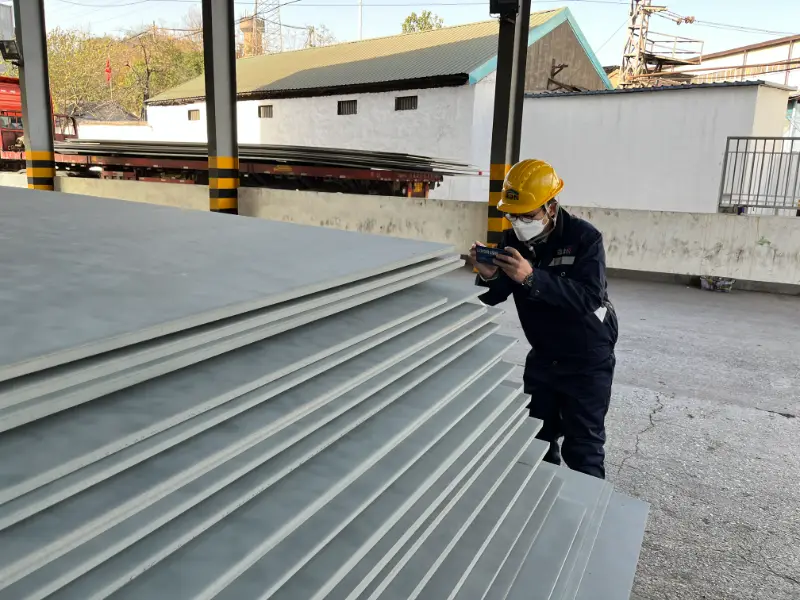
GB/T 24186 NM500 High-Strength Abrasion Resistant Steel Plate Material
GB/T 24186 NM500 High-Strength Abrasion Resistant Steel Plate for Construction Machinery
Comprehensive data for NM500 wear-resistant steel according to GB/T 24186, including chemical composition, hardness, mechanical and physical properties, equivalent grades, and application guidelines.
Cutting, forming, machining, welding (with preheat and post-weld treatment)
- Phone : +8618037372205
- Email : [email protected]
- WhatsApp: Contact via Whtsapp
- WeChat: +8618037372205
GB/T 24186 NM500 High-Strength Abrasion Resistant Steel Plate Introduction
NM500 is a high-strength, abrasion-resistant structural steel plate conforming to Chinese standard GB/T 24186. It is primarily used in demanding wear environments where extreme hardness and toughness are required.
- Nominal hardness: 500 HBW, providing excellent resistance to sliding and impact wear.
- Supplied in quenched and tempered condition to achieve a refined microstructure with uniform properties.
- Typical applications include heavy-duty construction machinery, mining equipment, and material handling systems.
- Offers a good balance of wear life and weldability when appropriate preheating and low-hydrogen procedures are followed.
GB/T 24186 NM500 High-Strength Abrasion Resistant Steel Plate Chemical Composition
The chemical composition of NM500 is designed to provide high hardenability and consistent through-thickness hardness after quenching and tempering.
- All values are maximum unless a range is given.
- The carbon equivalent (CEV) is typically controlled below 0.60 to ensure adequate weldability.
- Microalloying elements such as Al, Ti, Nb, or V may be added for grain refinement and further property optimization, but are not mandatory per the standard.
| Element | Standard Value (max, wt%) | Remarks |
|---|---|---|
| C | 0.38 | Max. – Key hardenability and strength contributor |
| Si | 0.70 | Max. – Deoxidation and strength |
| Mn | 1.60 | Max. – Hardenability and toughness |
| P | 0.020 | Max. – Stray element, controlled for toughness |
| S | 0.010 | Max. – Stray element, controlled for ductility |
| Cr | 1.00 | Max. – Hardenability and wear resistance |
| Ni | 0.70 | Max. – Toughness and hardenability |
| Mo | 0.60 | Max. – Hardenability and temper resistance |
| B | 0.005 | Max. – Boron for enhanced hardenability |
| CEV | ≤0.60 (typical) | Carbon equivalent = C+Mn/6+(Cr+Mo+V)/5+(Ni+Cu)/15 |
GB/T 24186 NM500 High-Strength Abrasion Resistant Steel Plate Physical Properties
The physical properties listed are representative of low-alloy quenched and tempered wear-resistant steels.
- Room-temperature density is standard for steel.
- Thermal expansion coefficient is provided for two temperature intervals commonly encountered in welding and service.
- Thermal conductivity and electrical resistivity affect processing and any electrical applications.
- Values may vary slightly depending on the exact chemical composition and heat treatment.
| Property | Typical Value | Unit | Condition |
|---|---|---|---|
| Density (ρ) | 7.85 | g/cm³ | 20°C |
| Modulus of Elasticity (E) | 210 | GPa | 20°C |
| Shear Modulus (G) | 81 | GPa | 20°C |
| Poisson's Ratio (ν) | 0.3 | - | Elastic range |
| Thermal Expansion Coefficient (α) | 12.5 / 13.5 | 10⁻⁶/K | 20–100°C / 20–200°C |
| Thermal Conductivity (λ) | 36 | W/(m·K) | 20°C |
| Specific Heat Capacity (cₚ) | 460 | J/(kg·K) | 20–100°C |
| Electrical Resistivity (ρₑ) | 0.25 | 10⁻⁶ Ω·m | 20°C |
GB/T 24186 NM500 High-Strength Abrasion Resistant Steel Plate Mechanical Properties
The primary requirement of GB/T 24186 is hardness; other tensile and impact properties are given for guidance only and are not mandatory.
- Hardness is measured on the surface after removal of decarburized layer, usually in the delivery condition.
- Minimum yield and tensile strength values are typical for quenched and tempered plates of this grade.
- Impact energy is often specified at -20°C to ensure sufficient low-temperature toughness.
- Bend test is performed with a mandrel diameter proportional to plate thickness to assess formability.
| Property | Typical Value | Unit | Test Condition |
|---|---|---|---|
| Brinell Hardness (HBW) | 470 – 530 | HBW | Plate thickness ≤80 mm; EN ISO 6506-1 |
| Yield Strength (ReH) | ≥ 1250 | MPa | Transverse specimen, room temperature |
| Tensile Strength (Rm) | ≥ 1450 | MPa | Transverse specimen, room temperature |
| Elongation (A50) | ≥ 8 | % | Gauge length 50 mm, transverse |
| Impact Energy (KV₂) | ≥ 27 | J | Charpy-V, -20°C, transverse |
| Cold Bending (180°) | d = 4a | - | a = plate thickness; no cracks |
GB/T 24186 NM500 High-Strength Abrasion Resistant Steel Plate Completely Equivalent Material Standards and Replaceable Grades
| Country / Region | Standard / Specification | Grade | Remarks |
|---|---|---|---|
| China | GB/T 24186 | NM500 | Original standard grade |
| Sweden / Global | SSAB Brand | Hardox 500 | Commercial brand, equivalent hardness and wear performance |
| Germany | Dillinger Brand | Dillidur 500 | Commercial brand with similar chemistry and hardness |
| Japan | JFE Steel Brand | JFE-EH500 | High hardness wear plate; equivalent performance |
| Australia | Bisalloy Brand | Bisalloy 500 | Wear‑resistant steel plate, nominal 500 HBW |
GB/T 24186 NM500 High-Strength Abrasion Resistant Steel Plate Application Introduction
NM500 is designed for severe wear conditions. Proper selection and fabrication practices are essential to maximize service life and maintain structural integrity.
- Preheating (150–200°C) is recommended before welding, and low‑hydrogen filler metals should be used.
- Cutting can be done by plasma, laser, or abrasive water jet; flame cutting may require additional preheat.
- Cold forming is possible to a limited degree; hot forming above 250°C should be avoided to prevent softening.
Product Applications: Dump truck bodies and wear liners, Excavator and loader buckets, Crusher jaws, hammers, and impact bars, Chutes, hoppers, and conveyor components, Bulldozer blades and cutting edges, Shredder and scrap shear parts
Processed into products: Bucket wear plates, lips, and adapters, Truck bed liners and tailgates, Crusher concaves, mantles, and cheek plates, Screw conveyor flights and trough liners, Silos and bunker liners, Wear bars, skids, and grizzly bars
Application industries: Mining and quarrying, Heavy construction and earth moving, Recycling and scrap processing, Agriculture and forestry machinery, Cement and aggregate production, Port and bulk material handling
GB/T 24186 NM500 High-Strength Abrasion Resistant Steel Plate Similar / Comparable Material Recommendations
| Country / Region | Standard / Specification | Grade | Description |
|---|---|---|---|
| China | GB/T 24186 | NM450 | Lower hardness (450 HBW) – higher toughness, easier formability |
| China | GB/T 24186 | NM550 | Higher hardness (550 HBW) – better wear resistance but reduced ductility |
| Global | Various brand | AR500 / 500HB | General designation for 500 HBW wear plate, similar in concept |
| Germany | ThyssenKrupp Brand | XAR 500 | High-strength wear plate with 500 HBW, chemistry and properties closely related |
Notes:
Welding: Low‑hydrogen electrodes (AWS E11018-M or equivalent) are recommended. Preheat to 150–200°C; interpass temperature should not exceed 250°C. Post‑weld heat treatment is generally not required for thicknesses up to 50 mm.
Corrosion: NM500 is not stainless; in corrosive environments, surface protection or painting is required.
Stock Availability: Commonly available thicknesses range from 6 to 80 mm; widths up to 3000 mm and lengths up to 12000 mm, depending on mill capabilities.
- Share



