
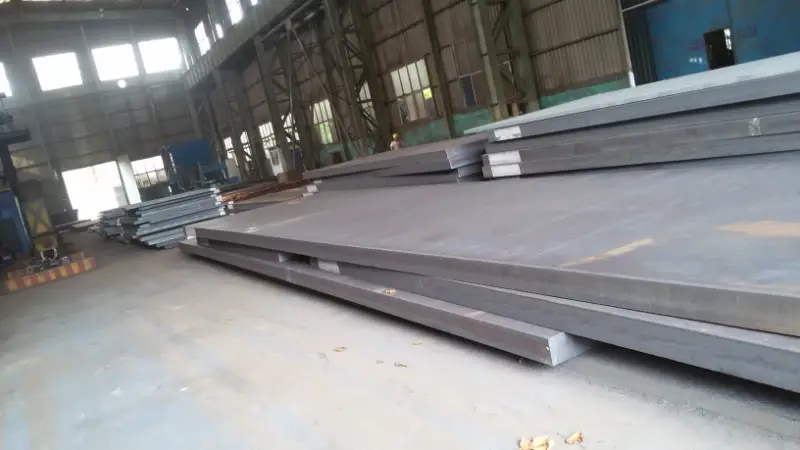
EN 10120 P310NB Gas Cylinder Steel Material
EN 10120 P310NB Gas Cylinder Steel - High Formability & Low-Temperature Toughness for Welded Cylinders
P310NB is a normalized fine-grain steel designed for welded gas cylinders, offering reliable yield strength ≥310 MPa, good weldability, and impact toughness down to -20°C. This comprehensive data sheet includes chemical composition, mechanical and thermophysical properties, and international equivalents based on EN 10120 and ISO 4978-1.
Cutting, cold forming (deep drawing, bending), welding, normalizing (if required), surface treatment
- Phone : +8618037372205
- Email : [email protected]
- WhatsApp: Contact via Whtsapp
- WeChat: +8618037372205
EN 10120 P310NB Gas Cylinder Steel Introduction
P310NB is a weldable fine-grain structural steel specified in EN 10120, exclusively intended for the manufacture of welded gas cylinders. It is typically supplied in the normalized or normalized-rolled condition, ensuring a uniform ferritic-pearlitic microstructure. The material combines:
- Minimum yield strength of 310 MPa for thicknesses up to 16 mm
- Tensile strength in the range 440–560 MPa
- Good ductility with elongation ≥22% (thickness ≤16 mm)
- Excellent cold formability for deep drawing and bending processes
- Guaranteed Charpy-V impact energy of ≥27 J at -20°C (transverse)
- Superior weldability with conventional methods, thanks to a low carbon equivalent
Its controlled composition with microalloying elements (Nb, V, Ti) ensures grain refinement, which contributes to both strength and toughness. P310NB is widely used for LPG cylinders, industrial gas bottles, and similar pressure vessels operating at moderate temperatures. The steel is delivered as coils, sheets, or cut plates according to customer requirements, often in descaled or surface-treated condition.
EN 10120 P310NB Gas Cylinder Steel Chemical Composition
The chemical composition of P310NB is designed to provide adequate strength, cold formability, and weldability. Microalloying with Nb, V, and Ti ensures a fine-grain structure. The maximum carbon equivalent (CEV) for cold-cracking resistance is typically below 0.45 according to EN 10120.
- All values are in weight percent, maximum unless a range is given.
- Aluminium is present as a grain-refining element; Al/N ratio is controlled.
- The sum Nb+V+Ti ≤ 0.12% ensures a balanced precipitation hardening without impairing toughness.
| Element | Standard Value | Remarks |
|---|---|---|
| Carbon (C) | ≤ 0.20 | Max |
| Silicon (Si) | ≤ 0.50 | Max |
| Manganese (Mn) | 0.90 – 1.70 | Suitable range for strength and weldability |
| Phosphorus (P) | ≤ 0.025 | Max |
| Sulfur (S) | ≤ 0.015 | Max |
| Aluminium (Al) | ≥ 0.020 | Total aluminium, min |
| Niobium (Nb) | ≤ 0.05 | Microalloying element |
| Vanadium (V) | ≤ 0.05 | Microalloying element |
| Titanium (Ti) | ≤ 0.05 | Microalloying element |
| Chromium (Cr) | ≤ 0.30 | Residual element, max |
| Nickel (Ni) | ≤ 0.30 | Residual element, max |
| Copper (Cu) | ≤ 0.35 | Residual element, max |
| Molybdenum (Mo) | ≤ 0.08 | Residual element, max |
| Nitrogen (N) | ≤ 0.012 | Max, for product analysis 0.014 |
| Nb+V+Ti | ≤ 0.12 | Combined microalloy limits, product analysis |
EN 10120 P310NB Gas Cylinder Steel Thermal and Electrical Physical Properties
These data are typical for low-carbon fine-grain steels like P310NB and are not mandatory requirements of EN 10120. They are provided for engineering calculations such as thermal expansion compensation, heat treatment design, and electrical earthing. Actual values may vary slightly with heat treatment and microstructure.
- Room temperature values unless specified otherwise.
- Thermal conductivity and specific heat are averaged over the indicated temperature range.
- Density is assumed based on a ferritic-pearlitic structure.
| Property | Typical Value | Unit | Test Conditions |
|---|---|---|---|
| Density (ρ) | 7.85 | g/cm³ | At 20°C |
| Elastic Modulus (E) | 205 – 210 | GPa | At 20°C |
| Shear Modulus (G) | 80 – 82 | GPa | At 20°C (calculated from E and ν) |
| Poisson Ratio (ν) | 0.29 – 0.30 | – | Elastic range, room temperature |
| Thermal Expansion Coefficient (α) | 11.5 – 12.0 | 10⁻⁶/K | 20°C to 100°C |
| Thermal Expansion Coefficient (α) | 12.5 – 13.0 | 10⁻⁶/K | 20°C to 200°C |
| Thermal Expansion Coefficient (α) | 13.5 – 14.0 | 10⁻⁶/K | 20°C to 300°C |
| Thermal Conductivity (λ) | 50 – 55 | W/(m·K) | At 20°C |
| Specific Heat Capacity (cp) | 460 – 500 | J/(kg·K) | At 20°C |
| Electrical Resistivity (ρe) | 0.20 – 0.25 | μΩ·m | At 20°C |
EN 10120 P310NB Gas Cylinder Steel Mechanical Properties
Mechanical properties are guaranteed in the delivery condition (+N or normalized-rolled) for transverse test pieces. Impact test temperature is -20°C. Bend test is performed with a specified mandrel diameter. The values depend on the nominal thickness (e) of the product.
- Tensile test according to EN ISO 6892-1.
- Charpy-V impact test according to EN ISO 148-1.
- Bend test according to EN ISO 7438.
Properties are provided for the three standard thickness ranges from EN 10120: ≤16 mm, >16 to ≤40 mm, and >40 to ≤60 mm.
| Property | Required Value | Unit | Test Conditions |
|---|---|---|---|
| Yield Strength (ReH) | ≥ 310 | MPa | Nominal thickness e ≤ 16 mm, transverse |
| Yield Strength (ReH) | ≥ 290 | MPa | 16 mm < e ≤ 40 mm, transverse |
| Yield Strength (ReH) | ≥ 280 | MPa | 40 mm < e ≤ 60 mm, transverse |
| Tensile Strength (Rm) | 440 – 560 | MPa | All thicknesses, transverse |
| Elongation after Fracture (A, 5.65√So) | ≥ 22 | % | e ≤ 16 mm, transverse |
| Elongation after Fracture (A, 5.65√So) | ≥ 21 | % | 16 mm < e ≤ 40 mm, transverse |
| Elongation after Fracture (A, 5.65√So) | ≥ 20 | % | 40 mm < e ≤ 60 mm, transverse |
| Charpy Impact Energy (KV₂) | ≥ 27 (average), ≥ 21 (single) | J | At -20°C, transverse test piece |
| Bend Test (180°) | Mandrel diameter d = 2a | – | e ≤ 16 mm (a = specimen thickness) |
| Bend Test (180°) | Mandrel diameter d = 3a | – | 16 mm < e ≤ 40 mm |
| Bend Test (180°) | Mandrel diameter d = 4a | – | 40 mm < e ≤ 60 mm |
EN 10120 P310NB Gas Cylinder Steel Directly Equivalent Standards and Designations
| Country/Region | Standard | Grade | Remarks |
|---|---|---|---|
| Europe | EN 10120 | P310NB | Original standard and grade; this material is defined here |
| International | ISO 4978-1 | P310NB | Identical technical delivery conditions; fully interchangeable |
EN 10120 P310NB Gas Cylinder Steel Application Introduction
P310NB is specifically targeted for welded gas cylinders and pressure vessels requiring good low-temperature toughness and reliable weld quality. Typical fabrication includes sheet/plate cutting, cold forming (press drawing), longitudinal or spiral welding, heat treatment (stress relief or normalization), and final pressure testing. The steel can be readily painted or coated after shot blasting.
Product Applications: Standard 5 kg to 50 kg domestic LPG cylinders, Acetylene gas bottles for welding/cutting, Portable air receivers and compressor tanks, UL-approved refrigerant cylinders, Fire extinguisher bodies
Processed into products: Cylinder shell (deep-drawn top and bottom halves, or rolled-and-welded cylinders), Foot ring and shroud parts (cold-formed from strip), Valve boss reinforcement plates, Welded pressure vessel ends (dished heads)
Application industries: Liquefied Petroleum Gas (LPG) cylinder manufacturing, Industrial gas (oxygen, nitrogen, acetylene) bottle production, Refrigerant and fire-extinguisher vessel fabrication, Manufacture of seamless or welded compressed natural gas (CNG) cylinders (sheet-based), General small to medium welded pressure vessels
EN 10120 P310NB Gas Cylinder Steel Similar or Alternative Materials
| Country/Region | Standard | Grade | Remarks |
|---|---|---|---|
| China | GB/T 6653 | HP295 | Yield ≥295 MPa, tensile 440–560 MPa, similar formability; lower yield than P310NB |
| China | GB/T 6653 | HP325 | Yield ≥325 MPa, tensile 490–590 MPa; higher strength, still suitable for many cylinders |
| Japan | JIS G3116 | SG295 | Yield ≥295 MPa, tensile 440–560 MPa; often used for domestic LPG cylinders |
| Japan | JIS G3116 | SG325 | Yield ≥325 MPa, tensile 490–610 MPa; higher strength alternative |
Notes:
For guaranteed properties, the material must be ordered according to the full specification of EN 10120, including any supplementary requirements (e.g., improved surface quality, restricted chemical ranges for special forming). The normalized condition (+N) is standard; alternative delivery conditions like thermomechanical rolling (+M) may be agreed. Product analysis tolerances are defined in the standard. For thicknesses above 60 mm, properties shall be agreed upon. This steel is not intended for sour service or hydrogen embrittlement-critical applications unless specifically tested.
- Share



