
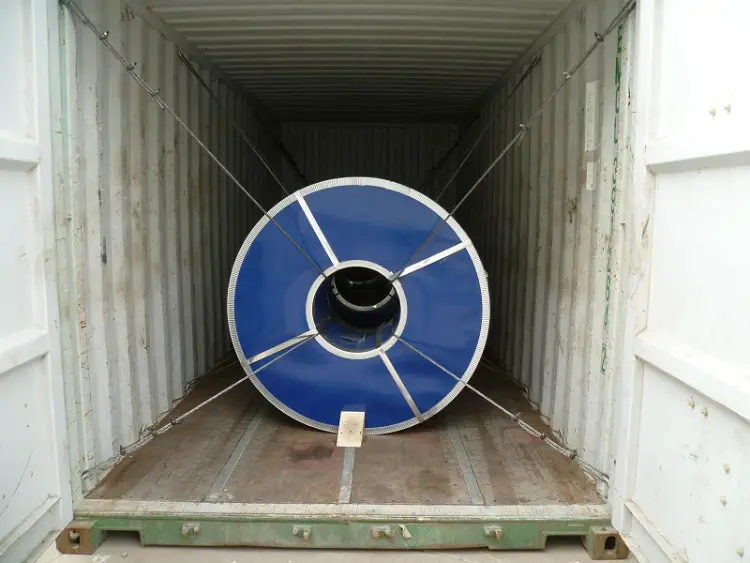
NK Grade D Shipbuilding Steel Coil
NK Grade D Shipbuilding Steel Coil: Normal Strength Hull Structural Steel with Superior Notch Toughness at -20°C
Complete material data for NK Grade D shipbuilding steel coil including chemical composition, mechanical and physical properties, worldwide equivalents, and typical applications in marine and offshore engineering.
Hot rolling, cold rolling, pickling, slitting, cutting, forming, welding
- Phone : +8618037372205
- Email : [email protected]
- WhatsApp: Contact via Whtsapp
- WeChat: +8618037372205
NK Grade D Shipbuilding Steel Coil Introduction
NK Grade D is a normal strength hull structural steel certified by Nippon Kaiji Kyokai (ClassNK) under Part K of its Rules for the Survey and Construction of Steel Ships. As a member of the IACS unified requirements for ordinary strength shipbuilding steel, NK Grade D exhibits excellent weldability and good low-temperature toughness, meeting a minimum Charpy V-notch impact energy of 27 J at -20°C. Key characteristics:
- Minimum yield strength of 235 MPa
- Tensile strength in the range 400–520 MPa
- Reliable toughness in cold environments
- Good formability and weldability
- Available in coils, plates, and sections
It is widely used for hull structures, decks, bulkheads, and other primary members in shipbuilding and offshore platforms.
NK Grade D Shipbuilding Steel Coil Chemical Composition
The chemical composition complies with IACS UR W11 for ordinary strength hull structural steel Grade D. Key points:
- Carbon is limited to ≤0.21% to ensure good weldability.
- Manganese is required to be at least 2.5 times the carbon content to maintain tensile strength and notch toughness.
- Grain refining elements such as aluminium (acid soluble) are often added to meet impact requirements, especially for thicker gauges.
- Residual elements (Cu, Cr, Ni, Mo) are controlled to avoid adverse effects on weldability and corrosion resistance.
| Element | Standard Value (wt%) | Remarks |
|---|---|---|
| C | ≤ 0.21 | Weldability control |
| Mn | ≥ 2.5 × C (typically 0.60–1.50) | Min. required to reach strength and toughness |
| Si | ≤ 0.50 | Deoxidation element, standard limit |
| P | ≤ 0.035 | Phosphorus max. for toughness |
| S | ≤ 0.035 | Sulphur max. for cleanliness |
| Al (acid soluble) | ≥ 0.015 | If used as grain refiner; total Al min. 0.020 possible |
| Cu | ≤ 0.35 | Residual element, max. limit |
| Cr | ≤ 0.20 | Residual element, max. limit |
| Ni | ≤ 0.40 | Residual element, max. limit |
| Mo | ≤ 0.08 | Residual element, max. limit |
| V | ≤ 0.10 | May be present as microalloy; max. limit |
| Nb | ≤ 0.05 | May be present as microalloy; max. limit |
| Ti | ≤ 0.02 | May be present as microalloy; max. limit |
| Others (total) | ≤ 0.50 (each) | Except for intentional alloying additions with agreement |
NK Grade D Shipbuilding Steel Coil Thermal and Electrical Physical Properties
These physical properties are typical for carbon‑manganese structural steels similar to NK Grade D. They are not specified in the classification rules but are provided for engineering calculations. Notes:
- Density and elastic properties are standard for mild steel.
- Thermal expansion and conductivity vary with temperature; representative values are given for a range of conditions.
- Electrical resistivity is typical for steel with this composition.
| Property | Typical Value | Unit | Test Condition |
|---|---|---|---|
| Density (ρ) | 7850 | kg/m³ | At 20°C |
| Modulus of Elasticity (E) | 210 | GPa | At 20°C |
| Shear Modulus (G) | 81 | GPa | At 20°C |
| Poisson's Ratio (ν) | 0.30 | - | At 20°C |
| Coefficient of Thermal Expansion (α) | 12.0 × 10⁻⁶ | 1/K | 0–100°C |
| Coefficient of Thermal Expansion (α) | 12.5 × 10⁻⁶ | 1/K | 0–200°C |
| Coefficient of Thermal Expansion (α) | 13.0 × 10⁻⁶ | 1/K | 0–300°C |
| Thermal Conductivity (λ) | 51.9 | W/(m·K) | At 0°C |
| Thermal Conductivity (λ) | 50.0 | W/(m·K) | At 20°C |
| Thermal Conductivity (λ) | 42.5 | W/(m·K) | At 300°C |
| Specific Heat Capacity (cp) | 486 | J/(kg·K) | At 20°C |
| Electrical Resistivity (ρₑ) | 0.16 × 10⁻⁶ | Ω·m | At 20°C |
NK Grade D Shipbuilding Steel Coil Mechanical Properties
Mechanical properties are determined in accordance with NK rules and IACS UR W11. The tensile test is performed on test pieces taken in the direction of rolling. Important conditions:
- Yield strength and tensile strength apply to all thicknesses up to 100 mm (higher thickness may need further verification).
- Elongation values depend on gauge length; the 5.65√So gauge (50 mm) and 200 mm gauge are both indicated.
- Impact tests are carried out at -20°C; both longitudinal and transverse values are given for reference (longitudinal is the standard requirement in most rules).
- Bend test 180° with diameters specified in relation to thickness (a = specimen thickness).
| Property | Standard Requirement | Unit | Test Condition |
|---|---|---|---|
| Yield Strength (ReH) | ≥ 235 | MPa | Full thickness range (all products) |
| Tensile Strength (Rm) | 400 – 520 | MPa | Full thickness range |
| Elongation (A) | ≥ 24 | % | Gauge length Lo = 5.65√So (50 mm); thickness ≤ 50 mm |
| Elongation (A200) | ≥ 22 | % | Gauge length Lo = 200 mm; thickness ≤ 50 mm |
| Bend Test (180°) | d = 3a | - | Thickness a ≤ 25 mm |
| Bend Test (180°) | d = 4a | - | Thickness a > 25 mm |
| Charpy Impact Energy (KV2) Longitudinal | ≥ 27 (average) | J | At -20°C; one individual value ≥ 20 J |
| Charpy Impact Energy (KV2) Transverse | ≥ 20 (average) | J | At -20°C; one individual value ≥ 14 J |
NK Grade D Shipbuilding Steel Coil Direct Equivalent Material Standards and Substitute Grades
| Country / Region | Standard | Grade | Remarks |
|---|---|---|---|
| USA | ABS (American Bureau of Shipping) | ABS Grade D | Fully equivalent under IACS UR W11 |
| France | BV (Bureau Veritas) | BV Grade D | Fully equivalent |
| China | CCS (China Classification Society) | CCS Grade D | Fully equivalent |
| Norway/Germany | DNV (Det Norske Veritas) | DNV Grade D (now DNV GL) | Fully equivalent |
| South Korea | KR (Korean Register) | KR Grade D | Fully equivalent |
| UK | LR (Lloyd's Register) | LR Grade D | Fully equivalent |
| Italy | RINA (Registro Italiano Navale) | RINA Grade D | Fully equivalent |
| Russia | RS (Russian Maritime Register of Shipping) | RS Grade D | Fully equivalent |
| International | IACS (International Association of Classification Societies) | W11 Grade D | Unified requirement; basis for all above |
NK Grade D Shipbuilding Steel Coil Application Introduction
NK Grade D shipbuilding steel coil is designed primarily for the construction of ships and offshore structures where good weldability and low-temperature toughness are mandatory. Processing and fabrication: The steel can be cold‑formed, hot‑rolled, and welded using conventional methods. Certification: Material is delivered with NK surveyor's stamp or certification, ensuring compliance with NK Rules and IACS requirements. Corrosion protection: Typical surface preparation and coating systems are applied for marine environments.
Product Applications: Merchant ship hulls (bulk carriers, tankers, container ships), Naval vessels (secondary structures), Jack‑up rigs and semi‑submersible platforms, Floating production storage and offloading (FPSO) units, Barges and pontoons, Hatch covers and deck panels, Bridge and lock gate components (where marine certification is accepted)
Processed into products: Shell plates and bottom plates, Deck plates and stiffeners, Bulkhead plating and webs, Longitudinal girders and stringers, Transverse frames and web frames, Brackets and structural connections, Wash bulkheads and tank boundaries
Application industries: Shipbuilding and ship repair, Offshore oil & gas platforms, Marine engineering, Port and harbor construction, Wind energy (offshore turbine substructures), Heavy civil engineering (with additional approval)
NK Grade D Shipbuilding Steel Coil Similar / Alternative Structural Steels with Comparable Performance
| Country / Region | Standard | Grade | Remarks |
|---|---|---|---|
| USA | ASTM A131 / A131M | Grade D | Shipbuilding steel; equivalent mechanical properties but may differ in testing requirements |
| EU | EN 10025-2 | S235J2 | Structural steel with similar strength and impact energy at -20°C; not a shipbuilding grade; lacks classification society approval and bend test requirements |
| China | GB/T 712 | Grade D | Chinese shipbuilding standard, equivalent to CCS Grade D and NK D |
| Japan | JIS G 3106 | SM400B (or SM400C) | Weldable structural steel with similar yield strength; impact properties differ, not directly approved for ship classification |
Notes:
Additional remarks:
- NK Grade D is typically supplied in the as‑rolled condition for thicknesses up to 25 mm. For greater thickness, normalizing or thermomechanical controlled processing (TMCP) is recommended to guarantee the required toughness.
- Welding consumables should be compatible with the base material and are usually selected according to NK Rules for welding.
- Ultrasonic testing and other NDE may be required by the purchaser or classification society depending on the criticality of the application.
- All data presented are based on IACS UR W11 (2021 revision) and NK Rules Part K. For actual procurement, the specific survey schedule and additional requirements should be agreed upon with the classification society.
- Share



