
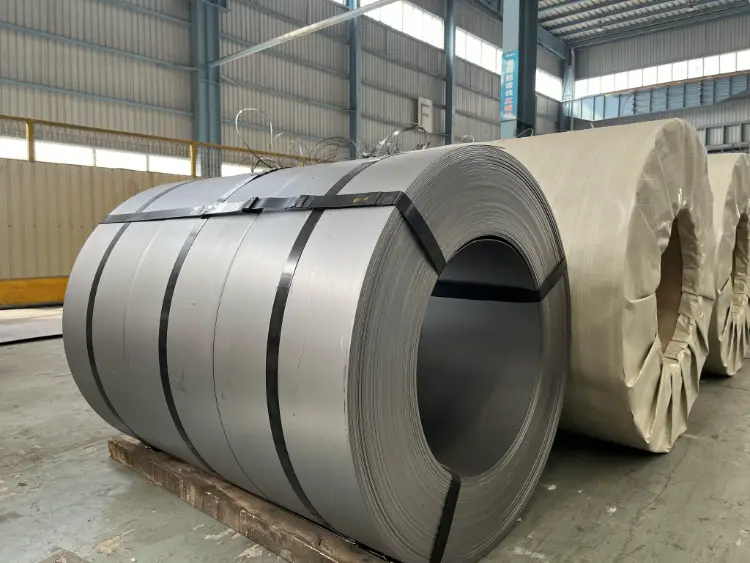
LR DH36 Shipbuilding Steel Coil
LR DH36 Shipbuilding Steel Coil: Properties, Equivalents & Applications
Comprehensive material data for LR DH36 shipbuilding steel coil per Lloyd's Register rules. Includes chemical composition, mechanical and physical properties, international equivalents, and application guidance.
Hot rolling, thermomechanical rolling (TMCP), normalizing, welding, cutting, bending, forming
- Phone : +8618037372205
- Email : [email protected]
- WhatsApp: Contact via Whtsapp
- WeChat: +8618037372205
LR DH36 Shipbuilding Steel Coil Introduction
LR DH36 is a high-strength structural steel grade certified by Lloyd's Register (LR) for shipbuilding and marine applications. It belongs to the DH36 category under IACS UR W11, characterized by a minimum yield strength of 355 MPa and excellent notch toughness at -20°C. This thermomechanically rolled or normalized steel offers a good balance of strength, weldability, and crack resistance, making it suitable for critical hull members, decks, and offshore structures. Its controlled chemical composition, typically with microalloying elements (Nb, V, Ti), ensures refined grain structure and reliable low-temperature performance. Available as plates, coils, and sections, it meets strict requirements for cold bending, lamellar tearing resistance, and fatigue durability in harsh marine environments.
LR DH36 Shipbuilding Steel Coil Chemical Composition
The chemical composition of LR DH36 steel is controlled to achieve a fine-grained microstructure and good low-temperature toughness. Requirements are based on Lloyd's Register rules and IACS UR W11. All values are maximum unless a range is given. Total microalloying additions of Nb, V, and Ti may be used singly or in combination to reach the required properties.
| Element | Standard Value (max or range) | Remarks |
|---|---|---|
| Carbon (C) | 0.18% | Ladle analysis |
| Manganese (Mn) | 0.90 – 1.60% | For thickness ≤ 30 mm, Mn min 0.90% |
| Silicon (Si) | 0.50% | Deoxidization element |
| Phosphorus (P) | 0.035% | Austenite grain refinement usually requires min 0.015% acid-soluble Al |
| Sulfur (S) | 0.035% | For improved weldability and toughness |
| Aluminum (Al, acid soluble) | ≥ 0.015% | When used for grain refining. If other grain refiners are present, Al may be lower with LR approval. |
| Niobium (Nb) | 0.02 – 0.05% | Optional microalloy; total Nb+V+Ti ≤ 0.12% typical |
| Vanadium (V) | 0.05 – 0.10% | Optional microalloy |
| Titanium (Ti) | 0.02% | Optional microalloy; if used, Ti content up to 0.02% |
| Copper (Cu) | 0.35% | Residual element |
| Chromium (Cr) | 0.20% | Residual element |
| Nickel (Ni) | 0.40% | Residual element; higher amounts by agreement |
| Molybdenum (Mo) | 0.08% | Residual element |
| Nitrogen (N) | 0.009% | If not fixed by Ti, etc.; max value not explicitly in LR but commonly controlled |
| Ceq (CEV max) | 0.38% (typical) | Carbon equivalent = C+Mn/6+(Cr+Mo+V)/5+(Ni+Cu)/15; for through-thickness properties, CEV may be limited |
LR DH36 Shipbuilding Steel Coil Thermal and Electrical Physical Properties
The following physical properties are representative of LR DH36 steel and are based on standard carbon-manganese steel behavior. These values are not part of the LR specification but are useful for design calculations. Properties may vary slightly with actual composition and temperature.
| Property | Typical Value | Unit | Condition / Temperature |
|---|---|---|---|
| Density (ρ) | 7.85 | g/cm³ | At 20°C |
| Elastic Modulus (E) | 205 | GPa | At 20°C |
| Shear Modulus (G) | 80 | GPa | At 20°C |
| Poisson's Ratio (ν) | 0.3 | – | At 20°C |
| Thermal Expansion Coefficient (α) | 11.7 | 10⁻⁶ /K | From 20°C to 100°C |
| Thermal Expansion Coefficient (α) | 12.5 | 10⁻⁶ /K | From 20°C to 300°C |
| Thermal Conductivity (λ) | 50 | W/(m·K) | At 20°C |
| Thermal Conductivity (λ) | 46 | W/(m·K) | At 200°C |
| Specific Heat Capacity (cp) | 460 | J/(kg·K) | At 20°C |
| Electrical Resistivity (ρe) | 0.20 | Ω·mm²/m | At 20°C |
LR DH36 Shipbuilding Steel Coil Mechanical Properties
Mechanical testing is performed on transverse specimens in accordance with LR and IACS standards. All values are minimum unless stated otherwise. The properties vary with product thickness; data below cover the most common thickness range (t ≤ 50 mm). For heavier sections, the minimum yield strength may be slightly reduced.
| Property | Standard Requirement | Unit | Test Condition / Thickness (t) |
|---|---|---|---|
| Yield Strength (ReH) | 355 | MPa | t ≤ 50 mm, transverse |
| Tensile Strength (Rm) | 490 – 620 | MPa | t ≤ 50 mm, transverse |
| Elongation (A5) | 21 | % | Gauge length L0=5.65√S0; t ≤ 50 mm |
| Bend Test (Bend Angle 180°) | d = 3a | – | t ≤ 25 mm; bend mandrel diameter = 3 × thickness (a) |
| Bend Test (Bend Angle 180°) | d = 4a | – | 25 < t ≤ 50 mm |
| Charpy V-notch Impact Energy (KV2) | 34 (min average of 3 tests) | J | Longitudinal, -20°C; individual min 24 J |
| Charpy V-notch Impact Energy (KV2) | 24 (min single value) | J | Longitudinal, -20°C |
| Through-thickness Reduction of Area (Z) | Average ≥ 25% (Z25) | % | Optional Z-quality (e.g., Z25, Z35) per LR by agreement |
LR DH36 Shipbuilding Steel Coil Direct Equivalent Standards and Substitutability by Classification Society
| Country / Classification Society | Standard | Grade / Designation | Remarks |
|---|---|---|---|
| Lloyd's Register (LR) | LR Rules Chapter 3 | DH36 | Base specification; direct acceptance by LR |
| American Bureau of Shipping (ABS) | ABS Rules Part 2 | ABS DH36 | Fully equivalent via IACS; grade AB/DH36 |
| DNV (Det Norske Veritas) | DNV-RU-SHIP Pt.2 Ch.2 | DNV DH36 | IACS harmonized grade; certified interchangeable |
| Bureau Veritas (BV) | BV Rules NR216 | BV DH36 | Equivalent in all respects; IACS grade |
| China Classification Society (CCS) | CCS Rules Part 3 | CCS DH36 | Same chemistry and mechanical requirements |
| Korean Register (KR) | KR Rules Pt.2 Ch.1 | KR DH36 | IACS grade; direct substitution allowed |
| Nippon Kaiji Kyokai (ClassNK) | NK Rules Part K | NK DH36 | Equivalent under IACS W11 |
| RINA (Registro Italiano Navale) | RINA Rules Pt. C, Ch.1 | RINA DH36 | Harmonized grade, identical properties |
| Russian Maritime Register (RS) | RS Rules Part XIII | RS DH36 | IACS grade; accepted as equivalent |
| European (offshore structural steel) | EN 10225 | S355G2+N | Similar strength and toughness; requires supplementary certification for marine equivalence |
LR DH36 Shipbuilding Steel Coil Application Introduction
LR DH36 is primarily used in the construction of seagoing vessels and offshore installations where high yield strength and reliable low-temperature toughness are required. It is suitable for applications involving dynamic loading, cold climates, and corrosive marine atmospheres. The material can be fabricated using conventional welding and cold forming processes, provided appropriate preheating and interpass temperatures are observed. It is routinely supplied with certified through-thickness properties (Z-quality) for welded joints subjected to high restraint.
Product Applications: Steel plates for hull envelopes and decks, Stiffened panel lines for compartments, Coiled strips for longitudinals and stiffeners, Cold‑formed hollow sections for secondary structures, Built‑up girders and columns for offshore platforms, Flame‑cut shapes for welded assemblies
Processed into products: Ship shell plating and bottom structures, Longitudinal stiffeners (flat bars, angles, bulb flats), Transverse frames and floors, Main deck and stringer plates, Bulkhead plating, Offshore module main girders and braces, Transition piece shells for wind towers, Crane pedestal columns and slew ring supports, Fatigue‑critical connection plates
Application industries: Commercial shipbuilding (bulk carriers, tankers, container ships, cruise vessels), Naval and defense ship structures, Offshore oil & gas (jack‑up rigs, jackets, topsides, FPSO modules), Renewable offshore structures (wind turbine foundations, transition pieces), Bridge construction (especially in seismic and marine environments), Harbor and port infrastructure (dolphins, fender panels, mooring systems)
LR DH36 Shipbuilding Steel Coil Similar or Alternative High-Strength Structural Steels
| Country / Region | Standard | Grade | Remarks |
|---|---|---|---|
| International (IACS) | UR W11 | AH36 | Identical strength (355 MPa), impact test at 0°C instead of -20°C |
| International (IACS) | UR W11 | EH36 | Identical strength, impact test at -40°C (better low-temperature toughness) |
| International (IACS) | UR W11 | FH36 | Identical strength, impact test at -60°C |
| European Union | EN 10025-3 | S355N/NL | Normalized structural steel with impact at -20°C (NL), CEV often higher than DH36 |
| China | GB/T 712 | DH36 | Direct Chinese standard equivalent for shipbuilding; same properties |
| Japan | JIS G 3106 | SM490A/B/C | Welding structural steel with min 325-365 MPa YS; SM490C provides 0°C impact, not direct DH36 |
| USA (structural) | ASTM A572 / A709 | Grade 50 / 50W | Minimum 345 MPa yield; not generally certified for marine classification without additional testing |
| USA (structural) | ASTM A131 | DH36 | Marine grade DH36, equivalent to LR DH36 under IACS |
Notes:
Welding: LR DH36 requires low‑hydrogen welding consumables and controlled heat input. Preheating (typically 100–150°C for thicknesses >30 mm) is recommended to avoid hydrogen‑induced cracking. Post‑weld heat treatment: Generally not required for normalized or TMCP conditions. Corrosion protection: Painting and cathodic protection systems compatible with marine service are strongly advised. Additional testing: Through‑thickness tensile (Z‑quality), ultrasonic testing (UT), and fracture toughness (CTOD) can be ordered to specific LR rules when required by project specifications.
- Share



