
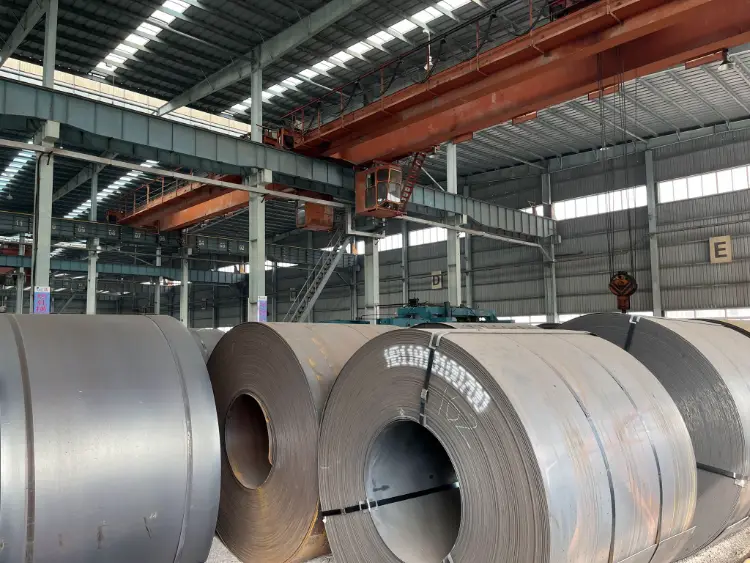
LR AH36 Shipbuilding Steel Coil
LR AH36 Shipbuilding Steel Coil: High-Strength Hull Structural Material for Marine Engineering
LR AH36 is a high-strength shipbuilding structural steel approved by Lloyd's Register, widely used in hull and offshore structures. It offers a minimum yield strength of 355 MPa and excellent weldability and toughness at 0°C.
Hot rolling, normalizing rolling, thermomechanical controlled processing (TMCP), normalizing, welding, cutting, forming, bending
- Phone : +8618037372205
- Email : [email protected]
- WhatsApp: Contact via Whtsapp
- WeChat: +8618037372205
LR AH36 Shipbuilding Steel Coil Introduction
LR Grade AH36 steel is a high-strength hull structural steel specified under the Lloyd's Register Rules for the Manufacture, Testing and Certification of Materials. It is classified as a higher-strength steel for shipbuilding, with a minimum yield strength of 355 MPa and tensile strength ranging from 490 to 620 MPa. This grade is designed for critical structural applications in ship hulls and offshore platforms where weight savings combined with high strength and good toughness are essential. LR AH36 exhibits excellent weldability and notch toughness at 0°C, meeting the requirements for ordinary-strength and higher-strength hull structural steels according to IACS UR W11. It is typically supplied in hot-rolled coil form, and can be processed using normalizing rolling, thermomechanical controlled processing (TMCP), or normalizing heat treatment. The material is widely adopted by shipyards worldwide due to its balanced combination of strength, ductility, and fabrication properties.
LR AH36 Shipbuilding Steel Coil Chemical Composition
The chemical composition of LR AH36 conforms to IACS UR W11 for high-strength hull structural steels. The steel is fully killed and made to fine-grained practice, typically with a minimum total aluminum content of 0.015% or adequate amounts of other grain-refining elements (Nb, V, Ti). Carbon equivalent (CEV) is strictly controlled to ensure weldability. All values below are maximum unless a range is shown.
| Chemical Element | Standard Value (max %) | Remarks |
|---|---|---|
| Carbon (C) | ≤ 0.18 | Ladle analysis; CEV = C + Mn/6 + (Cr+Mo+V)/5 + (Ni+Cu)/15 typically ≤ 0.38 for TMCP |
| Silicon (Si) | ≤ 0.50 | Killed steel; silicon content may be reduced for better surface quality |
| Manganese (Mn) | 0.90 - 1.60 | Higher Mn for strength and toughness balance |
| Phosphorus (P) | ≤ 0.035 | Control of residual elements for improved ductility and weldability |
| Sulfur (S) | ≤ 0.035 | Low sulfur for toughness; with calcium treatment or inclusion shape control |
| Aluminum (total, Al) | ≥ 0.015 | Minimum total aluminum required for fine grain practice |
| Niobium (Nb) | ≤ 0.05 | Optional grain-refining element; may be added alone or with V and Ti |
| Vanadium (V) | ≤ 0.10 | Optional microalloying for strength; combined Nb+V+Ti ≤ 0.12% |
| Titanium (Ti) | ≤ 0.02 | Optional for grain refinement and nitrogen fixation |
| Chromium (Cr) | ≤ 0.20 | Residual; higher values generally not permitted unless agreed |
| Nickel (Ni) | ≤ 0.40 | Residual; may be slightly higher for low-temperature grades but typical limit for AH36 |
| Molybdenum (Mo) | ≤ 0.08 | Residual; not normally added |
| Copper (Cu) | ≤ 0.35 | Residual; controlled to prevent hot shortness |
| Nitrogen (N) | ≤ 0.012 | Typically low; may be combined with nitrogen-binding elements |
LR AH36 Shipbuilding Steel Coil Thermal and Electrical Physical Properties
Physical properties are typical for carbon-manganese structural steels and are not part of the mandatory specification, but are essential for design calculations such as heat transfer, deformation, and electrical conductivity. Values may vary slightly with actual chemical composition and heat treatment condition.
| Property | Typical Value | Unit | Test Conditions |
|---|---|---|---|
| Density (ρ) | 7.85 | g/cm³ | At 20°C |
| Modulus of Elasticity (E) | 210 | GPa | In tension, room temperature |
| Shear Modulus (G) | 80 | GPa | Calculated from E and Poisson's ratio |
| Poisson's Ratio (ν) | 0.3 | — | In elastic range |
| Thermal Expansion Coefficient (α) | 11.2 - 11.8 | 10⁻⁶·K⁻¹ | 20 - 100°C; average linear expansion |
| Thermal Expansion Coefficient (α) | 12.3 - 13.1 | 10⁻⁶·K⁻¹ | 20 - 200°C |
| Thermal Expansion Coefficient (α) | 13.2 - 14.2 | 10⁻⁶·K⁻¹ | 20 - 400°C |
| Thermal Conductivity (λ) | 51.9 - 52.5 | W/(m·K) | At 20°C |
| Thermal Conductivity (λ) | 47 - 49 | W/(m·K) | At 200°C |
| Thermal Conductivity (λ) | 40 - 44 | W/(m·K) | At 400°C |
| Specific Heat Capacity (Cp) | 460 - 480 | J/(kg·K) | At 20°C |
| Specific Heat Capacity (Cp) | 490 - 520 | J/(kg·K) | At 200°C |
| Specific Heat Capacity (Cp) | 550 - 580 | J/(kg·K) | At 400°C |
| Electrical Resistivity (ρe) | 0.15 - 0.22 | μΩ·m | At 20°C; dependent on composition |
LR AH36 Shipbuilding Steel Coil Mechanical Properties
Mechanical properties are determined on test specimens taken from the finished product in the delivery condition. Values satisfy Lloyd's Register Rules and IACS UR W11 for thicknesses up to 100 mm. Impact test temperature for AH36 is 0°C. For thickness > 50 mm, slightly reduced elongation may apply.
| Property | Specified Value | Unit | Test Conditions |
|---|---|---|---|
| Yield Strength (ReH) | ≥ 355 | MPa | Transverse or longitudinal tensile test; thickness ≤ 100 mm |
| Tensile Strength (Rm) | 490 - 620 | MPa | At room temperature; thickness ≤ 100 mm |
| Elongation (A5) | ≥ 22 | % | Gauge length 5.65√S0; thickness ≤ 50 mm |
| Elongation (A5) | ≥ 21 | % | Thickness > 50 mm to 70 mm |
| Elongation (A5) | ≥ 20 | % | Thickness > 70 mm to 100 mm |
| Charpy V-notch Impact Energy (KV2) | ≥ 34 (average) | J | At 0°C; longitudinal specimen; thickness > 5 mm |
| Charpy V-notch Impact Energy (KV2) | ≥ 24 (single) | J | Minimum individual value at 0°C |
| Cold Bend Test | No cracks or laminations | — | Bend radius 3×thickness (180°) for t ≤ 50 mm; 4×t for 50 < t ≤ 100 mm |
| Hardness | Not specified (typical ≤ 200) | HB | Not normally required; hardness can be specified for special applications |
LR AH36 Shipbuilding Steel Coil Completely Equivalent Material Standards and Substitutable Grades
| Country/Region | Standard | Grade | Remarks |
|---|---|---|---|
| International (IACS) | IACS UR W11 | AH36 | Approved by all IACS members; identical to LR AH36 |
| USA | ASTM A131/A131M | AH36 | Structurally identical; may have slight variation in aluminum or deoxidation practice |
| China | GB 712 | AH36 | Chinese national standard for hull structural steel; CCS AH36 is identical |
| South Korea | KS D 4107 | AH36 | Korean standard, interchangeable with LR AH36 |
| Japan | JIS G 3106 | SM490A (roll) / KD36 | KD36 is the specific shipbuilding grade equivalent |
| European Union | EN 10025-4 | S355M/ML | Thermomechanical rolled; comparable strength but requires verification of toughness at 0°C and LR approval |
| Russia | GOST 5521 | A36 | Similar shipbuilding steel with comparable chemistry and properties |
| Other class societies | ABS/BV/DNV/GL/KR/NK/RINA/CCS Rules | AH36 | All these classification societies have identical AH36 as per IACS UR |
LR AH36 Shipbuilding Steel Coil Application Introduction
LR AH36 shipbuilding steel coil is specifically designed for load-bearing and structural components in marine vessels and offshore installations. Its combination of high strength, good low-temperature toughness (0°C), and excellent weldability makes it a preferred material for weight-critical designs. The hot-rolled coil form allows efficient cutting, blanking, and forming into a wide range of shapes. Typical usage includes:
Product Applications: Hull shell plates and stiffeners, Deck and bottom long structures, Bulkhead plates and corrugated panels, Girders, frames, and brackets, Hatch coamings and covers, Offshore module structural beams and columns, Pipe racks and walkways on offshore platforms
Processed into products: Flat bar stiffeners (produced from slit coil), Cold-formed sections (channels, angles, zees), Welded beams and grillages, Round or rectangular hollow sections (via roll forming or welding of strip), Sheared or stamped brackets and gussets, Fabricated sub-assemblies for block erection in shipyards, Piling and sheet piles for marine retaining walls
Application industries: Shipbuilding and ship repair, Offshore oil & gas platform construction, Marine engineering and port infrastructure, Wind turbine foundation structures (transition pieces, monopiles), Bridge and civil construction (when marine environment approval is required), Pressure vessels and storage tanks for low-temperature surroundings
LR AH36 Shipbuilding Steel Coil Similar or Alternative Materials for Consideration
| Country/Region | Standard | Grade | Remarks |
|---|---|---|---|
| IACS | IACS UR W11 | DH36 | Lower impact test temperature (-20°C) with otherwise identical strength and chemistry ranges; suitable for colder service conditions |
| IACS | IACS UR W11 | EH36 | Even lower impact test temperature (-40°C); used in arctic or low-temperature marine structures |
| IACS | IACS UR W11 | A36 | Normal-strength hull structural steel; yield ≥ 235 MPa, lower strength but good weldability; may be cost-effective where high strength not required |
| ASTM | ASTM A572/A572M | Grade 50 (345) | Structural carbon steel with 345 MPa yield; not shipbuilding-certified but similar in strength; requires supplementary testing for marine use |
| EN | EN 10025-4 | S355ML | Fine-grain structural steel with TMCP and low-temperature toughness; can be considered with LR acceptance |
| API | API 2W | Grade 50 | Steel for offshore structures with similar strength and toughness; may be approved as equivalent by some class societies |
Notes:
Weldability: LR AH36 is readily weldable by conventional arc welding methods (SMAW, GMAW, FCAW, SAW) with low-hydrogen practices. Preheating requirements depend on thickness and carbon equivalent, generally not needed for moderate thicknesses. Corrosion: As carbon steel, it requires protective coatings (painting, cathodic protection) in marine environments. Tolerances: Coil thickness and flatness tolerances follow applicable LR or recognized shipbuilding standards. Certification: Each shipment is accompanied by LR surveyor's test certificate confirming chemical analysis, tensile, bend, and impact test results as per the Rules.
- Share



