
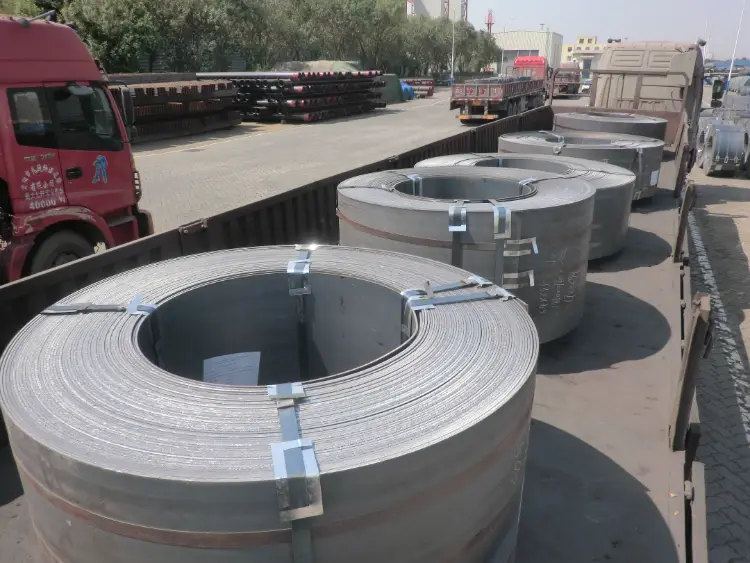
LR AH55 Shipbuilding Steel Coil
LR AH55 Shipbuilding Steel Coil - Extra High Strength Hull Structural Steel (IACS UR W11)
Comprehensive technical data for LR AH55 shipbuilding steel coil: chemical composition, mechanical properties, thermal-physical properties, and international equivalent grades. Certified by Lloyd's Register and compliant with IACS UR W11.
Hot rolling, thermo-mechanical controlled processing (TMCP), normalizing rolling (optional)
- Phone : +8618037372205
- Email : [email protected]
- WhatsApp: Contact via Whtsapp
- WeChat: +8618037372205
LR AH55 Shipbuilding Steel Coil Introduction
LR AH55 is an extra high-strength hull structural steel designed for ship and offshore structures, certified by Lloyd's Register (LR) and fully compliant with IACS UR W11. It offers a minimum yield strength of 550 MPa, excellent toughness even at 0 °C, and good weldability through thermo-mechanical controlled processing (TMCP).
- High strength-to-weight ratio for weight reduction in large vessels
- Superior cold cracking resistance thanks to controlled carbon equivalent (CEV)
- Suitable for heavy plate thicknesses up to 70 mm in demanding marine environments
The steel is typically supplied as hot-rolled coil, plate, or sheet, and finds application in hull girders, decks, and offshore platform components.
LR AH55 Shipbuilding Steel Coil Chemical Composition
The following chemical limits are based on IACS UR W11 for grade AH55 extra high-strength hull steel. All values are maximum (max) unless otherwise specified. A fine balance of microalloying elements (Nb, V, Ti) combined with controlled rolling ensures the required mechanical properties and carbon equivalent (CEV) ≤ 0.43 for weldability.
| Element | Value (wt. %) | Remark |
|---|---|---|
| Carbon (C) | ≤ 0.18 | Max. |
| Silicon (Si) | ≤ 0.50 | Max. |
| Manganese (Mn) | 0.90 – 1.60 | Range |
| Phosphorus (P) | ≤ 0.020 | Max. |
| Sulfur (S) | ≤ 0.020 | Max. |
| Aluminium (Al, total) | ≥ 0.015 | Min. acid soluble |
| Niobium (Nb) | ≤ 0.05 | Max. |
| Vanadium (V) | ≤ 0.10 | Max. |
| Titanium (Ti) | ≤ 0.02 | Max. |
| Copper (Cu) | ≤ 0.35 | Max. |
| Chromium (Cr) | ≤ 0.20 | Max. |
| Nickel (Ni) | ≤ 0.40 | Max. |
| Molybdenum (Mo) | ≤ 0.08 | Max. |
| Nitrogen (N) | ≤ 0.012 | Max. |
| CEV | ≤ 0.43 | Carbon equivalent (CE = C+Mn/6+(Cr+Mo+V)/5+(Ni+Cu)/15) |
LR AH55 Shipbuilding Steel Coil Thermal and Electrical Physical Properties
The following physical data are typical for HSLA steels of this strength class and are not specification requirements. They serve as engineering reference for structural design and thermal analysis. Values are at room temperature except where noted.
- Density: 7850 kg/m³
- Elastic modulus: 205 GPa
- Thermal conductivity: 45 W/(m·K)
| Property | Typical Value | Unit | Condition / Temperature |
|---|---|---|---|
| Density (ρ) | 7850 | kg/m³ | 20 °C |
| Elastic modulus (E) | 205 | GPa | 20 °C |
| Shear modulus (G) | 80 | GPa | 20 °C |
| Poisson's ratio (ν) | 0.30 | – | 20 °C |
| Thermal expansion coefficient (α) | 12.0 | 10⁻⁶ /K | 20 – 300 °C |
| Thermal conductivity (λ) | 45 | W/(m·K) | 20 °C |
| Specific heat capacity (c) | 460 | J/(kg·K) | 20 °C |
| Electrical resistivity (ρₑ) | 0.20 | µΩ·m | 20 °C |
LR AH55 Shipbuilding Steel Coil Mechanical Properties
Mechanical properties are tested on longitudinal specimens taken from the product at the specified thickness. AH55 demands excellent toughness at 0 °C (Charpy V‑notch). Values below are minimum for thicknesses ≤ 70 mm unless noted.
- Yield strength ReH ≥ 550 MPa
- Tensile strength Rm 670–830 MPa
- Elongation A5 ≥ 16 %
- Charpy impact energy ≥ 34 J at 0°C (longitudinal, average of 3 tests)
| Property | Required Value | Unit | Test Condition |
|---|---|---|---|
| Yield strength (ReH) | ≥ 550 | MPa | Room temperature, longitudinal, thickness ≤ 70 mm |
| Tensile strength (Rm) | 670 – 830 | MPa | Room temperature, longitudinal |
| Elongation (A5) | ≥ 16 | % | Gauge length 5.65√S₀, longitudinal, thickness ≤ 70 mm |
| Charpy impact energy (KV) | ≥ 34 (average) | J | +0 °C, longitudinal, thickness ≤ 70 mm; min. single value 24 J |
| Charpy impact energy (KV), transverse | ≥ 24 (average) | J | +0 °C, transverse; min. single value 17 J (if specified) |
LR AH55 Shipbuilding Steel Coil Complete Equivalent Material Standards and Replaceable Grades
| Country / Region | Standard | Grade | Remark |
|---|---|---|---|
| International (IACS) | IACS UR W11 | AH55 | Equivalent to LR AH55, adopted by all IACS members |
| China | GB 712-2011 | AH550 | Equivalent, same chemical and mechanical limits |
| Norway / Germany | DNV GL Rules (IACS UR W11) | AH55 | DNV GL certified shipbuilding steel |
| France | BV Rules (IACS UR W11) | AH55 | Bureau Veritas certified |
| USA | ABS Rules (IACS UR W11) | AH55 | American Bureau of Shipping certified |
| Italy | RINA Rules (IACS UR W11) | AH55 | Registro Italiano Navale certified |
LR AH55 Shipbuilding Steel Coil Application Introduction
LR AH55 steel, with its 550 MPa minimum yield strength, is engineered for the most demanding marine structures where high strength, excellent weldability, and good low‑temperature toughness are essential. Typical uses span shipbuilding and offshore engineering, and the material can be formed into a wide variety of finished components.
- Hull girder plates and stiffeners
- Deck and bottom shell panels for large container vessels
- Offshore platform decks and jacket braces
Product Applications: Hull plates and coil for container ships, bulk carriers, tankers, Upper deck and stringer plates of large vessels, Offshore platform deck plates and legs, Heavy‑lift crane booms for marine applications
Processed into products: Longitudinal stiffeners and frames, Transverse bulkhead strakes, Main deck and side shell panels, Bottom floors and girder webs, Connection plates in jacket structures
Application industries: Shipbuilding (commercial, naval), Offshore oil and gas, Marine renewable energy (wind substructures), Port and harbour construction
LR AH55 Shipbuilding Steel Coil Near/Similar Alternative Materials Recommendation
| Country / Region | Standard | Grade | Remark |
|---|---|---|---|
| International (IACS) | IACS UR W11 | AH51 | Lower yield strength (510 MPa) alternative; very similar weldability and toughness at 0 °C |
| International (IACS) | IACS UR W11 | AH47 | Lower strength (470 MPa) alternative; suitable where 550 MPa is not mandatory |
| Europe | EN 10225 (offshore) | S460 | Offshore structural steel with lower strength but widely used; not fully equivalent |
| Japan | JIS G 3106 | SM570 | High tensile steel for welded structures, not ship‑class certified, similar strength range |
Notes:
- All mechanical properties are valid for thicknesses up to 70 mm; for greater thicknesses special adjustment may be required per LR Rules.
- TMCP delivery is strongly recommended to achieve a fine‑grained microstructure and optimum toughness/strength balance.
- Welding must be carried out with low‑hydrogen procedures and appropriate preheat/interpass temperatures to avoid hydrogen‑induced cracking.
- Material should be certified with Lloyd's Register mark and full test reports including chemical, tensile, and Charpy impact results at 0 °C.
- Share



