
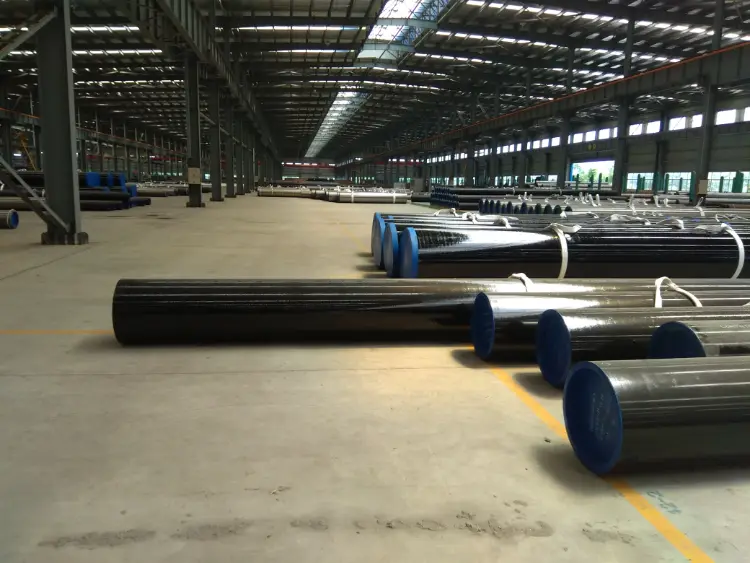
SUS321 Stainless Steel Pipe (JIS G4305)
SUS321 Stainless Steel Pipe (JIS G4305): Properties, Equivalents & Applications
Detailed technical data for SUS321 stainless steel pipe conforming to JIS G4305, including chemical composition, mechanical and thermal properties, complete equivalents, and application guidance.
Solution annealing, cold forming, bending, welding (TIG, MIG, resistance), machining
- Phone : +8618037372205
- Email : [email protected]
- WhatsApp: Contact via Whtsapp
- WeChat: +8618037372205
SUS321 Stainless Steel Pipe Introduction
SUS321 is a titanium-stabilized austenitic stainless steel defined in JIS G4305 (cold-rolled stainless steel plate, sheet and strip). The addition of titanium prevents intergranular corrosion by stabilizing carbides, making it superior to SUS304 in applications involving sustained exposure to temperatures in the chromium carbide precipitation range (425–850 °C).
As a pipe material, SUS321 offers excellent high-temperature strength, oxidation resistance up to about 900 °C, and good resistance to many chemicals. It is commonly supplied in the solution-annealed condition and can be easily formed, welded, and machined. The grade meets the requirements of various international standards, ensuring global interchangeability.
SUS321 Stainless Steel Pipe Chemical Composition per JIS G4305
The chemical composition of SUS321 is regulated by JIS G4305. Titanium content must be at least five times the carbon content to ensure effective stabilization against intergranular corrosion.
| Element | Content (wt%) | Remarks |
|---|---|---|
| Carbon, C | ≤ 0.08 | |
| Silicon, Si | ≤ 1.00 | |
| Manganese, Mn | ≤ 2.00 | |
| Phosphorus, P | ≤ 0.045 | |
| Sulfur, S | ≤ 0.030 | |
| Nickel, Ni | 9.00 – 13.00 | |
| Chromium, Cr | 17.00 – 19.00 | |
| Titanium, Ti | ≥ 5 × C % | Typical range 0.50 – 0.70 % |
| Iron, Fe | Balance |
SUS321 Stainless Steel Pipe Thermal & Electrical Physical Properties
The following physical properties represent typical data for SUS321 annealed stainless steel. Values may vary slightly depending on exact composition and processing.
| Property | Typical Value | Unit | Test Conditions / Temperature |
|---|---|---|---|
| Density (ρ) | 7.93 | g/cm³ | at 20 °C |
| Modulus of Elasticity (E) | 193 | GPa | at 20 °C |
| Shear Modulus (G) | 78 | GPa | at 20 °C |
| Poisson's Ratio (ν) | 0.30 | — | at 20 °C |
| Thermal Expansion Coefficient (α) | 16.6 | 10−6/K | 20 – 100 °C |
| Thermal Expansion Coefficient (α) | 17.2 | 10−6/K | 20 – 300 °C |
| Thermal Expansion Coefficient (α) | 18.0 | 10−6/K | 20 – 500 °C |
| Thermal Conductivity (λ) | 16.3 | W/(m·K) | at 100 °C |
| Thermal Conductivity (λ) | 21.5 | W/(m·K) | at 500 °C |
| Specific Heat Capacity | 500 | J/(kg·K) | 0 – 100 °C |
| Electrical Resistivity (ρe) | 0.72 | µΩ·m | at 20 °C |
SUS321 Stainless Steel Pipe Mechanical Properties
All values represent minimum requirements for SUS321 stainless steel pipe in the solution-annealed condition (1000–1100 °C, water quenched) as specified in JIS G3459. Testing is performed at room temperature on longitudinal specimens.
| Property | Required Value | Unit | Test Conditions |
|---|---|---|---|
| Tensile Strength (Rm) | ≥ 520 | MPa | Room temperature, longitudinal specimen |
| Yield Strength (ReH or Rp0.2) | ≥ 205 | MPa | Room temperature, 0.2 % offset |
| Elongation (A) | ≥ 35 | % | Gauge length 50 mm, OD ≥ 20 mm, wall thickness any (longitudinal) |
| Bend Test | Bend angle 180°, inside radius 4 × wall thickness — no cracks or flaws | — | Room temperature, full-section pipe bend or flattening test per agreement |
SUS321 Stainless Steel Pipe Exact Equivalent Standards and Grades for SUS321
| Country/Region | Standard | Grade | Remarks |
|---|---|---|---|
| USA | ASTM A312 / A240, ASME SA312 / SA240 | 321 (UNS S32100) | Fully interchangeable for chemical and mechanical requirements |
| European Union | EN 10028-7, EN 10216-5, EN 10217-7 | 1.4541 (X6CrNiTi18-10) | Same titanium-stabilized type; slight variation in element ranges |
| China | GB/T 14976, GB/T 24593 | 06Cr18Ni11Ti (S32168) | Equivalent austenitic stainless steel pipe grade |
| International | ISO 9328-5, ISO 1127 | X6CrNiTi18-10 (1.4541) | Harmonized grade under ISO standards |
| Korea | KS D 3576, KS D 3692 | STS321 | Identical chemistry to JIS SUS321 |
| Russia | GOST 5632, GOST 9941 | 08Х18Н10Т (08Ch18N10T) | Titanium-stabilized analogue |
SUS321 Stainless Steel Pipe Application Introduction
SUS321 pipes are widely utilized where both high temperature and corrosion resistance are required, particularly in environments where the material may be slowly heated or cooled through the sensitization range. Typical applications include:
Product Applications: Seamless and welded stainless steel pipes, Heat exchanger tubes (U-bend, straight), Boiler and superheater tubes, High-temperature ducting, Bellows and expansion joints
Processed into products: Tube bundles for shell-and-tube heat exchangers, Superheater coils, Aircraft exhaust stacks, Chemical reactor inner sleeves, Pipe fittings (elbows, tees, reducers, flanges), Instrumentation tubing, Automotive exhaust manifolds (flexible pipe sections)
Application industries: Oil and gas (downhole tubing, process piping), Petrochemical and chemical processing (heat exchangers, reactors), Power generation (boiler superheaters, reheaters), Aerospace (exhaust systems, thrust reverser components), Food and beverage processing (dairy, brewing equipment), Automotive (turbocharger piping, EGR coolers)
SUS321 Stainless Steel Pipe Similar or Alternative Materials for SUS321
| Country/Region | Standard | Grade | Remarks |
|---|---|---|---|
| Japan | JIS G4305 / G4304 | SUS347 | Niobium-stabilized; similar corrosion resistance, better in some welding conditions, but often more expensive. |
| Japan | JIS G4305 / G4304 | SUS304 | Non-stabilized 18-8 grade; lower cost, but susceptible to intergranular corrosion after welding or heating in the 425-850 °C range. |
| Japan | JIS G4305 / G4304 | SUS321H | Higher carbon variant (C 0.04–0.10 %) for improved high-temperature strength, used above 500 °C. |
| EU / USA | EN 1.4550 / AISI 347 | X6CrNiNb18-10 | Niobium-stabilized, equivalent to SUS347. Good alternative where titanium stabilization may be less effective (e.g., strongly oxidizing environments). |
| China | GB/T 14976 | 06Cr18Ni11Nb (S34778) | Niobium-stabilized, can replace SUS321 in many elevated-temperature services. |
Notes:
Heat treatment: Solution annealing at 1000–1100 °C followed by water quenching or rapid air cooling is essential to dissolve chromium carbides and fully restore corrosion resistance. Stabilizing anneal at 870–900 °C may be applied before service to precipitate titanium carbides.
Welding: SUS321 is readily weldable by all common methods. Filler metal ER321 (or ER347) is recommended. Post-weld heat treatment is generally not required if service temperature is below sensitization range, but a stabilizing anneal can be beneficial. Avoid prolonged heating in the 425–850 °C range without stabilization.
Intergranular corrosion resistance test: ASTM A262 Practice E or equivalent (JIS G0575) may be specified to verify resistance after sensitizing treatment.
- Share



