
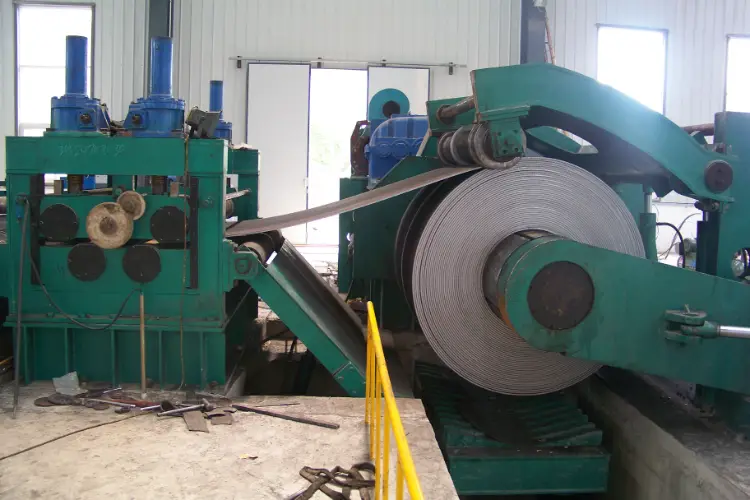
KR F70 Shipbuilding Steel Coil
KR F70 Shipbuilding Steel Coil - High Strength 690 MPa Marine Grade Steel
Comprehensive material data for KR F70 shipbuilding steel coil: chemical composition, mechanical properties, physical properties, international equivalents, and typical applications in ship and offshore structures.
Thermomechanical controlled rolling (TMCP), Normalizing, Quenching and Tempering (Q&T), Hot rolling
- Phone : +8618037372205
- Email : [email protected]
- WhatsApp: Contact via Whtsapp
- WeChat: +8618037372205
KR F70 Shipbuilding Steel Coil Introduction
KR F70 is a high-strength, weldable fine-grain structural steel produced under the Korean Register (KR) Rules for Steel Ships, Part 2, Chapter 1. With a minimum yield strength of 690 MPa in thicknesses up to 50 mm, this quenched and tempered (or TMCP) grade is designed for critical offshore and marine applications where high load-bearing capacity and excellent low-temperature toughness are essential. The 'F' designation indicates guaranteed impact properties at -60 °C. The steel is typically supplied in coil or plate form and is often processed by thermomechanical controlled rolling (TMCP) or quenching and tempering (Q&T) to achieve the required strength and toughness. Its low carbon equivalent ensures good weldability, while microalloying elements such as niobium, vanadium, and titanium refine the grain structure and enhance mechanical performance. KR F70 is widely used in the construction of jack-up rigs, heavy lift crane structures, and high-stress hull members, where weight savings and structural integrity are paramount.
KR F70 Shipbuilding Steel Coil Chemical Composition
The chemical composition of KR F70 is not strictly fixed by the standard but must ensure the specified mechanical properties and weldability. The following ranges are typical ladle analysis limits based on KR Rules for R690 grade and common mill practice. The carbon equivalent (CEV = C + Mn/6 + (Cr+Mo+V)/5 + (Ni+Cu)/15) is usually controlled to ≤0.55 for good weldability.
| Element | Typical Limit (max or range) | Remarks |
|---|---|---|
| Carbon (C) | ≤0.20 % | For strength and weldability |
| Silicon (Si) | ≤0.55 % | Deoxidation and strength |
| Manganese (Mn) | ≤1.70 % | Hardenability and strength |
| Phosphorus (P) | ≤0.025 % | Max for toughness |
| Sulfur (S) | ≤0.025 % | Max for ductility |
| Chromium (Cr) | ≤0.70 % | Hardenability |
| Nickel (Ni) | ≤1.50 % | Toughness at low temperature |
| Molybdenum (Mo) | ≤0.70 % | Hardenability and temper resistance |
| Copper (Cu) | ≤0.50 % | Weathering resistance (optional) |
| Niobium (Nb) | ≤0.06 % | Grain refinement |
| Vanadium (V) | ≤0.12 % | Precipitation strengthening |
| Titanium (Ti) | ≤0.05 % | Grain refinement and deoxidation |
| Aluminium (Al) total | ≥0.020 % | Grain refinement and deoxidation |
| Nitrogen (N) | ≤0.012 % | Max to avoid brittleness |
KR F70 Shipbuilding Steel Coil Thermal and Electrical Physical Properties
Physical properties are typical for Q&T high-strength low-alloy steels and are provided for general engineering calculations. Values may vary slightly depending on exact composition and heat treatment.
| Property | Typical Value | Unit | Test Condition / Remark |
|---|---|---|---|
| Density (ρ) | 7850 | kg/m³ | At 20 °C |
| Elastic modulus (E) | 205 | GPa | Tensile modulus, ambient |
| Shear modulus (G) | 80 | GPa | Calculated from E and ν |
| Poisson's ratio (ν) | 0.3 | Typical for steel | |
| Thermal expansion coefficient (α) | 12 x 10⁻⁶ | K⁻¹ | 20 – 100 °C range |
| Thermal conductivity (λ) | 45 | W/(m·K) | At 20 °C |
| Specific heat capacity (cp) | 500 | J/(kg·K) | At 20 °C |
| Electrical resistivity (ρe) | 0.25 | µΩ·m | At 20 °C |
KR F70 Shipbuilding Steel Coil Mechanical Properties
Mechanical properties are tested according to KR Rules on transverse specimens unless otherwise specified. Charpy V-notch tests are performed at -60 °C for F-grade. Minimum values are given for various thickness ranges. The steel must exhibit adequate ductility and toughness to meet strict ship classification requirements.
| Property | Standard Requirement | Unit | Test Condition / Thickness Range |
|---|---|---|---|
| Yield strength (ReH) | ≥690 | MPa | t ≤ 50 mm |
| Yield strength (ReH) | ≥670 | MPa | 50 < t ≤ 100 mm |
| Tensile strength (Rm) | 770 – 940 | MPa | t ≤ 50 mm |
| Tensile strength (Rm) | 740 – 900 | MPa | 50 < t ≤ 100 mm |
| Elongation after fracture (A5) | ≥14 | % | Gauge length 5.65√So, t ≤ 50 mm |
| Elongation after fracture (A5) | ≥14 | % | Gauge length 5.65√So, 50 < t ≤ 100 mm |
| Charpy impact energy (KV, -60 °C) | ≥27 (longitudinal) / ≥20 (transverse) | J | t ≤ 50 mm, full-size specimen |
| Charpy impact energy (KV, -60 °C) | ≥27 (longitudinal) / ≥20 (transverse) | J | 50 < t ≤ 100 mm |
| Bend test (180°) | d = 3a | t ≤ 50 mm, no cracks | |
| Bend test (180°) | d = 4a | 50 < t ≤ 100 mm, no cracks |
KR F70 Shipbuilding Steel Coil Exact Equivalent Material Standards and Replaceable Grades
| Country/Region | Standard | Grade | Remarks |
|---|---|---|---|
| International | ISO 19902 | F690 | Fixed offshore structures, equivalent strength and toughness (-60 °C) |
| Europe | EN 10225 | S690QL1 | Weldable structural steels for offshore structures, Q&T |
| USA | ASTM A514 / A517 | Grade Q | High strength quenched and tempered alloy steel plate, similar yield |
| USA | API 2W | Grade 70 | Steel plates for offshore structures, TMCP, 690 MPa yield |
| Norway / Germany | DNV Rules | F690 | DNV offshore standard, identical property requirements |
| UK | LR Rules | F690 | Lloyd's Register, identical designation |
| France | BV Rules | F690 | Bureau Veritas, identical designation |
| Italy | RINA Rules | F690 | Italian classification society, identical designation |
| China | CCS Rules | F690 | China Classification Society, equivalent |
| Japan | NK Rules | F690 | Nippon Kaiji Kyokai, equivalent |
KR F70 Shipbuilding Steel Coil Application Introduction
KR F70 steel is engineered for extreme structural demands in marine and offshore environments. Its combination of ultra-high strength, excellent low-temperature toughness, and good weldability makes it ideal for weight-critical, dynamically loaded structures. Typical application areas include:
Product Applications: Jack-up rig legs, chords, and spudcans, Heavy-lift crane booms and lattice structures, Deck structures and high-load bearing bulkheads, Ship longitudinal stiffeners and frames for ice-class vessels, Pressure hull components for submersibles, Piles and transition pieces for offshore wind monopiles
Processed into products: Welded I-beams and box girders for high-strength applications, Rack-and-pinion components of self-elevating platforms, Bracket and node connections in tubular trusses, Crane pedestals and slewing rings, Hatch coaming and side shell plating in ships under heavy sea loads, Reinforced plates around moonpools and other structural openings
Application industries: Shipbuilding (naval and commercial vessels, high-stress hull members), Offshore oil & gas (jack-up rigs, semi-submersible platforms, fixed platforms), Marine heavy lifting and crane construction, Renewable energy (offshore wind turbine foundations, transition pieces), Heavy civil engineering (bridges, high-rise buildings)
KR F70 Shipbuilding Steel Coil Similar / Near-Substitute Material Recommendations
| Country/Region | Standard | Grade | Remarks |
|---|---|---|---|
| Europe | EN 10025-6 | S690Q | Hot-rolled high strength structural steel, Q&T; similar strength but not certified for marine -60 °C impact; may need special agreement |
| USA | ASTM A709 | Grade HPS 100W | High performance structural steel; yield 690 MPa, but toughness class may differ |
| International | API 2Y | Grade 60 | Offshore structures, yield 415 MPa, lower strength alternative if stress allows |
| South Korea | KS D 3611 | HSA690 | High strength steel for welded structures; similar strength, different toughness guarantee |
| Japan | JIS G 3128 | SHY685 | High yield strength steel plates for welded structures; 685 MPa yield, close alternative |
Notes:
Welding: Preheating (typically 100–150 °C) and post-weld heat treatment may be required depending on thickness and welding process. Low-hydrogen welding consumables are mandatory to avoid cold cracking.
NDT: Ultrasonic testing (UT) per class requirements is often specified for thickness ≥40 mm.
Certification: Material must be produced at a KR-approved mill and delivered with inspection certificate 3.1 (EN 10204) or equivalent, confirming compliance with KR Rules.
Surface condition: Plates and coils are shot-blasted and primed (shop primer) unless otherwise agreed.
- Share



