
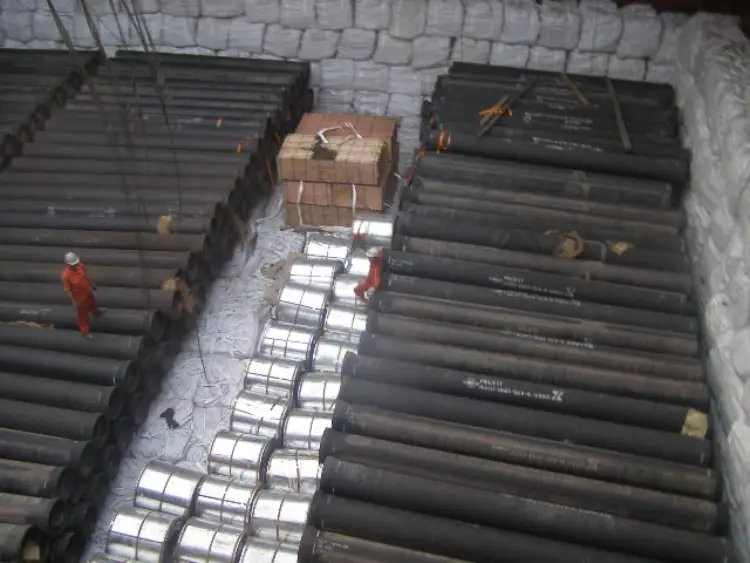
KR E63 Shipbuilding Steel Coil
KR E63 Shipbuilding Steel Coil - High Strength Marine Grade for Extreme Environments
Discover KR E63 shipbuilding steel coil: a quenched and tempered high-tensile steel with minimum yield strength 620 MPa, excellent low-temperature toughness at -40°C, and full compliance with Korean Register rules for critical marine and offshore constructions.
Hot rolling + quenching and tempering (Q&T); suitable for cutting, cold forming (limited), and fusion welding (low-hydrogen processes recommended)
- Phone : +8618037372205
- Email : [email protected]
- WhatsApp: Contact via Whtsapp
- WeChat: +8618037372205
KR E63 Shipbuilding Steel Coil Introduction
KR E63 is a high-strength hull structural steel grade certified by the Korean Register (KR), designated for use in shipbuilding and offshore engineering where stringent requirements for strength and low-temperature toughness are essential. This grade, equivalent to EH63, belongs to the quenched and tempered (Q&T) family of steels, offering a minimum yield strength of 620 MPa and tensile strength between 720 and 890 MPa, depending on thickness. Its superior notch toughness at -40°C (27 J minimum) ensures reliable performance in cold climates and ice-going vessels.
The steel is microalloyed with niobium, vanadium, and titanium to achieve fine grain structure and high strength without compromising weldability. Controlled carbon equivalent values (typically Ceq ≤ 0.50) facilitate safe fabrication. KR E63 steel coils are typically supplied in a quenched and tempered condition and are suitable for critical structural components such as hull frames, deck plates, and offshore platform members. They are produced in accordance with KR Rules Pt. 2, Ch. 2, ensuring uniformity and traceability.
KR E63 Shipbuilding Steel Coil Chemical Composition
The chemical composition of KR E63 steel is tailored to achieve high strength and excellent low-temperature toughness while maintaining good weldability. The following values represent typical heat analysis limits according to KR rules and common mill practices. Individual elements are controlled to ensure a fine-grained microstructure and adequate hardenability for the quenched and tempered condition.
| Element | Requirement / Typical Value (max unless range given) | Remarks |
|---|---|---|
| C (Carbon) | ≤ 0.20 | Lower carbon improves weldability |
| Si (Silicon) | ≤ 0.55 | Deoxidizer and strength contributor |
| Mn (Manganese) | 0.90 – 1.70 | Promotes hardenability and toughness |
| P (Phosphorus) | ≤ 0.025 | Controlled to avoid embrittlement |
| S (Sulfur) | ≤ 0.020 | Controlled for cleanliness and toughness |
| Cu (Copper) | ≤ 0.35 | Optional, may enhance corrosion resistance |
| Cr (Chromium) | ≤ 0.80 | Improves strength and hardenability |
| Ni (Nickel) | ≤ 0.80 | Enhances low-temperature toughness |
| Mo (Molybdenum) | ≤ 0.30 | Prevents temper embrittlement |
| Nb (Niobium) | ≤ 0.05 | Grain refinement and precipitation strengthening |
| V (Vanadium) | ≤ 0.10 | Precipitation strengthening |
| Ti (Titanium) | ≤ 0.05 | Grain refinement and nitrogen fixation |
| Al (Aluminum) | 0.015 – 0.050 (total) | Deoxidation and grain size control |
| N (Nitrogen) | ≤ 0.020 | Controlled to ensure toughness |
| Ceq (Carbon Equivalent) | ≤ 0.50 (typical) | Based on IIW formula, critical for weldability |
KR E63 Shipbuilding Steel Coil Physical Properties
Physical properties of KR E63 steel are similar to those of high-strength low-alloy steels. Data below are typical for the quenched and tempered condition at room temperature unless otherwise noted. These values aid design calculations for thermal expansion, heat transfer, and electromagnetic compatibility.
| Property | Typical Value | Unit | Test Condition / Temperature |
|---|---|---|---|
| Density (ρ) | 7.85 | g/cm³ | 20°C |
| Elastic Modulus (E) | 210 | GPa | 20°C; tensile |
| Shear Modulus (G) | 81 | GPa | 20°C |
| Poisson's Ratio (ν) | 0.3 | - | Elastic region |
| Thermal Expansion Coefficient (α) | 11.5 | 10⁻⁶/K | 20–100°C |
| Thermal Expansion Coefficient (α) | 12.0 | 10⁻⁶/K | 20–200°C |
| Thermal Conductivity (λ) | 42 | W/(m·K) | 20°C |
| Specific Heat Capacity | 460 | J/(kg·K) | 20°C |
| Electrical Resistivity (ρ_e) | 0.25 | μΩ·m | 20°C |
KR E63 Shipbuilding Steel Coil Mechanical Properties
Mechanical properties of KR E63 steel are validated through tensile and impact testing in accordance with KR Pt. 2, Ch. 2 requirements. Values depend on product thickness; the table provides the most common ranges for coil products (≤ 25 mm). Impact testing is performed on longitudinal Charpy V-notch specimens at -40°C.
| Property | Required / Typical Value | Unit | Test Condition / Remarks |
|---|---|---|---|
| Yield Strength (ReH) | ≥ 620 | MPa | Thickness ≤ 100 mm; transverse or longitudinal specimens |
| Tensile Strength (Rm) | 720 – 890 | MPa | Applies to all thicknesses |
| Elongation (A5) | ≥ 15 | % | Gauge length 5.65√S0, thickness ≤ 50 mm |
| Yield-to-Tensile Ratio | ≤ 0.90 (typical) | - | Indicative of ductility |
| Charpy Impact Energy (KV2) | ≥ 27 (longitudinal) | J | -40°C, average of three specimens |
| Charpy Impact Energy (KV2) | ≥ 19 (single min) | J | -40°C, individual specimen |
| Bend Test (180°) | D = 3a (transverse) | – | Mandrel diameter; no cracks permitted |
KR E63 Shipbuilding Steel Coil Full Equivalent Material Standards and Replaceable Grades
| Country / Region | Standard / Classification Society | Grade | Remarks |
|---|---|---|---|
| International | American Bureau of Shipping (ABS) | ABS EH63 | Chemically and mechanically identical; ABS certified equivalent |
| International | DNV (Det Norske Veritas) | DNV EH63 (VL E63) | DNV high-strength structural steel for ships |
| International | Lloyd's Register (LR) | LR EH63 | LR certified grade for ship and offshore structures |
| International | Bureau Veritas (BV) | BV EH63 | BV rules for hull structural steel |
| International | China Classification Society (CCS) | CCS EH63 | CCS equivalent high-strength grade |
| International | Nippon Kaiji Kyokai (NK) | NK EH63 | ClassNK certified high-tensile steel |
| International | Registro Italiano Navale (RINA) | RINA EH63 | RINA approved platform and hull steel |
| International | ISO 4995:2020 | S620Q (approximate) | Similar yield class; supplementary requirements may apply |
KR E63 Shipbuilding Steel Coil Application Introduction
Thanks to its outstanding combination of high strength, excellent low-temperature toughness, and good weldability, KR E63 steel is the material of choice for demanding maritime and structural applications. Its delivery in coil form enables continuous processing for automated manufacturing lines. Typical uses include:
Product Applications: Hull plates and frames for container ships, bulk carriers, and ice-class vessels, Deck and bottom longitudinals, Bulkhead plates and web frames, Offshore platform legs and bracings, Crane jibs and booms, Piles and structural tubes for marine foundations
Processed into products: Stiffeners and brackets, Transverse floors and girders, Bilge keels and rudder horns, Pad eyes and lifting lugs, Flanges for large bore piping, Cut-to-length parts for welded assemblies, Modular building blocks for offshore topsides
Application industries: Shipbuilding (commercial and naval vessels), Offshore engineering (jack-up rigs, semisubmersibles, FPSO modules), Heavy machinery and lifting equipment, Bridge and infrastructure construction, Pressure vessels and storage tanks (cryogenic service)
KR E63 Shipbuilding Steel Coil Similar / Alternative Materials
| Country / Region | Standard / Specification | Grade | Remarks |
|---|---|---|---|
| USA | ASTM A514 / A517 | Grade E / Grade F | Quenched and tempered structural steel; yield 690 MPa, high toughness; not identical in chemistry but comparable in strength and application. |
| Europe | EN 10025-6 | S690Q / S690QL | 690 MPa yield, Q&T fine-grain steel; wide use in structural engineering; S690QL offers improved toughness. |
| Japan | JIS G 3128 / JIS G 3108 | SHY685 / SHY685N | High yield strength steel for welded structures; 685 MPa class; good notch toughness. |
| China | GB/T 16270 | Q690D / Q690E | High strength structural steel plates; quenched and tempered; Q690E delivers -40°C impact energy ≥ 34 J. |
| Russia | GOST 19281 | 14ChGN2M or similar 590/690 class | Custom high-strength grades; not direct equivalents but can be substituted with design review. |
Notes:
Welding: Low-hydrogen processes (SMAW with low-hydrogen electrodes, GMAW, SAW) are strongly recommended. Preheat and interpass temperature should be controlled based on carbon equivalent and thickness (typically 100–200°C). Post-weld heat treatment is not usually required for thicknesses under 30 mm.
Forming: Cold forming is possible with generous radii; hot forming, if used, must be followed by a new quenching and tempering cycle to restore mechanical properties.
Corrosion protection: Exposure to seawater requires standard protective coatings; the steel has no inherent corrosion resistance beyond that of typical carbon-manganese steels.
Certification: All products must be accompanied by a Korean Register inspection certificate ( material certificate 3.1 or 3.2) indicating compliance with KR rules.
- Share



