
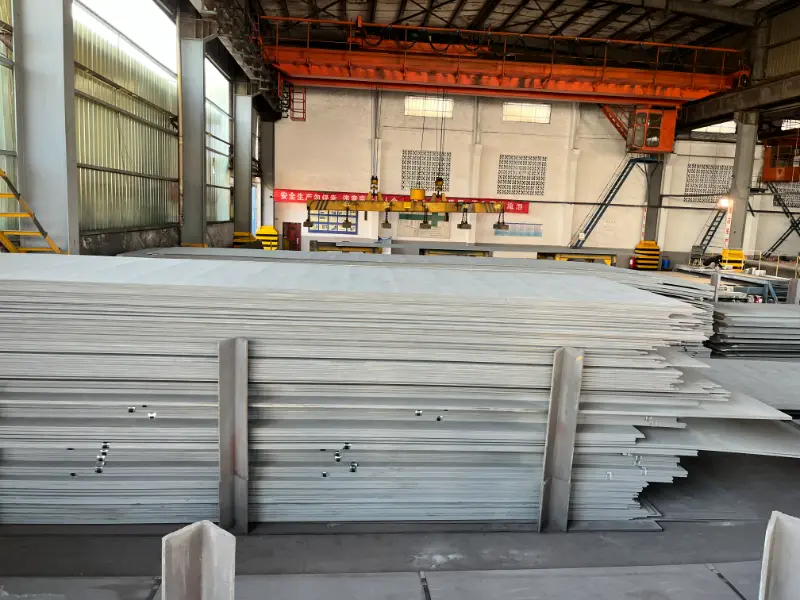
JIS G4304/G4305 SUS305 Stainless Steel
SUS305 Stainless Steel: JIS G4304/G4305 Austenitic Plate & Coil
Comprehensive data on SUS305 austenitic stainless steel plate/coil per JIS G4304/G4305: chemical composition, mechanical and physical properties, international equivalents, and application guidelines.
Hot rolling, cold rolling, deep drawing, stamping, bending, welding (low heat input recommended), spinning, cold heading
- Phone : +8618037372205
- Email : [email protected]
- WhatsApp: Contact via Whtsapp
- WeChat: +8618037372205
JIS G4304/G4305 SUS305 Stainless Steel Introduction
SUS305 is an austenitic stainless steel specified in JIS G4304 (hot-rolled stainless steel plates, sheets, and strip) and JIS G4305 (cold-rolled stainless steel plates, sheets, and strip). It features a high nickel content (10.50-13.00%) and low carbon (≤0.12%), providing excellent deep drawability, low work-hardening rate, and non-magnetic properties in the annealed condition. Compared with SUS304, SUS305 offers superior formability due to its higher nickel and lower work-hardening tendency, making it ideal for severe forming operations such as deep drawing, spinning, and cold heading. The alloy has good corrosion resistance in mildly aggressive environments and is widely used in kitchenware, electronic components, and decorative applications. Its stable austenitic structure renders it virtually non-magnetic even after cold working.
JIS G4304/G4305 SUS305 Stainless Steel Chemical Composition
The chemical composition of SUS305 as per JIS G4304/G4305 specifies the following limits for major elements. The steel is an iron-based alloy with controlled levels of carbon, silicon, manganese, phosphorus, sulfur, nickel, and chromium. The high nickel content stabilizes the austenitic structure and reduces work hardening, while chromium provides corrosion resistance.
| Element | Standard Value | Remarks |
|---|---|---|
| Carbon (C) | ≤0.12 | Maximum |
| Silicon (Si) | ≤1.00 | Maximum |
| Manganese (Mn) | ≤2.00 | Maximum |
| Phosphorus (P) | ≤0.045 | Maximum |
| Sulfur (S) | ≤0.030 | Maximum |
| Nickel (Ni) | 10.50 - 13.00 | Range |
| Chromium (Cr) | 17.00 - 19.00 | Range |
| Iron (Fe) | Balance | Remainder |
JIS G4304/G4305 SUS305 Stainless Steel Thermal and Electrical Physical Properties
Physical properties of SUS305 are representative for the fully austenitic structure in the annealed condition. Thermal expansion, thermal conductivity, and electrical resistivity are critical for applications involving temperature variations or non-magnetic requirements. Values are based on published data for similar 18Cr-12Ni stainless steels.
| Property | Typical Value | Unit | Test Condition |
|---|---|---|---|
| Density (ρ) | 7.9 | g/cm³ | At 20°C |
| Elastic Modulus (E) | 193 | GPa | At 20°C |
| Shear Modulus (G) | 74 | GPa | At 20°C (calculated) |
| Poisson's Ratio (ν) | 0.28 | - | At 20°C |
| Thermal Expansion (α) | 17.3 | 10⁻⁶/K | 20-100°C |
| Thermal Expansion (α) | 17.8 | 10⁻⁶/K | 20-200°C |
| Thermal Expansion (α) | 18.4 | 10⁻⁶/K | 20-300°C |
| Thermal Expansion (α) | 18.9 | 10⁻⁶/K | 20-400°C |
| Thermal Conductivity (λ) | 16.2 | W/(m·K) | At 100°C |
| Thermal Conductivity (λ) | 21.5 | W/(m·K) | At 500°C |
| Specific Heat Capacity (c) | 500 | J/(kg·K) | At 20°C |
| Electrical Resistivity (ρe) | 0.73 | µΩ·m | At 20°C |
JIS G4304/G4305 SUS305 Stainless Steel Mechanical Properties
Mechanical properties for SUS305 plate, sheet, and strip in the solution-annealed condition are specified in JIS G4304 and G4305. Values may vary slightly depending on product thickness and test direction. Hardness limits are given to ensure sufficient ductility for forming. These properties are measured at room temperature.
| Property | Required Value | Unit | Test Condition |
|---|---|---|---|
| Tensile Strength (Rm) | ≥480 | MPa | Room temperature, longitudinal/transverse |
| Yield Strength (ReH, 0.2% offset) | ≥175 | MPa | Room temperature, longitudinal/transverse |
| Elongation (A) | ≥40 | % | Gauge length: 50 mm (standard specimen) |
| Hardness | ≤187 | HBW | Solution annealed condition |
| Hardness | ≤90 | HRB | Solution annealed condition (alternative) |
JIS G4304/G4305 SUS305 Stainless Steel Fully Equivalent Material Standards and Substitute Grades
| Country/Region | Standard | Grade | Remarks |
|---|---|---|---|
| Japan | JIS G4304 / G4305 | SUS305 | Original specification |
| USA | ASTM A240 / A666 | UNS S30500 (Type 305) | Equivalent composition and properties |
| EU | EN 10088-2 / EN 10088-3 | X4CrNi18-12 (1.4303) | Equivalent; EN 1.4303 is direct match |
| China | GB/T 3280 / GB/T 20878 | 10Cr18Ni12 | Closest Chinese equivalent |
| International | ISO 15510 | X4CrNi18-12 | ISO equivalent |
JIS G4304/G4305 SUS305 Stainless Steel Application Introduction
SUS305 is primarily used where severe forming and non-magnetic properties are required. Its excellent ductility and low work-hardening rate make it the preferred choice for deep-drawn parts that cannot be formed from standard 304. Typical applications span consumer goods, electronics, and architectural components.
Product Applications: Sinks and countertops, Deep-drawn pots, pans, and mixing bowls, Food service trays and containers, Non-magnetic electronic chassis and frames, Springs for electrical switches, Architectural curtain wall panels
Processed into products: Drawn shells for sensors and connectors, Clips and springs in electronic devices, Cold-headed bolts and screws, Kitchen sink basins, Vacuum flask inner bodies, Diaphragms and bellows
Application industries: Food processing equipment, Kitchenware and household appliances, Electronics and telecommunication (non-magnetic housings), Automotive (small springs, fasteners), Architecture and decoration (trim, panels), Chemical and pharmaceutical (mild corrosive environments)
JIS G4304/G4305 SUS305 Stainless Steel Similar / Nearby Substitute Materials
| Country/Region | Standard | Grade | Remarks |
|---|---|---|---|
| Japan | JIS G4304/G4305 | SUS304 | Lower Ni (8-10.5%), higher work hardening, more magnetic after cold work |
| USA | ASTM A240 | UNS S30400 (304) | Widely used, less formability than 305 |
| EU | EN 10088-2 | X5CrNi18-10 (1.4301) | Similar to 304, more work hardening |
| Japan | JIS G4304/G4305 | SUSXM7 (301Cu) | Added Cu for improved deep drawability, comparable |
| EU | EN 10088-2 | X3CrNiCu18-9-4 (1.4567) | High Cu version for deep drawing |
Notes:
- SUS305 exhibits excellent non-magnetic behavior even after cold working, typically with relative permeability below 1.02.
- Welding is possible with standard austenitic electrodes (e.g., AWS E308L), but low heat input is advised to minimize carbide precipitation and distortion.
- The alloy is not hardenable by heat treatment; it is strengthened only by cold working.
- Corrosion resistance is similar to 304 in many environments, but may be slightly lower in chloride stress-corrosion cracking due to higher nickel; nevertheless, it performs well in mildly acidic and alkaline media.
- Share



