
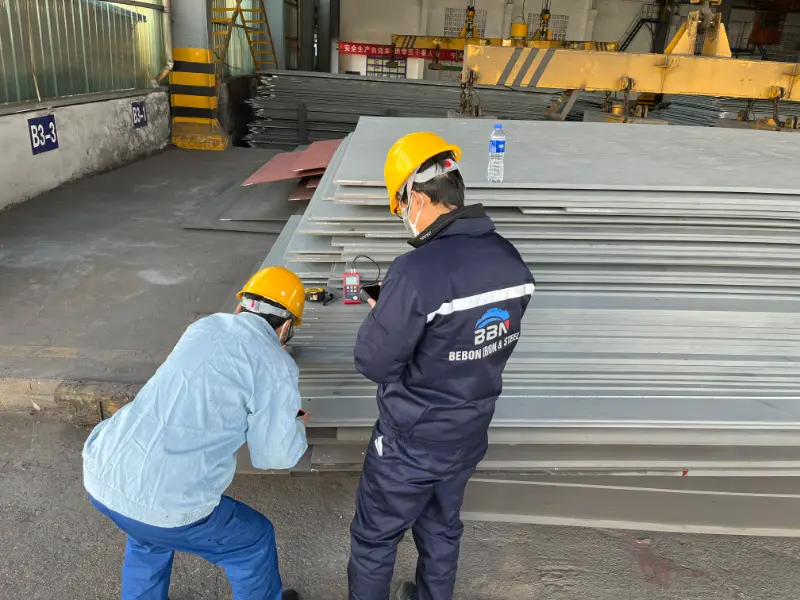
JIS G4304/G4305 SUS304L Austenitic Stainless Steel
JIS G4304/G4305 SUS304L Austenitic Stainless Steel: Low Carbon Excellence for Corrosion-Resistant Fabrications
Comprehensive technical data for SUS304L stainless steel plate and coil according to JIS G4304 and G4305, including chemical composition, mechanical and physical properties, international equivalents, and application guidance.
Hot rolling, cold rolling, solution annealing, pickling, skin-pass rolling, bright annealing
- Phone : +8618037372205
- Email : [email protected]
- WhatsApp: Contact via Whtsapp
- WeChat: +8618037372205
JIS G4304/G4305 SUS304L Austenitic Stainless Steel Introduction
SUS304L, specified in JIS G4304 (hot-rolled) and JIS G4305 (cold-rolled), is an ultra-low carbon austenitic stainless steel with excellent corrosion resistance and weldability. Its carbon content is limited to a maximum of 0.030%, which effectively suppresses chromium carbide precipitation during welding and prevents intergranular corrosion in the as-welded condition. The steel offers good formability, toughness at cryogenic temperatures, and oxidation resistance up to about 870°C in intermittent service. It is widely used in the food, chemical, and architectural industries. Typical delivery conditions include solution-annealed and pickled finishes such as No.1, 2B, and BA. Key features:
- Outstanding resistance to intergranular corrosion after welding
- Excellent deep-drawing and stretch-forming characteristics
- High toughness even at sub-zero temperatures
- Good resistance to a wide range of organic and inorganic chemicals
JIS G4304/G4305 SUS304L Austenitic Stainless Steel Chemical Composition
Heat analysis according to JIS G4304/G4305. All values are in weight percent (mass fraction). The low carbon content (<0.030%) ensures resistance to sensitization during welding. Nickel and chromium ranges are balanced to provide stable austenitic structure and corrosion resistance.
- Carbon (C): controlled at ≤0.030% to minimize carbide precipitation
- Chromium (Cr): 18-20% provides basic corrosion resistance
- Nickel (Ni): 9-13% stabilizes the austenite phase and improves ductility
| Element | Standard Value (wt%) | Remarks |
|---|---|---|
| Carbon (C) | ≤0.030 | Maximum |
| Silicon (Si) | ≤1.00 | Maximum |
| Manganese (Mn) | ≤2.00 | Maximum |
| Phosphorus (P) | ≤0.045 | Maximum |
| Sulfur (S) | ≤0.030 | Maximum |
| Nickel (Ni) | 9.00 - 13.00 | |
| Chromium (Cr) | 18.00 - 20.00 |
JIS G4304/G4305 SUS304L Austenitic Stainless Steel Thermal and Electrical Physical Properties
Typical physical properties for SUS304L at 20°C unless otherwise stated. These values are representative for fully austenitic annealed material and are provided for engineering design guidance. Variations may occur depending on exact composition and heat treatment.
- Density: similar to standard 304, allowing weight estimation in structural designs
- Thermal expansion: moderate; higher than ferritic steels, requiring allowance in high-temperature applications
- Thermal conductivity: lower than carbon steel, influencing heat transfer calculations
| Property | Typical Value | Unit | Test Condition |
|---|---|---|---|
| Density (ρ) | 7.93 | g/cm³ | 20°C |
| Modulus of elasticity (E) | 193 | GPa | 20°C, tension |
| Shear modulus (G) | 77 | GPa | Ambient temperature |
| Poisson ratio (ν) | 0.30 | - | Ambient temperature |
| Thermal expansion coefficient (α) | 17.3 | 10⁻⁶/K | 20 to 100°C |
| Thermal expansion coefficient (α) | 18.7 | 10⁻⁶/K | 20 to 500°C |
| Thermal conductivity (λ) | 16.3 | W/(m·K) | 100°C |
| Thermal conductivity (λ) | 21.5 | W/(m·K) | 500°C |
| Specific heat capacity (cp) | 0.50 | J/(g·K) | 0 to 100°C |
| Electrical resistivity (ρ_e) | 0.72 | µΩ·m | 20°C |
JIS G4304/G4305 SUS304L Austenitic Stainless Steel Mechanical Properties
Mechanical properties specified in JIS G4304 for hot-rolled plates and coils, also applicable to cold-rolled products under JIS G4305 when stated in the standard. Tests are performed at ambient temperature on material in the solution-annealed condition. Elongation requirements depend on plate thickness.
- Yield strength (0.2% proof): minimum 175 MPa
- Tensile strength: minimum 480 MPa
- Elongation: high ductility confirms excellent formability
- Hardness: low hardness values indicate good workability
| Property | Required Value | Unit | Test Condition |
|---|---|---|---|
| Yield strength (0.2% offset) | ≥175 | MPa | Solution annealed, ambient temperature |
| Tensile strength (Rm) | ≥480 | MPa | Solution annealed, ambient temperature |
| Elongation (A) | ≥40 | % | Thickness ≤ 5 mm |
| Elongation (A) | ≥40 | % | 5 mm < thickness ≤ 8 mm |
| Elongation (A) | ≥40 | % | 8 mm < thickness ≤ 20 mm |
| Elongation (A) | ≥38 | % | 20 mm < thickness ≤ 100 mm |
| Hardness (HBW) | ≤187 | - | As delivered, typical |
| Hardness (HRB) | ≤90 | - | As delivered, typical |
| Hardness (HV) | ≤200 | - | As delivered, typical |
JIS G4304/G4305 SUS304L Austenitic Stainless Steel Complete Equivalent Material Standards and Replaceable Grades
| Country/Region | Standard | Grade | Remarks |
|---|---|---|---|
| Japan | JIS G4304/G4305 | SUS304L | Base standard |
| USA | ASTM A240/A240M | 304L (UNS S30403) | Identical composition and properties |
| EU | EN 10088-2 | 1.4307 (X2CrNi18-9) | Identical; also in EN 10088-3 for bars |
| China | GB/T 3280 | 022Cr19Ni10 | Identical; old designation 00Cr19Ni10 |
| International | ISO 15510 | X2CrNi19-11 | Harmonized composition |
| Russia | GOST 5632 | 03Kh18N11 | Close match; check Ni range |
JIS G4304/G4305 SUS304L Austenitic Stainless Steel Application Introduction
SUS304L's combination of low carbon content, high corrosion resistance, and excellent formability makes it suitable for a wide range of fabricated products. It is especially favoured where welding is required and post-weld annealing is not feasible. Typical application areas include:
Product Applications: Storage tanks and silos, Heat exchangers and condenser tubes, Kitchen sinks and countertops, Brewery, dairy, and wine-making equipment, Steam tables and food service equipment, Architectural handrails and decorative panels, Automotive exhaust manifolds and mufflers
Processed into products: Dished ends and flanges for pressure vessels, Stamped and deep-drawn sink bowls, Welded pipe and tube for fluid transport, Precision folded architectural cassettes, Machined pump and valve bodies, Ducting and ventilation components, Cryogenic pipe spools and vessel linings
Application industries: Food and beverage processing, Chemical and petrochemical plants, Architectural and construction (cladding, roofing), Pharmaceutical and medical equipment, Automotive (exhaust systems, trims), Cryogenic and pressure vessel manufacturing, Household appliances and kitchenware
JIS G4304/G4305 SUS304L Austenitic Stainless Steel Similar / Nearby Substitute Material Recommendations
| Country/Region | Standard | Grade | Remarks |
|---|---|---|---|
| Japan | JIS G4304/G4305 | SUS304 | Higher carbon (≤0.08%), may suffer intergranular corrosion after welding; use only if low carbon not required |
| USA/European | ASTM A240 / EN 10088-2 | 304 (1.4301) | Standard 18-8; higher strength but risk of sensitization; 304L preferred for welded applications |
| USA/European | ASTM A240 / EN 10088-2 | 316L (1.4404) | Addition of Mo improves pitting resistance; comparable formability, higher cost; suitable for more aggressive environments |
| China | GB/T 3280 | 06Cr19Ni10 (304) | Direct counterpart to SUS304; evaluate weld corrosion requirements before substitution |
Notes:
- For welded applications, SUS304L can be used in the as-welded condition without subsequent heat treatment due to its resistance to intergranular corrosion.
- Magnetic permeability of fully austenitic SUS304L is typically below 1.02 in the annealed condition, but may increase slightly after cold working.
- Recommended filler metal for welding: AWS A5.9 E308L/ER308L or equivalent.
- Pickling after hot rolling removes scale and restores corrosion resistance; passivation may be applied for enhanced surface protection.
- Physical properties are typical values; actual values may vary by ±5% depending on processing and test direction.
- Share



