
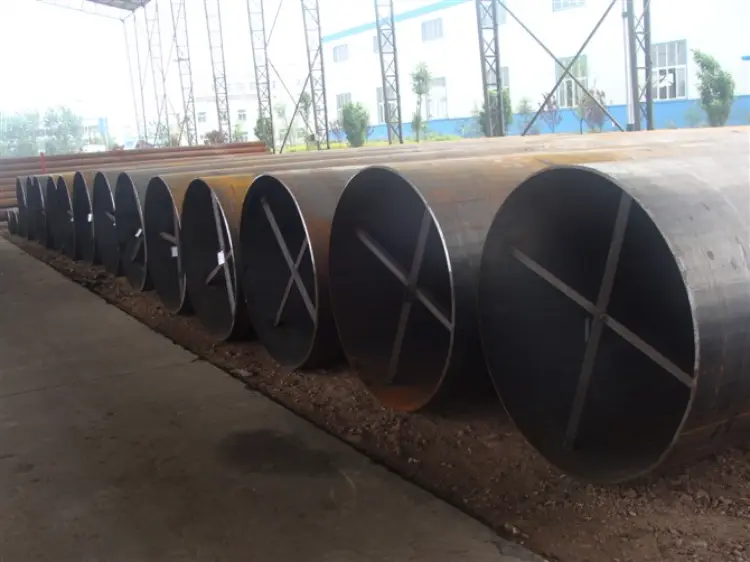
JIS G3459 SUS 310 TP Stainless Steel Pipe
JIS G3459 SUS 310 TP Stainless Steel Pipe: High-Temperature Austenitic Alloy
Comprehensive material data for SUS 310 TP pipe according to JIS G3459, including chemical composition, mechanical and physical properties, equivalents, and applications.
Welding (TIG, MIG, SMAW), bending, flaring, flattening, machining, heat treatment (solution annealing at 1030–1150°C + water quenching), cold working (limited)
- Phone : +8618037372205
- Email : [email protected]
- WhatsApp: Contact via Whtsapp
- WeChat: +8618037372205
JIS G3459 SUS 310 TP Stainless Steel Pipe Introduction
SUS 310 TP is a fully austenitic stainless steel pipe grade standardized under JIS G3459 (Stainless steel pipes for general service). It features a high chromium (24–26%) and nickel (19–22%) content, providing outstanding oxidation resistance up to 1100°C and good high-temperature strength. The low carbon content (≤0.08%) minimizes sensitization. Typical delivery condition is solution annealed and pickled (or bright annealed). It is widely used in furnace components, heat exchangers, and chemical processing equipment where high-temperature oxidation and moderate corrosion resistance are required. The material is non-magnetic in the annealed state, has excellent weldability, and can be formed by bending, flaring, and flattening operations. Its high alloy content also ensures resistance to carburization and nitridation in certain environments.
JIS G3459 SUS 310 TP Stainless Steel Pipe Chemical Composition
Chemical composition as per JIS G3459 and JIS G4304 (SUS 310). High chromium and nickel levels ensure exceptional oxidation resistance and stabilise the austenitic structure.
- Low carbon reduces risk of intergranular corrosion after welding.
- Silicon and manganese are controlled to maintain hot workability and deoxidation.
- Phosphorus and sulfur are kept low to preserve ductility and weldability.
| Element | Standard Value (%) | Remarks |
|---|---|---|
| Carbon (C) | ≤ 0.08 | |
| Silicon (Si) | ≤ 1.50 | |
| Manganese (Mn) | ≤ 2.00 | |
| Phosphorus (P) | ≤ 0.045 | |
| Sulfur (S) | ≤ 0.030 | |
| Nickel (Ni) | 19.00 – 22.00 | |
| Chromium (Cr) | 24.00 – 26.00 |
JIS G3459 SUS 310 TP Stainless Steel Pipe Thermal and Electrical Physical Properties
Reference physical properties for fully austenitic SUS 310 in the solution-annealed condition.
- Thermal expansion is relatively high but thermal conductivity is moderate.
- Non-magnetic even after cold work.
- High electrical resistivity is typical for Fe-Cr-Ni alloys.
| Property | Typical Value | Unit | Test Condition |
|---|---|---|---|
| Density (ρ) | 7.98 | g/cm³ | Room temperature |
| Elastic Modulus (E) | 200 | GPa | Room temperature |
| Shear Modulus (G) | 77 | GPa | Room temperature |
| Poisson's Ratio (ν) | 0.30 | — | Room temperature |
| Thermal Expansion (α, 20–100°C) | 15.9 | 10⁻⁶/K | Mean coefficient |
| Thermal Expansion (α, 20–600°C) | 17.5 | 10⁻⁶/K | Mean coefficient |
| Thermal Expansion (α, 20–1000°C) | 18.5 | 10⁻⁶/K | Mean coefficient |
| Thermal Conductivity (λ) | 14.2 | W/(m·K) | at 100°C |
| Thermal Conductivity (λ) | 18.7 | W/(m·K) | at 500°C |
| Specific Heat (c) | 500 | J/(kg·K) | at 20°C |
| Electrical Resistivity (ρ_e) | 0.78 | µΩ·m | at 20°C |
JIS G3459 SUS 310 TP Stainless Steel Pipe Mechanical Properties
Mechanical properties for solution-annealed pipes according to JIS G3459 (room temperature). Tensile testing uses longitudinal test pieces.
- Elongation values depend on test piece type and wall thickness.
- Bend test requires 180° bending without cracks around a mandrel of 4× wall thickness for pipes with wall ≤ 8 mm; flattening test may apply for larger sizes.
- No hardness limits are specified for the pipe product standard.
| Property | Minimum Value | Unit | Test Condition |
|---|---|---|---|
| Yield Strength (0.2% offset, ReH) | ≥ 205 | MPa | Room temperature, longitudinal specimen |
| Tensile Strength (Rm) | ≥ 520 | MPa | Room temperature, longitudinal specimen |
| Elongation (A) | ≥ 35 | % | Test piece No.11 or No.12, wall thickness ≤ 8 mm |
| Elongation (A) | ≥ 30 | % | Test piece No.5, wall thickness 8–20 mm |
| Bend Test (180°) | No cracks | — | Mandrel diameter = 4 × wall thickness, wall ≤ 8 mm |
JIS G3459 SUS 310 TP Stainless Steel Pipe Completely Equivalent Material Standards and Replaceable Grades
| Country/Region | Standard | Grade | Remarks |
|---|---|---|---|
| USA | ASTM A312 | TP310 | Seamless and welded austenitic stainless steel pipe for high-temperature service |
| USA | ASME SA312 | TP310 | Identical to ASTM A312; accepted for pressure vessel applications |
| Europe | EN 10217-7 | 1.4845 (X8CrNi25-21) | Welded tube grade; composition closely matches SUS 310, but has Si ≤ 1.0% |
| International | ISO 2604-2 | TS10 | Equivalent to SUS 310 TP for pressure purposes |
JIS G3459 SUS 310 TP Stainless Steel Pipe Application Introduction
SUS 310 TP pipes excel in high-temperature environments up to approximately 1100°C under oxidizing atmospheres, with good resistance to carburization and thermal cycling. They are commonly specified for the following sectors and end uses.
Product Applications: Heat exchanger tubes, Furnace radiant tubes, Boiler and superheater tubes, Thermal oxidizer piping, Kiln and furnace conveyor rolls
Processed into products: Burner nozzles and flame retention rings, Retorts and muffles, Combustion chamber components, Thermocouple protection tubes, Annealing boxes and trays
Application industries: Petrochemical refineries, Power generation (boilers, superheaters, waste heat recovery), Industrial furnace and kiln construction, Heat treatment equipment (annealing, hardening furnaces), Chemical processing plants (high-temperature reactors, reformers)
JIS G3459 SUS 310 TP Stainless Steel Pipe Similar and Substitution Material Recommendations
| Country/Region | Standard | Grade | Remarks |
|---|---|---|---|
| Japan | JIS G3459 | SUS 309S TP | Lower Cr (22–24%) and Ni (12–15%); suitable for less demanding high-temperature applications |
| USA | ASTM A312 | TP310S | Low carbon (≤ 0.04%) variant; offers better resistance to intergranular corrosion after welding |
| China | GB/T 14976 | S31008 (06Cr25Ni20) | Equivalent composition, similar high-temperature performance |
| Europe | EN 10095 | 1.4841 (X15CrNiSi25-21) | Higher silicon (1.5–2.5%) grade; enhanced oxidation resistance but slightly different fabrication characteristics |
Notes:
- Heat treatment: Solution anneal at 1030–1150°C followed by rapid water quenching or rapid air cooling for thin sections. Avoid slow cooling through 850–550°C to prevent sigma phase precipitation.
- Welding: Excellent weldability with ER310 filler (e.g., AWS A5.9 ER310) for matching high-temperature properties. Preheating is not required; clean the surface before welding. Post-weld heat treatment is not necessary for service up to 800°C but may be beneficial to relieve stresses when service temperature exceeds 550°C in reducing atmospheres.
- Service limits: Not recommended for prolonged use in sulfidizing atmospheres above 550°C, or in molten salts and strong reducing environments. In cyclic high-temperature service, the oxide scale is adherent and protective under clean, dry conditions.
- Certification: Material is typically supplied with 3.1 inspection certificate according to EN 10204 when requested.
- Share



