
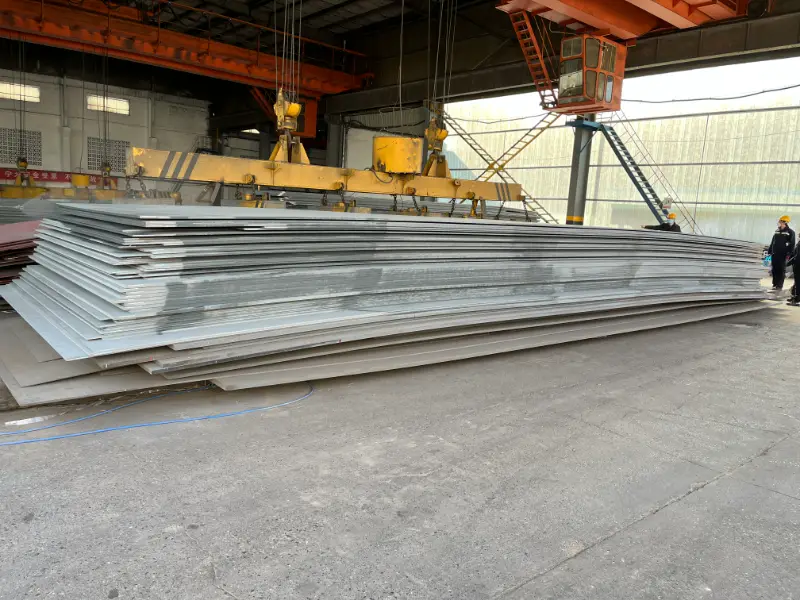
JIS G3106 SM520C Steel for Welded Structures
JIS G3106 SM520C Steel for Welded Structures: LSAW Pipe Material Properties & Equivalents
Detailed analysis of JIS G3106 SM520C steel, covering chemical composition, mechanical and physical properties, international equivalents, and its application in LSAW pipe manufacturing.
Hot rolling, welding, cutting, bending, machining
- Phone : +8618037372205
- Email : [email protected]
- WhatsApp: Contact via Whtsapp
- WeChat: +8618037372205
JIS G3106 SM520C Steel for Welded Structures Introduction
JIS G3106 SM520C is a high-strength rolled steel for welded structures, offering minimum tensile strength of 520 MPa and guaranteed impact toughness at 0 °C. It is widely used in heavy structural applications such as bridges, ships, offshore platforms, and particularly for longitudinal submerged arc welded (LSAW) pipes in oil and gas transmission. The steel exhibits good weldability, formability, and notch toughness, making it a reliable choice for demanding welded fabrications. Key characteristics include controlled carbon content for weldability, optional microalloying for strength enhancement, and strict limits on phosphorus and sulfur to ensure cleanliness and toughness.
JIS G3106 SM520C Steel for Welded Structures Chemical Composition
The chemical composition limits of SM520C according to JIS G3106 are given below. These elements are controlled to ensure appropriate strength, weldability, and toughness. Note: Microalloying elements such as Nb, V, or Ti may be added to achieve strength and grain refinement, but are not mandatory within the standard. Carbon equivalent (CEV) is often specified for LSAW pipe applications to ensure weldability, typically CEV ≤ 0.43% for thickness ≤ 50 mm.
| Element | Standard Value (mass %) | Remarks |
|---|---|---|
| Carbon (C) | ≤ 0.20 | Maximum limit for all thicknesses |
| Silicon (Si) | ≤ 0.55 | Typical range 0.15 – 0.55 |
| Manganese (Mn) | ≤ 1.65 | For thickness > 40 mm, Mn may be 1.65 max, otherwise typically 1.60 max |
| Phosphorus (P) | ≤ 0.035 | |
| Sulfur (S) | ≤ 0.035 |
JIS G3106 SM520C Steel for Welded Structures Thermal and Electrical Physical Properties
The physical properties are typical for carbon-manganese structural steels and can be used for design calculations. Values may vary slightly depending on actual composition and heat treatment condition. No specific limits are set by JIS G3106 for these properties.
| Property | Standard Requirement Value | Unit | Test Condition |
|---|---|---|---|
| Density (ρ) | 7.85 | g/cm³ | Room temperature |
| Elastic Modulus (E) | 205 | GPa | Room temperature |
| Shear Modulus (G) | 80 | GPa | Room temperature |
| Poisson's Ratio (ν) | 0.3 | – | Room temperature |
| Thermal Expansion Coefficient (α) | 12 × 10<sup>-6</sup> | /K | 20 – 100 °C |
| Thermal Conductivity (λ) | 50 | W/(m·K) | 20 °C |
| Specific Heat Capacity | 0.47 | J/(g·K) | Room temperature |
| Electrical Resistivity (ρ_e) | 0.15 | μΩ·m | 20 °C |
JIS G3106 SM520C Steel for Welded Structures Mechanical Properties
Mechanical properties are determined on test pieces taken from plates or sections. Yield strength and tensile strength vary with thickness. Charpy impact test is mandatory for SM520C at 0 °C for thicknesses > 12 mm. The values shown below are minimum requirements as per JIS G3106. For LSAW pipe application, additional requirements such as through-thickness properties or lower carbon equivalent may apply.
| Property | Standard Requirement | Unit | Test Condition / Thickness Range |
|---|---|---|---|
| Yield Strength (ReH) | ≥ 365 | MPa | t ≤ 16 mm |
| Yield Strength (ReH) | ≥ 355 | MPa | 16 mm < t ≤ 40 mm |
| Yield Strength (ReH) | ≥ 335 | MPa | 40 mm < t ≤ 75 mm |
| Yield Strength (ReH) | ≥ 325 | MPa | 75 mm < t ≤ 100 mm |
| Tensile Strength (Rm) | 520 – 640 | MPa | All thicknesses |
| Elongation (A) | ≥ 19 | % | Gauge length 200 mm, t ≤ 16 mm (No.1A specimen) |
| Elongation (A) | ≥ 21 | % | Gauge length 200 mm, 16 mm < t ≤ 40 mm (No.1A specimen) |
| Elongation (A) | ≥ 19 | % | Gauge length 200 mm, 40 mm < t ≤ 75 mm |
| Charpy Impact (KV₂, 0 °C) | ≥ 27 (mean) | J | t > 12 mm; individual min ≥ 19 J |
JIS G3106 SM520C Steel for Welded Structures Complete Equivalent Material Standards and Replaceable Grades
| Country/Region | Standard | Grade | Remarks |
|---|---|---|---|
| Japan | JIS G3106 | SM520C | Original standard grade, 0 °C impact |
| China | GB/T 1591 | Q355C | 0 °C impact, tensile 470–630 MPa, pay attention to CEV for LSAW |
| Europe | EN 10025-2 | S355J0 | 0 °C impact, tensile 470–630 MPa; SM520C has slightly higher tensile |
| USA | ASTM A572 / A572M | Grade 55 (Type 1) | YS 380 MPa min, TS 485 min; may need supplementary 'C' requirement for 0 °C impact |
| USA (Bridge) | ASTM A709 / A709M | Grade 50S | Zone 2 impact 0 °C possible; check tensile range |
JIS G3106 SM520C Steel for Welded Structures Application Introduction
SM520C steel is specially suited for heavy welded structures where good low-temperature toughness is needed. It finds extensive use in the production of LSAW pipes for oil and gas transmission lines, as well as in structural components for bridges and offshore platforms. The steel can be processed by conventional hot or cold forming, flame cutting, and welding with preheat when necessary. For LSAW pipe manufacturing, plates undergo edge preparation, forming, submerged arc welding (inside and outside), and mechanical expansion. Post-weld heat treatment is typically not required for thicknesses up to 50 mm.
Product Applications: LSAW pipes (longitudinal submerged arc welded pipes) for oil, gas, and water pipelines, Welded H-beams and box columns for high-rise buildings, Bridge girders and structural plates, Offshore jacket legs and braces, Penstocks and spiral casings for hydropower plants, Storage tanks and silos
Processed into products: Pipe mill formed LSAW pipe body (plate rolling, tack welding, ID/OD SAW), Pipe end bevels and connectors, Flanges and reinforcement rings, Cut-to-length structural plates, Welded beam-to-column connections, Stiffeners and gusset plates
Application industries: Oil & gas pipeline transportation, Bridge engineering, Shipbuilding and marine structures, Offshore platform construction, Building and civil engineering, Pressure vessel and tank fabrication, Wind turbine tower manufacturing
JIS G3106 SM520C Steel for Welded Structures Similar / Alternative Material Recommendations
| Country/Region | Standard | Grade | Remarks |
|---|---|---|---|
| Japan | JIS G3106 | SM520B | Lower toughness than SM520C; impact test at +20 °C only |
| Japan | JIS G3106 | SM490C | Lower strength, YS 325–365 MPa, similar impact requirement |
| Europe | EN 10025-3 | S355N/NL | Normalized, improved toughness; S355NL has −50 °C impact |
| China | GB/T 1591 | Q355D | Lower design temperature (−20 °C), otherwise similar mechanical properties |
| International | ISO 630-2 | S355C | Comparable to S355J0, 0 °C impact |
Notes:
Special Considerations for LSAW Pipe: When SM520C plates are used for LSAW pipe, the mill test certificate should include carbon equivalent (CEV ≤ 0.43% for t ≤ 50 mm typical), and often supplementary hydrogen-induced cracking (HIC) and sulfide stress cracking (SSC) tests are requested for sour service. Minimum impact energy at 0 °C is standard, but for thicker pipes (> 30 mm), Z-direction through-thickness tensile properties (Z35) may be specified. Weld procedure qualification must ensure matching strength and toughness. Preheating (100 – 150 °C) is recommended when ambient temperature is below 5 °C or for thick sections.
- Share



