
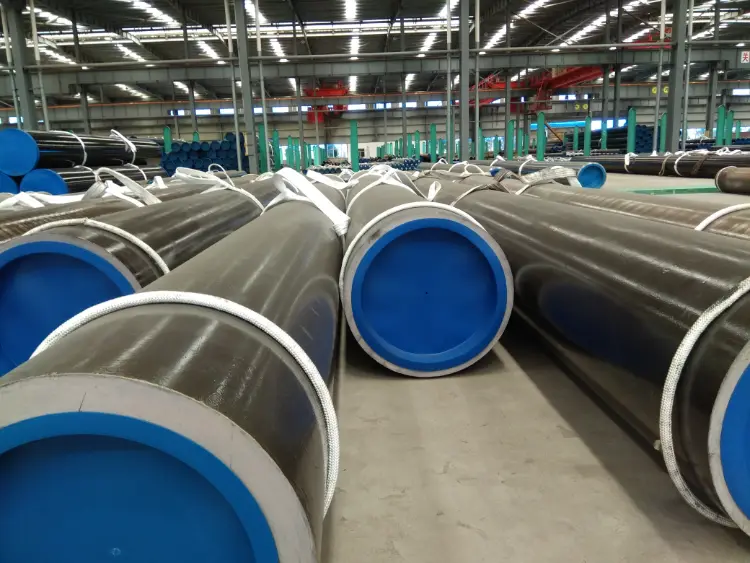
ASTM A671 CA55 LSAW Pipe
ASTM A671 CA55 LSAW Pipe: Low-Temp Carbon Steel Welded Pipe for Pressure Vessels
Detailed analysis of ASTM A671 Grade CA55 electric-fusion-welded steel pipe made from A516 Grade 55 plates. Covers chemical composition, mechanical and physical properties, equivalent grades, and industrial applications.
Welding (LSAW, SAW), hot forming, cold forming, machining, heat treatment (normalizing, stress relieving)
- Phone : +8618037372205
- Email : [email protected]
- WhatsApp: Contact via Whtsapp
- WeChat: +8618037372205
ASTM A671 CA55 LSAW Pipe Introduction
ASTM A671 CA55 is a specification for electric-fusion-welded (LSAW) steel pipe manufactured from pressure vessel quality plates conforming to ASTM A516/A516M Grade 55. This carbon-silicon steel is intended primarily for moderate- and lower-temperature service in pressure-containing applications. CA55 grade offers a minimum tensile strength of 55 ksi (380 MPa) and a minimum yield strength of 30 ksi (205 MPa), with good notch toughness when supplementary impact testing is specified. The longitudinal submerged arc welding (LSAW) process ensures uniform wall thickness and high joint efficiency. Typical delivery condition is as-rolled or normalized. This material is widely used in the construction of pressure vessels, boilers, storage tanks, and industrial piping systems requiring reliable performance down to -46°C (-50°F).
ASTM A671 CA55 LSAW Pipe Chemical Composition
Chemical requirements of the base steel plate ASTM A516 Grade 55, as referenced in ASTM A671 CA55. Values vary with plate thickness. Typical composition shown for thickness up to 12.5 mm (1/2 in.). For thicker plates, carbon and manganese limits are adjusted as per ASTM A516 standard.
- Silicon is required for deoxidation; range 0.15–0.40%.
- Phosphorus and sulfur are kept low for improved notch toughness.
- The steel may contain small amounts of residual elements (Cu, Ni, Cr, Mo) typical of carbon steel, but no intentional additions are made.
| Element | Specification (max, unless range) | Remarks |
|---|---|---|
| C | 0.18 max | For thickness ≤12.5 mm; higher limits for thicker sections |
| Mn | 0.60 – 0.90 | For thickness ≤12.5 mm; range expands to 0.60–1.20 for thicker sections |
| P | 0.035 max | |
| S | 0.035 max | |
| Si | 0.15 – 0.40 | Silicon-killed fine grain practice |
| Fe | Balance |
ASTM A671 CA55 LSAW Pipe Physical Thermal and Electrical Properties
The following data represent typical room-temperature properties and temperature-dependent values for carbon steel conforming to A516 Grade 55. These are compiled from ASME BPVC Section II Part D (Tables TE-1, TE-2, and TM-1) and are acceptable for engineering calculations.
- Density, moduli, and Poisson's ratio are nearly constant across the service range.
- Thermal expansion, conductivity, and specific heat are given for representative temperatures; linear interpolation is acceptable.
- Electrical resistivity is provided for room temperature.
| Property | Typical Value | Unit | Test Condition / Temperature |
|---|---|---|---|
| Density (ρ) | 7830 | kg/m³ | Room temperature |
| Modulus of Elasticity (E) | 201 | GPa | Room temperature |
| Shear Modulus (G) | 77 | GPa | Room temperature |
| Poisson's Ratio (ν) | 0.30 | Room temperature (elastic range) | |
| Thermal Expansion (α) | 11.7 | 10⁻⁶/K | At 100°C |
| Thermal Expansion (α) | 12.6 | 10⁻⁶/K | At 300°C |
| Thermal Conductivity (λ) | 51.9 | W/(m·K) | At 100°C |
| Thermal Conductivity (λ) | 44.8 | W/(m·K) | At 300°C |
| Specific Heat Capacity (cₚ) | 486 | J/(kg·K) | At 100°C |
| Specific Heat Capacity (cₚ) | 521 | J/(kg·K) | At 300°C |
| Electrical Resistivity (ρₑ) | 0.142 | µΩ·m | Room temperature |
ASTM A671 CA55 LSAW Pipe Tensile & Mechanical Properties
Mechanical properties are derived from the base plate ASTM A516 Grade 55 and apply to the pipe body. Testing is performed at room temperature unless otherwise noted. Elongation requirements vary with specimen orientation and thickness.
- Yield strength (ReH) is specified at 0.2% offset or 0.5% extension under load.
- Bend test is performed on a full section or strip specimen; no cracks allowed.
- Charpy V-notch impact test is optional (supplementary requirement) and often specified for low-temperature service. Typical values at -46°C are shown for reference but are not mandatory unless ordered.
| Property | Specified Value | Unit | Test Condition |
|---|---|---|---|
| Yield Strength (ReH) | 205 min | MPa | Room temperature, transverse specimen |
| Tensile Strength (Rm) | 380 – 515 | MPa | Room temperature, transverse specimen |
| Elongation in 200 mm (A) | 23 min | % | For thickness > 8 mm; 200 mm gauge length |
| Elongation in 50 mm (A) | 23 min | % | For thickness ≤ 8 mm; 50 mm gauge length |
| Bend Test (180°) | No cracks | Bend diameter = 3 × thickness; full-section or strip | |
| Charpy V-Notch (CVN) | ≥ 18 (typical) | J | At -46°C, transverse, specimen 10×10 mm (only if specified) |
ASTM A671 CA55 LSAW Pipe Fully Equivalent Materials – Identical Standards & Replaceable Grades
| Country/Region | Standard | Grade | Remarks |
|---|---|---|---|
| USA (ASME) | ASME SA-671 | CA55 | Identical specification for ASME construction |
| USA | ASTM A671 / A671M | CA55 | Original specification |
| USA (base plate) | ASTM A516 / A516M | Grade 55 | Plate material from which the pipe is fabricated |
| USA (base plate) | ASME SA-516 / SA-516M | Grade 55 | ASME equivalent plate standard |
ASTM A671 CA55 LSAW Pipe Application Introduction
ASTM A671 CA55 pipe is engineered for pressure containment in moderate- and low-temperature environments. It combines good weldability, uniform properties, and proven reliability in heavy-wall applications.Key considerations:
- Suitable for temperatures down to -46°C when Charpy impact requirements are invoked.
- The LSAW fabrication method allows large diameters (up to 60 inches and beyond) and wall thicknesses from 6 mm to over 50 mm.
- Pipe can be further hot or cold formed into elbows, tees, reducers, and other fittings.
- Post-weld heat treatment (PWHT) is commonly applied to relieve residual stresses and improve toughness.
Product Applications: Pressure Vessels (separators, knock‑out drums, flash tanks), Boilers & Steam Drums, Storage Tanks (bullets, spheres, cylindrical tanks), Industrial Piping Systems (high‑pressure steam, process gases), Heat Exchanger Shells, Reactor Shells for mild catalytic processes
Processed into products: Pipe spools and straight pipe sections, Long‑radius elbows (formed from pipe), Tees and reducing tees, Concentric and eccentric reducers, Caps and end‑plates, Stub‑ends and lap‑joint flanges, Shell courses of large diameter vessels (rolled from plate), Nozzle necks and reinforcing pads
Application industries: Oil & Gas (refineries, petrochemical plants, gas processing), Chemical Industry (reactors, columns, heat exchangers), Power Generation (boiler feedwater, steam drums, economizers), Pipeline Transportation (low-temperature high-pressure lines), Offshore & Marine (platform pressure vessels, flare systems), Cryogenic Storage (inner vessel components when normalized & impact tested)
ASTM A671 CA55 LSAW Pipe Similar / Closely Related Alternatives
| Country/Region | Standard | Grade | Remarks |
|---|---|---|---|
| USA | ASTM A671 | CB60 / CC60 | Similar LSAW pipe grade using A515 Gr.60 or A516 Gr.60; slightly higher strength |
| Europe | EN 10028-2 | P275N | Comparable carbon steel plate for pressure purposes; yield ~275 MPa |
| China | GB/T 713 | Q245R | Pressure vessel carbon steel plate; similar tensile range but lower Mn |
| Japan | JIS G3118 | SGV450 | Medium‑temperature pressure vessel carbon steel; yield 245 MPa min |
| API 5L | API 5L | Grade B | Line pipe steel with yield ~241 MPa; used in non‑vessel piping |
Notes:
Supplementary Requirements: When ordering ASTM A671 CA55 pipe, impact testing (e.g., S5 Charpy V‑Notch test at -46°C) may be specified per Supplementary Requirements of A671. Welding: The LSAW seam is fully normalized or stress relieved to match base‑metal properties. Pressure boundary integrity: The standard requires 100% radiographic or ultrasonic examination of the weld seam. Hydrostatic testing is mandatory to a minimum pressure of 1.5 times the design pressure, and to a maximum test stress of 90% specified minimum yield strength. Marking: Each pipe is stencilled with the specification grade, heat number, manufacturer's mark, and 'CA55' designation.
- Share



