
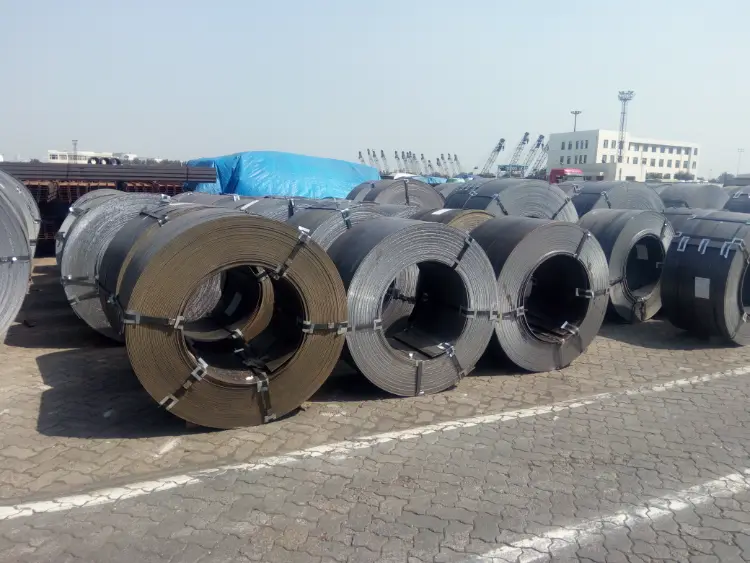
JIS G3106 SM520C Carbon & Low-alloy High-strength Steel Coil
JIS G3106 SM520C Carbon & Low-alloy High-strength Steel Coil: Properties & Equivalents
Comprehensive material data for JIS G3106 SM520C carbon and low-alloy high-strength steel coil, including chemical composition, mechanical properties, thermal and electrical physical properties, exact equivalents, similar substitutes, and application guide.
Hot-rolling, controlled rolling, normalizing, thermo-mechanically controlled processing (TMCP), welding, oxy-fuel cutting, plasma/laser cutting, bending, machining, drilling
- Phone : +8618037372205
- Email : [email protected]
- WhatsApp: Contact via Whtsapp
- WeChat: +8618037372205
JIS G3106 SM520C Carbon & Low-alloy High-strength Steel Coil Introduction
JIS G3106 SM520C is a carbon and low-alloy high-strength steel specifically designed for welded structures that require a minimum tensile strength of 520 MPa and guaranteed low-temperature toughness down to -10°C (27J Charpy V-notch). The steel is supplied in coil, plate, or sheet form up to 100 mm thickness in as-rolled, normalized, or thermomechanically controlled processed (TMCP) condition. Its balanced chemistry—controlled carbon (≤0.20%) and manganese (≤1.65%) with microalloying elements like Nb, V, or Ti—ensures excellent weldability, good formability, and reliable structural integrity. SM520C is widely used in bridges, heavy machinery, offshore platforms, and pressure vessels where high strength-to-weight ratio and resistance to brittle fracture are essential. The standard JIS G3106 covers requirements for hot-rolled steels for welded structures; the "C" suffix denotes a guaranteed impact test at -10°C, making it suitable for cold climates and demanding service conditions. Typical yield strength ranges from 325 to 365 MPa depending on thickness, while elongation can reach 23% for thick plates, providing a commendable balance of strength and ductility. International equivalents exist under the Korean KS D3515 standard, while grades such as EN S460N and ASTM A572 Grade 65 offer similar performance in other regulatory systems.
JIS G3106 SM520C Carbon & Low-alloy High-strength Steel Coil Chemical Composition
The table below lists the ladle analysis limits for SM520C according to JIS G3106. All values are maximum unless a range is shown. Microalloying elements (Nb, V, Ti) may be added singly or in combination up to a total of approximately 0.15% to fulfil strength requirements; their amounts are not fixed by the standard but must be reported. Carbon equivalent (Ceq) is typically restricted to 0.44% for thickness ≤50 mm and 0.46% for 50–100 mm to ensure good weldability. Phosphorus and sulfur are strictly controlled to preserve toughness and ductility.
| Element | Standard Value | Remarks |
|---|---|---|
| C | ≤0.20% | Principal hardening element; kept low to ensure weldability and avoid cold cracking |
| Si | ≤0.55% | Deoxidizer and strengthening agent; contributes slightly to strength without impairing toughness |
| Mn | ≤1.65% | Improves strength and hardenability; balanced to maintain formability and low‑temperature toughness |
| P | ≤0.035% | Residual element; restricted to prevent cold shortness and grain boundary embrittlement |
| S | ≤0.035% | Residual element; low content critical for avoiding hot shortness and ensuring good weld toughness |
JIS G3106 SM520C Carbon & Low-alloy High-strength Steel Coil Thermal & Electrical Physical Properties
These physical constants are representative for SM520C grade carbon‑manganese‑microalloyed steel at room temperature (≈20°C) unless otherwise noted. They are not mandatory in JIS G3106 but are drawn from published data for similar high‑strength structural steels. Slight variations may occur depending on exact composition, heat treatment, and manufacturing route.
| Property | Typical Value | Unit | Condition |
|---|---|---|---|
| Density (ρ) | 7.85 | g/cm³ | 20°C |
| Elastic modulus (E) | 205 | GPa | 20°C |
| Shear modulus (G) | ~80 | GPa | estimated from E and ν |
| Poisson's ratio (ν) | 0.30 | — | 20°C |
| Thermal expansion coefficient (α) | 11.7 | 10⁻⁶/K | 20 – 100°C average |
| Thermal expansion coefficient (α) | 12.2 | 10⁻⁶/K | 20 – 200°C average |
| Thermal expansion coefficient (α) | 12.7 | 10⁻⁶/K | 20 – 300°C average |
| Thermal expansion coefficient (α) | 13.2 | 10⁻⁶/K | 20 – 400°C average |
| Thermal conductivity (λ) | 45 | W/(m·K) | 20°C |
| Specific heat capacity (c) | 480 | J/(kg·K) | 20°C |
| Electrical resistivity (ρₑ) | 0.16 | µΩ·m | 20°C |
JIS G3106 SM520C Carbon & Low-alloy High-strength Steel Coil Mechanical Properties
The following values are minimum requirements (yield, tensile, elongation, impact) and maximum limits (bend test inside radius) per JIS G3106 for SM520C steel in the delivery condition. Tensile testing is performed at room temperature on transverse or longitudinal specimens as per standard. For plates/coils with thickness ≥12 mm, Charpy V‑notch impact tests are mandatory at -10°C. Properties vary with product thickness; multiple rows are given for the relevant thickness ranges.
| Property | Required Value | Unit | Test Condition |
|---|---|---|---|
| Yield strength (ReH) | ≥365 | MPa | Thickness t ≤16 mm, upper yield point or 0.2% offset (ReL/ReH) |
| Yield strength (ReH) | ≥355 | MPa | 16 < t ≤40 mm |
| Yield strength (ReH) | ≥335 | MPa | 40 < t ≤75 mm |
| Yield strength (ReH) | ≥325 | MPa | 75 < t ≤100 mm |
| Tensile strength (Rm) | 520 – 680 | MPa | All thicknesses ≤100 mm |
| Elongation (A) | ≥15 | % | t ≤5 mm, test piece No.5 (L₀=50 mm) |
| Elongation (A) | ≥16 | % | 5 < t ≤16 mm, test piece No.1A (L₀=200 mm) |
| Elongation (A) | ≥21 | % | 16 < t ≤50 mm, test piece No.1A |
| Elongation (A) | ≥23 | % | 50 < t ≤100 mm, test piece No.1A |
| Charpy impact energy (KV₂) | ≥27 | J | t ≥12 mm, longitudinal, at -10°C ± 2°C, V‑notch |
| Bend test (180°) – mandrel diameter | 1.5×t (max) | — | t ≤16 mm, no cracking, inside radius = 1.5 × thickness |
| Bend test (180°) – mandrel diameter | 2.0×t (max) | — | 16 < t ≤50 mm, no cracking |
| Bend test (180°) – mandrel diameter | 2.5×t (max) | — | 50 < t ≤100 mm, no cracking |
JIS G3106 SM520C Carbon & Low-alloy High-strength Steel Coil Fully Equivalent Material Standards & Substitutable Grades
| Country/Region | Standard | Grade | Remarks |
|---|---|---|---|
| South Korea | KS D3515 | SM520C | Identical to JIS G3106 SM520C; same chemical and mechanical requirements, including impact test at -10°C. |
JIS G3106 SM520C Carbon & Low-alloy High-strength Steel Coil Application Introduction
SM520C is engineered for welded structures that must bear high static and dynamic loads while retaining good toughness and weldability. It is delivered in hot‑rolled condition and can be further processed using common fabrication techniques. The -10°C impact guarantee extends its service envelope to moderately low‑temperature environments without the need for additional qualification.
Product Applications: Welded bridge girders and box beams, High‑rise building columns and base plates, Pressure vessels and storage tanks for moderate service, Offshore platform legs and module support frames, Crane booms, excavator arms, and heavy lift structures
Processed into products: I‑beam and H‑beam sections, Stiffened plate panels, Flanges and gusset plates, Boom and stick sections, Thick‑walled tubular nodes and transition rings, Welded built‑up sections (e.g., box columns)
Application industries: Civil engineering & infrastructure (bridges, expressway supports), Heavy machinery & equipment (earth‑moving, mining trucks), Shipbuilding & marine engineering (non‑class deck and structural members), Offshore oil & gas (platforms, sub‑structures, transition pieces), Wind power & energy (tower sections, flanges, transition rings)
JIS G3106 SM520C Carbon & Low-alloy High-strength Steel Coil Similar / Alternative Substitute Material Recommendations
| Country/Region | Standard | Grade | Remarks |
|---|---|---|---|
| Europe | EN 10025-3 / EN 10025-4 | S460N / S460M | Higher minimum yield strength (460 MPa); tensile 540–720 MPa; N grades offer -20°C impact, M grades are thermomechanically rolled. SM520C may be replaced if design allows the higher yield. |
| USA | ASTM A572/A572M | Grade 65 [450] | Min yield 450 MPa, tensile 550 MPa; lacks mandatory low‑temperature toughness unless supplementary requirement S5 is invoked. Similar strength range, often used in bridges and buildings. |
| China | GB/T 1591 | Q460C / Q460D | Min yield 460 MPa for ≤16mm, tensile 550–720 MPa; C grade impact at 0°C, D grade at -20°C. Suitable for welded structural applications, roughly equivalent in strength and usage. |
Notes:
Special agreements: Carbon equivalent (Ceq) limits, narrower chemical ranges, improved formability, or ultrasonic testing can be agreed at the time of order. Thicknesses >100 mm: Mechanical properties shall be mutually agreed. Post‑weld heat treatment: The steel is generally not intended for stress‑relief heat treatment above 600°C due to potential loss of toughness from microalloy precipitation. Base standard: Data above conform to JIS G3106:2015; always refer to the latest edition for exact requirements. Units: 1 MPa = 1 N/mm²; Charpy energy in Joules (J).
- Share



