
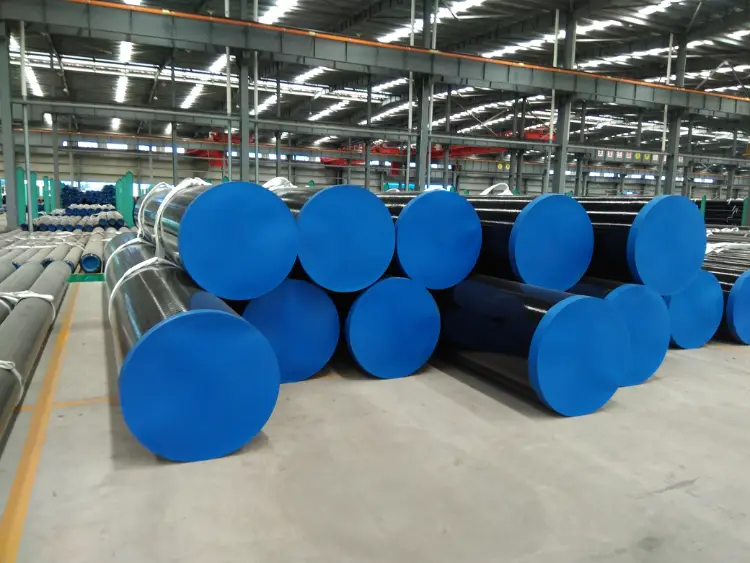
GB/T 9711 2011 PSL2 L245 LSAW Pipe Steel
Comprehensive Properties of GB/T 9711-2011 PSL2 L245 LSAW Steel Pipe
Detailed analysis of GB/T 9711-2011 PSL2 L245 LSAW steel pipe including chemical composition, mechanical & physical properties, and international equivalents.
Longitudinal submerged arc welding, hot rolling, normalizing, thermomechanical rolling; subsequent cold forming, bending, cutting, beveling, and coating
- Phone : +8618037372205
- Email : [email protected]
- WhatsApp: Contact via Whtsapp
- WeChat: +8618037372205
GB/T 9711 2011 PSL2 L245 LSAW Pipe Steel Introduction
GB/T 9711-2011 PSL2 L245 LSAW steel pipe is a low-carbon, low-alloy pipeline steel used for conveying oil, gas, and water. The designation L245 specifies a minimum yield strength of 245 MPa, with PSL2 indicating stricter chemical composition, notch toughness, and non-destructive testing requirements compared to PSL1. Produced via longitudinal submerged arc welding (LSAW), it offers excellent weldability, high strength, and good resistance to brittle fracture. Typical applications include long-distance pipelines, structural supports, and offshore systems.
GB/T 9711 2011 PSL2 L245 LSAW Pipe Steel Chemical Composition
The chemical requirements for L245 PSL2 according to GB/T 9711-2011. The product analysis tolerances apply. For PSL2, the sum of V + Nb + Ti ≤ 0.15%, and carbon equivalent (CE) limits are mandatory when C > 0.12%: CE(IIW) ≤ 0.43% and CE(Pcm) ≤ 0.25%.
| Element | Specified Value (max, %) | Remarks |
|---|---|---|
| C (Carbon) | 0.22 | For product analysis, +0.02 tolerance |
| Si (Silicon) | 0.45 | – |
| Mn (Manganese) | 1.20 | – |
| P (Phosphorus) | 0.025 | – |
| S (Sulfur) | 0.015 | – |
| V (Vanadium) | 0.05 | – |
| Nb (Niobium) | 0.05 | – |
| Ti (Titanium) | 0.04 | – |
| V+Nb+Ti | 0.15 | – |
| Cu (Copper) | 0.50 | – |
| Ni (Nickel) | 0.50 | – |
| Cr (Chromium) | 0.50 | – |
| Mo (Molybdenum) | 0.50 | – |
| CE(IIW) | 0.43 | Mandatory when C > 0.12% |
| CE(Pcm) | 0.25 | Mandatory when C > 0.12% |
GB/T 9711 2011 PSL2 L245 LSAW Pipe Steel Thermal and Electrical Physical Properties
The following physical properties are typical for low-carbon steel similar to L245. They are not specified in the product standard but are useful for design calculations.
| Property | Typical Value | Unit | Test Condition |
|---|---|---|---|
| Density (ρ) | 7.85 | g/cm³ | at 20 °C |
| Modulus of Elasticity (E) | 207 | GPa | at 20 °C |
| Shear Modulus (G) | 80 | GPa | at 20 °C |
| Poisson's Ratio (ν) | 0.30 | – | at 20 °C |
| Thermal Expansion Coefficient (α) | 11.7 | 10⁻⁶/K | between 20 °C and 100 °C |
| Thermal Conductivity (λ) | 51.9 | W/(m·K) | at 20 °C |
| Specific Heat Capacity | 486 | J/(kg·K) | at 20 °C |
| Electrical Resistivity (ρₑ) | 0.143 | 10⁻⁶ Ω·m | at 20 °C |
GB/T 9711 2011 PSL2 L245 LSAW Pipe Steel Mechanical Properties
Mechanical properties for L245 PSL2 pipe as per GB/T 9711-2011, based on full-section test specimens or machined test pieces, longitudinal or transverse direction. Both base metal and weld metal must meet the requirements.
| Property | Specified Value | Unit | Test Condition |
|---|---|---|---|
| Yield Strength (ReH) | 245 – 450 | MPa | Room temperature; transverse strip specimen |
| Tensile Strength (Rm) | 415 – 760 | MPa | Room temperature; transverse strip specimen |
| Elongation (A) | ≥ 23 (wall thickness ≤ 25 mm) / ≥ 22 (25 < t ≤ 30 mm) | % | Gauge length 50 mm, full section transverse specimen; min. values for pipe body |
| Yield to Tensile Ratio (ReH/Rm) | ≤ 0.93 | – | PSL2 requirement |
| Bend Test (180°) | No cracks or ruptures | – | Diameter of bending former: 180° around specified mandrel; mandrel size agreed upon |
| Charpy V-notch Impact Energy (KV) | Average ≥ 27 (single ≥ 18) | J | 0 °C, transverse, 10×10 mm specimen; alternative temperature by agreement |
| Shear Area (DWTT) for wall thickness ≥ 6.3 mm | ≥ 85 | % | 0 °C; requirement applies to pipe body |
GB/T 9711 2011 PSL2 L245 LSAW Pipe Steel Fully Equivalent Standard and Substitutable Grade Recommendations
| Country/Region | Standard | Grade | Remarks |
|---|---|---|---|
| International (ISO) | ISO 3183:2012 | L245 PSL2 | Identical technical content; same as GB/T 9711 |
| USA | API Specification 5L, 46th Edition | Grade B (PSL 2) | Substitutable for L245 PSL2; supplementary requirements may be needed |
| European Union | EN 10208-2:2009 | L245GA (PSL2 equivalent) | Similar grade for gas pipelines; cross-reference to ISO 3183 |
GB/T 9711 2011 PSL2 L245 LSAW Pipe Steel Application Introduction
L245 PSL2 LSAW pipe is primarily designed for pipeline transportation systems in the petroleum and natural gas industries. Due to its good combination of strength, ductility, and weldability, it is also used in structural applications and water transmission. The material can be fabricated into a wide variety of components.
Product Applications: Long-distance oil and gas trunk lines, Gathering and distribution lines, Spiral and longitudinal welded line pipes, Pressure piping systems for water and steam
Processed into products: Pipe segments (straight and fabricated bends), Tees, reducers, and caps, Welded flanges and connectors, Structural supports and piling
Application industries: Onshore and offshore oil & gas transportation, Municipal and industrial water supply networks, Civil engineering and structural construction, Offshore platform structures and risers
GB/T 9711 2011 PSL2 L245 LSAW Pipe Steel Similar / Alternative Materials Recommendation
| Country/Region | Standard | Grade | Remarks |
|---|---|---|---|
| China | GB/T 9711-2011 | L290/X42 PSL2 | Higher strength (min yield 290 MPa) with similar weldability; suitable for higher pressure lines |
| USA | API 5L | X42 PSL2 | Equivalent to GB/T 9711 L290; increased tensile properties compared to L245 |
| European Union | EN 10208-2 | L290MB | Thermomechanically rolled steel with enhanced toughness; suitable for severe environments |
Notes:
Special requirements: Supplementary requirements such as hydrogen-induced cracking (HIC) test, sulfide stress corrosion cracking (SSC) test, or stricter dimensional tolerances may be agreed upon. Non-destructive testing: PSL2 pipe requires full-body ultrasonic or electromagnetic inspection of the weld seam, plus radiographic inspection of the weld ends. Identification: Each pipe shall be marked with the manufacturer's name, standard, grade (L245), PSL2, size, and heat number.
- Share



