
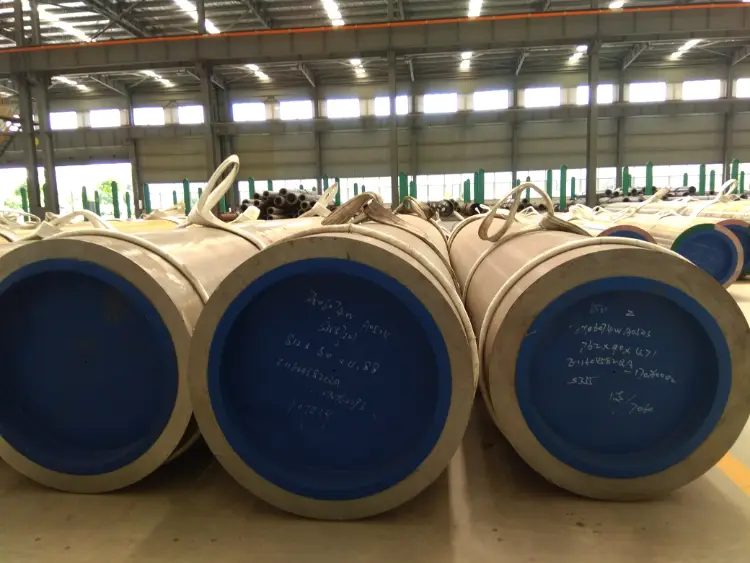
JIS G3106 SM520B LSAW Pipe Steel
JIS G3106 SM520B Steel for Welded Structures – LSAW Pipe Material Properties and Equivalents
Comprehensive material data for JIS G3106 SM520B steel used in longitudinal submerged arc welded pipes, including chemical composition, mechanical and physical properties, international equivalents, and application guidance.
Hot rolling, normalizing, thermo-mechanical control process (TMCP), submerged arc welding (SAW) for pipe production, cold forming, bending, machining
- Phone : +8618037372205
- Email : [email protected]
- WhatsApp: Contact via Whtsapp
- WeChat: +8618037372205
JIS G3106 SM520B LSAW Pipe Steel Introduction
JIS G3106 SM520B is a hot-rolled structural steel for welded constructions, widely utilized in heavy-duty fabrications requiring excellent weldability and high toughness. With a minimum tensile strength of 520 MPa and a guaranteed Charpy impact energy of 27 J at 0°C, it is suitable for load-bearing components. When formed into LSAW (Longitudinal Submerged Arc Welded) pipes, SM520B provides a robust combination of strength and ductility, making it ideal for oil & gas transmission pipelines, piling, and structural tubing. This grade is supplied in normalized or as-rolled condition, often with optional grain-refining elements, and meets stringent requirements for carbon equivalent to ensure weld integrity.
JIS G3106 SM520B LSAW Pipe Steel Chemical Composition
The chemical composition of SM520B complies with JIS G3106. In addition to the elements shown below, microalloying elements such as Nb, V, or Ti may be added at the manufacturer's discretion to refine grain size and improve mechanical properties. Carbon Equivalent Value (CEV) is typically limited to ≤0.38% for thicknesses ≤50 mm to ensure good weldability.
| Element | Standard Value | Remarks |
|---|---|---|
| C (Carbon) | ≤ 0.20% | Ladle analysis |
| Si (Silicon) | ≤ 0.55% | Ladle analysis |
| Mn (Manganese) | ≤ 1.60% | Ladle analysis |
| P (Phosphorus) | ≤ 0.035% | Ladle analysis |
| S (Sulfur) | ≤ 0.035% | Ladle analysis |
| Ceq (Carbon Equivalent) | ≤ 0.38% (for t ≤ 50 mm) | Ceq = C + Mn/6 + (Cr+Mo+V)/5 + (Ni+Cu)/15 |
JIS G3106 SM520B LSAW Pipe Steel Thermal and Electrical Properties
Thermal and electrical values provided below are typical for carbon-manganese structural steels and are not standardized requirements, but they are widely accepted for engineering calculations. The properties vary slightly with temperature, and average values at room temperature are given unless otherwise specified.
| Property | Typical Value | Unit | Test Condition / Temperature |
|---|---|---|---|
| Density (ρ) | 7850 | kg/m³ | 20°C |
| Young's Modulus (E) | 200 – 210 | GPa | Room temperature |
| Shear Modulus (G) | ~ 80 | GPa | Room temperature, calculated |
| Poisson's Ratio (ν) | 0.30 | — | Elastic range |
| Thermal Expansion Coefficient (α) | 11.7 | 10⁻⁶/K | 20°C – 100°C |
| Thermal Conductivity (λ) | 50 | W/(m·K) | 20°C |
| Specific Heat Capacity (c) | 460 | J/(kg·K) | 20°C |
| Electrical Resistivity (ρ_e) | 0.15 – 0.20 | μΩ·m | 20°C |
JIS G3106 SM520B LSAW Pipe Steel Mechanical Properties
Mechanical properties are determined in accordance with JIS G3106 and are valid for the steel in the delivery condition. Yield strength and elongation depend on plate thickness. Charpy impact tests are performed on longitudinal V-notch specimens at 0°C. Bending tests require that the specimen withstands 180° bending without cracks.
| Property | Standard Requirement | Unit | Test Condition |
|---|---|---|---|
| Yield Strength (ReH) | ≥ 365 | MPa | Plate thickness ≤ 16 mm |
| Yield Strength (ReH) | ≥ 355 | MPa | 16 mm < thickness ≤ 40 mm |
| Yield Strength (ReH) | ≥ 335 | MPa | 40 mm < thickness ≤ 75 mm |
| Yield Strength (ReH) | ≥ 325 | MPa | 75 mm < thickness ≤ 100 mm |
| Tensile Strength (Rm) | 520 – 640 | MPa | All thicknesses up to 100 mm |
| Elongation (A) | ≥ 15 | % | t ≤ 5 mm, gauge length L0=50 mm (JIS No.1A specimen) |
| Elongation (A) | ≥ 15 | % | 5 mm < t ≤ 16 mm, gauge length L0=200 mm (No.1A) |
| Elongation (A) | ≥ 19 | % | 16 mm < t ≤ 50 mm, gauge length L0=200 mm (No.1A) |
| Elongation (A) | ≥ 27 | % | t > 40 mm, gauge length L0=50 mm (JIS No.4 specimen through thickness) |
| Bend Test | No cracks (180°) | — | Bend diameter = 1.5 × t for t ≤ 16 mm |
| Bend Test | No cracks (180°) | — | Bend diameter = 2.0 × t for t > 16 mm |
| Charpy Impact Energy (KV2) | ≥ 27 | J | 0°C, V-notch, longitudinal direction |
JIS G3106 SM520B LSAW Pipe Steel Fully Equivalent Material Standards and Substitutable Grades
| Country/Region | Standard | Grade | Remarks |
|---|---|---|---|
| Japan | JIS G3106 | SM520B | Original specification; identical |
| South Korea | KS D 3515 | SM520B | Directly equivalent; same requirements |
| Europe | EN 10025-2:2019 | S355J0 | Closest match in terms of impact class (0°C); minimum yield is 355 MPa but tensile range is 470–630 MPa, slightly wider overlap |
| China | GB/T 1591-2018 | Q345C | Impact condition at 0°C, tensile 470–630 MPa; closely comparable but yield is 345 MPa for t≤16 mm |
| United States | ASTM A572/A572M | Grade 55 [380 MPa] | Yield 380 MPa min and tensile 485 MPa min; limited comparability, but sometimes acceptable for pipe applications |
JIS G3106 SM520B LSAW Pipe Steel Application Introduction
SM520B plates are specifically engineered for welded structures where reliability under dynamic loads and low-temperature toughness are essential. The LSAW pipe variant utilizes SM520B skelp, formed into a cylindrical shape and welded with longitudinal submerged arc process, delivering a high-integrity product for fluid transport and structural service. Typical applications cover both onshore and offshore environments. The steel's good formability allows pipe diameters from 16 inches up to 60 inches, with wall thicknesses up to 40 mm depending on the mill capability.
Product Applications: LSAW pipe for oil and gas linepipe, Structural hollow sections (columns, trusses), Spiral weld substitute for large diameter applications, Casing and conductor pipes, Bridge piers and marine piling
Processed into products: Longitudinal submerged arc welded pipe body, Welded connectors and flanges fabricated from the same plate, Pipe fittings (elbows, tees) made by hot forming or welding of SM520B plates, Tank shells and pressure-containing parts (when code approved), Welded beams and box columns for heavy construction
Application industries: Oil and gas transmission (cross-country pipelines, flowlines), Structural engineering (high-rise buildings, bridges, stadiums), Offshore and marine (jackets, topsides, piling, riser pipes), Water transport and penstock systems, Foundation and civil works (king piles, retaining walls)
JIS G3106 SM520B LSAW Pipe Steel Similar/Closely Related Material Recommendations
| Country/Region | Standard | Grade | Remarks |
|---|---|---|---|
| Japan | JIS G3106 | SM490B | Lower strength (min 490 MPa UTS), same toughness class; often used where SM520B is overqualified |
| Japan | JIS G3106 | SM570 | Higher strength (min 570 MPa UTS) with enhanced toughness; suitable for heavier-duty applications than SM520B |
| Europe | EN 10025-2 | S355JR | Slightly lower toughness (27J at +20°C); a more economical alternative if 0°C impact is not mandatory |
| USA | ASTM A572/A572M | Grade 50 [345] | Lower yield and tensile ranges, but widely available; may be considered for non-critical structural elements |
| International | ISO 630-2 | S355J0 | Equivalent to EN 10025-2 S355J0; globally recognized and interchangeable |
Notes:
LSAW Pipe Manufacturing: During pipe production, the SM520B plate is edge-milled, pre-formed, and then welded using tandem submerged arc welding (inner and outer passes). Post-weld heat treatment (PWHT) may be applied for thicknesses above 25 mm to relieve residual stresses. Nondestructive testing (UT or RT) of the full weld length is typically required. The final pipe can be supplied bare, coated, or lined according to service conditions. Weldability: With CEV ≤ 0.38, SM520B is suitable for welding without preheat for moderate thicknesses; however, welding procedure qualification should be conducted per project specifications. Consumables matching the strength and toughness level (e.g., E7018 or ER70S-6) are routinely used.
- Share



