
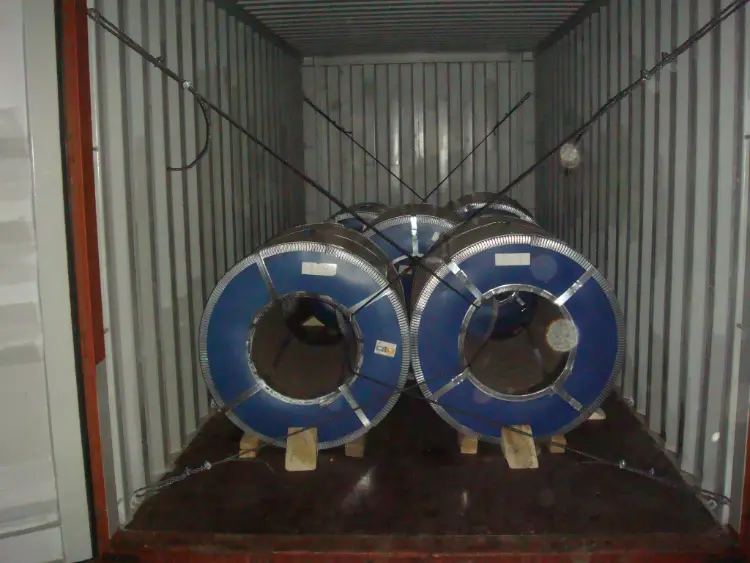
CCS EH32 Shipbuilding Steel Coil
CCS EH32 Shipbuilding Steel Coil: High Strength Hull Structure with Excellent Low-Temperature Toughness
Comprehensive technical data of CCS EH32 shipbuilding steel coil, including chemical composition, mechanical properties, thermal and electrical properties, equivalent grades, and application guidance.
Hot rolling, thermo-mechanical controlled rolling (TMCP), normalizing, shot blasting, cutting, forming, welding
- Phone : +8618037372205
- Email : [email protected]
- WhatsApp: Contact via Whtsapp
- WeChat: +8618037372205
CCS EH32 Shipbuilding Steel Coil Introduction
CCS EH32 is a high-strength hull structural steel grade certified by the China Classification Society (CCS). It is designed for the construction of ocean-going vessels, offshore platforms, and other marine structures requiring excellent weldability and good low-temperature impact toughness. With a minimum yield strength of 315 MPa and guaranteed impact energy at -40 °C, EH32 is commonly supplied as coil, plate, or sections in normalized, thermo-mechanically rolled (TMCP), or as-rolled condition. The steel offers a balanced combination of strength, ductility, and resistance to brittle fracture, making it suitable for critical structural applications in cold environments.
- High strength and good ductility
- Excellent low-temperature toughness (E grade: -40 °C)
- Superior weldability for shipyard fabrication
- Compliance with CCS Rules for Materials and Welding
CCS EH32 Shipbuilding Steel Coil Chemical Composition
The chemical composition of CCS EH32 shipbuilding steel is defined according to the CCS Rules for Materials and Welding. Tighter control of carbon equivalent (CEV) ensures good weldability. Micro-alloying elements such as niobium, vanadium, or titanium may be added singly or in combination to refine grain structure and improve strength and toughness.
- Carbon equivalent CEV = C + Mn/6 + (Cr+Mo+V)/5 + (Ni+Cu)/15 is usually ≤ 0.38% for thickness ≤ 50 mm.
- For products with a thickness greater than 25 mm, total aluminum content ≥ 0.015% shall be used for grain refinement, or sufficient other grain-refining elements.
| Element | Standard Value (%) | Remarks |
|---|---|---|
| Carbon (C) | ≤ 0.18 | Max |
| Silicon (Si) | ≤ 0.50 | Max |
| Manganese (Mn) | 0.90 - 1.60 | Range |
| Phosphorus (P) | ≤ 0.035 | Max |
| Sulfur (S) | ≤ 0.035 | Max |
| Aluminum (Al, acid soluble) | ≥ 0.015 | Min; if used for grain refinement |
| Copper (Cu) | ≤ 0.35 | Max |
| Chromium (Cr) | ≤ 0.20 | Max |
| Nickel (Ni) | ≤ 0.40 | Max |
| Molybdenum (Mo) | ≤ 0.08 | Max |
| Niobium (Nb) | 0.02 - 0.05 | Typical micro-alloying range |
| Vanadium (V) | 0.05 - 0.10 | Typical micro-alloying range |
| Titanium (Ti) | ≤ 0.02 | Max |
| Nitrogen (N) | ≤ 0.009 | Max if Al is present |
CCS EH32 Shipbuilding Steel Coil Thermal and Electrical Physical Properties
The following physical properties are typical for high-strength Mn-Si structural steels such as EH32 and are provided for engineering calculations. These values are not specified by CCS but represent commonly accepted data for this class of steel.
- Density used for weight estimation: 7.85 g/cm³.
- The thermal expansion coefficient is average between 20 °C and indicated temperature.
- Electrical resistivity is typical for normalized low-alloy steel.
| Physical Property | Typical Value | Unit | Test Condition / Remarks |
|---|---|---|---|
| Density (ρ) | 7.85 | g/cm³ | At 20 °C |
| Modulus of Elasticity (E) | 210 | GPa | At 20 °C |
| Shear Modulus (G) | 81 | GPa | At 20 °C |
| Poisson's Ratio (ν) | 0.3 | - | At 20 °C |
| Coefficient of Thermal Expansion (α) | 11.7 | 10⁻⁶/K | 20 °C to 100 °C |
| Coefficient of Thermal Expansion (α) | 12.4 | 10⁻⁶/K | 20 °C to 200 °C |
| Coefficient of Thermal Expansion (α) | 13.0 | 10⁻⁶/K | 20 °C to 300 °C |
| Thermal Conductivity (λ) | 51 | W/(m·K) | At 20 °C |
| Thermal Conductivity (λ) | 48 | W/(m·K) | At 200 °C |
| Thermal Conductivity (λ) | 45 | W/(m·K) | At 400 °C |
| Specific Heat Capacity (cp) | 460 | J/(kg·K) | At 20 °C |
| Electrical Resistivity (ρe) | 0.21 | μΩ·m | At 20 °C, typical for normalized steel |
CCS EH32 Shipbuilding Steel Coil Mechanical Properties
The mechanical properties of EH32 are determined on test specimens in the normalized or as-rolled/thermo-mechanically rolled condition. Requirements vary with product thickness. Transverse tensile test is standard unless otherwise agreed.
- Yield strength (ReH): minimum 315 MPa for all thicknesses.
- Tensile strength (Rm): 440 - 570 MPa.
- Elongation (A): based on gauge length L0 = 5.65√S0.
- Impact test (KV): longitudinal V-notch at -40 °C; minimum absorbed energy depends on thickness and specimen size.
| Property | Standard Required Value | Unit | Test Condition / Remarks |
|---|---|---|---|
| Yield Strength (ReH) | ≥ 315 | MPa | All thicknesses |
| Tensile Strength (Rm) | 440 - 570 | MPa | All thicknesses |
| Elongation (A) | ≥ 22 | % | Thickness ≤ 50 mm, L0=5.65√S0 |
| Elongation (A) | ≥ 22 | % | Thickness > 50 and ≤ 70 mm |
| Elongation (A) | ≥ 21 | % | Thickness > 70 and ≤ 100 mm |
| Bend Test (180°) | d=3a | - | Thickness ≤ 50 mm (a: specimen thickness) |
| Bend Test (180°) | d=4a | - | Thickness > 50 mm and ≤ 100 mm |
| Charpy Impact Energy (KV, longitudinal) | ≥ 31 | J | At -40 °C, 10x10 mm specimen; thickness ≤ 50 mm |
| Charpy Impact Energy (KV, longitudinal) | ≥ 24 | J | At -40 °C, 10x10 mm specimen; thickness > 50 mm and ≤ 70 mm |
| Charpy Impact Energy (KV, longitudinal) | ≥ 20 | J | At -40 °C, 10x7.5 mm specimen; when thickness 6-10 mm |
| Charpy Impact Energy (KV, longitudinal) | ≥ 15 | J | At -40 °C, 10x5 mm specimen; when thickness < 6 mm |
CCS EH32 Shipbuilding Steel Coil Complete Equivalent Material Standards and Replaceable Grades
| Country / Region | Standard | Grade | Remarks |
|---|---|---|---|
| International | CCS | EH32 | Original grade; E class low-temp toughness |
| USA | ABS | EH32 | Identical strength and toughness requirements |
| UK | LR | EH32 | Lloyd's Register equivalent |
| Norway/Germany | DNV GL | NV E32 (VL E32) | DNV rules; E32 grade |
| France | BV | EH32 | Bureau Veritas equivalent |
| Japan | NK | KE32 | Nippon Kaiji Kyokai; same strength level |
| Italy | RINA | E32 | Registro Italiano Navale |
| Korea | KR | REH32 | Korean Register; EH32 equivalent |
| Russia | RMRS | E32 | Russian Maritime Register; equivalent grade |
| China | GB 712-2011 | EH32 | Chinese national standard; technically identical |
CCS EH32 Shipbuilding Steel Coil Application Introduction
CCS EH32 shipbuilding steel coil is primarily intended for ship hulls and offshore structures operating in cold environments where resistance to brittle fracture at -40 °C is mandatory. The material can be fabricated using conventional shipyard processes including welding, flame cutting, and cold forming. It is designed to withstand heavy seas and dynamic loads.
- Excellent weldability with low carbon equivalent reduces preheating requirements.
- Coil supply enables efficient automated processing for longitudinally stiffened panels and other repetitive details.
- Typical final products after decoiling and cutting include strips, plates, and sections.
Product Applications: Hull outer shell plates, inner bottom plates, deck stringers, Longitudinal and transverse frames, girders, stiffeners, Bulkhead plates, Hatch coamings, Offshore module structural members
Processed into products: Bracket plates, floor plates, intercostal members, Stiffener sections (flat bars, bulb flats, angles) produced by cutting coil strips, Flanged brackets and beam knees (after cold forming of strip), Pipe supports and equipment foundations cut from coil plates, Bilge keels and skegs
Application industries: Shipbuilding (container ships, bulk carriers, tankers, LNG carriers), Offshore oil and gas platforms (jackets, decks, helidecks), Marine and port structures, Ice-breakers and polar supply vessels, Naval and coast guard vessels (non-combatant structural elements)
CCS EH32 Shipbuilding Steel Coil Similar / Alternative Material Recommendations
| Country / Region | Standard | Grade | Remarks |
|---|---|---|---|
| China / CCS | CCS | AH32 | Same strength; impact at 0 °C; lower cost for non-cold service |
| China / CCS | CCS | DH32 | Same strength; impact at -20 °C; good for moderate cold |
| China / CCS | CCS | FH32 | Same strength; impact at -60 °C; for extreme low temperature |
| China / CCS | CCS | EH36 | Higher strength (yield ≥ 355 MPa); same E-class toughness; weight-saving design |
| International | IACS | AH32/DH32/EH32/FH32 | All class societies recognize W32 ( 315 MPa) series |
| Europe | EN 10025-4 | S355ML | Similar strength TMCP structural steel; not certified for shipbuilding but comparable in properties |
Notes:
- For thickness up to 100 mm, EH32 is normally delivered with normalizing or TMCP. For thicker plates, normalization may be required by CCS depending on intended application.
- Surface condition: shot-blasted and coated with a shop primer (typically zinc silicate or epoxy primer) to a dry film thickness of 15-25 μm for corrosion protection during transit and construction.
- Ultrasonic testing may be specified according to CCS requirements for critical zones (e.g., sheer strake, bilge strake).
- All test certificates must be in accordance with CCS Rules and certified by a CCS surveyor or recognized manufacturer.
- The carbon equivalent should be reported in the ladle analysis certificate and must not exceed 0.38% for thickness ≤ 50 mm.
- Share



