
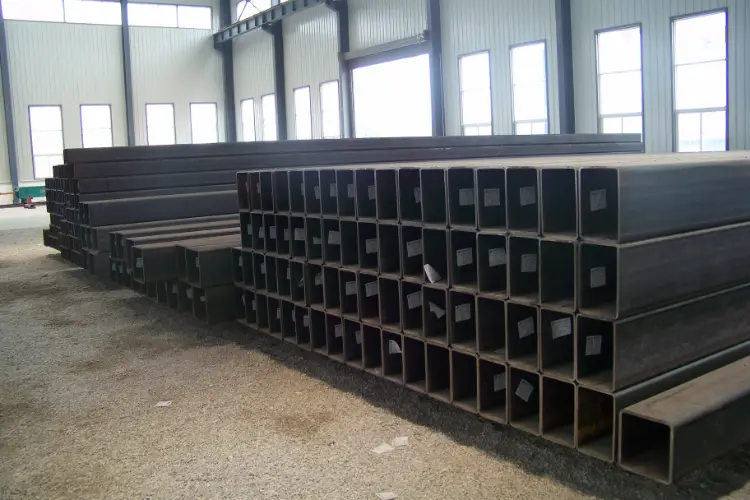
JIS G3106 SM490YB SSAW Pipe Steel
JIS G3106 SM490YB SSAW Pipe Steel - High Weldability Structural Steel for Spiral Submerged-Arc Welded Pipes
Comprehensive material profile of JIS G3106 SM490YB steel used for SSAW pipe, including chemical composition, mechanical properties, physical data, equivalent grades, and application guidance.
Spiral forming, Submerged‑arc welding (SAW), cold/hot bending, welding, machining
- Phone : +8618037372205
- Email : [email protected]
- WhatsApp: Contact via Whtsapp
- WeChat: +8618037372205
JIS G3106 SM490YB SSAW Pipe Steel Introduction
JIS G3106 SM490YB is a low‑alloy structural steel plate grade designed for welded structures. Its designation indicates:
- S – structural steel
- M – medium carbon / weldable
- 490 – minimum tensile strength 490 MPa
- Y – guaranteed minimum yield point
- B – impact test at 0 °C with minimum absorbed energy 27 J
This grade is widely used as the base material for SSAW (spiral submerged‑arc welded) pipes in oil & gas transmission, water mains, piling, and structural applications. It offers excellent weldability, good notch toughness at low temperatures, and reliable strength, making it suitable for heavy‑duty welded tubular products fabricated by spiral forming and submerged‑arc welding.
JIS G3106 SM490YB SSAW Pipe Steel Chemical Composition
The chemical composition of SM490YB according to JIS G3106 ensures good weldability and strength. The ladle analysis limits are shown below. Optional microalloying elements (Nb, V, Ti) may be added at the steelmaker's discretion for grain refinement. A maximum carbon equivalent is also specified to guarantee weldability.
- Ceq (%) = C + Mn/6 + Si/24 + Ni/40 + Cr/5 + Mo/4 + V/14 ≤ 0.44 (for thickness ≤ 50 mm).
| Element | Standard Value (max %) | Remarks |
|---|---|---|
| Carbon (C) | ≤ 0.20 | Ladle analysis |
| Silicon (Si) | ≤ 0.55 | Ladle analysis |
| Manganese (Mn) | ≤ 1.60 | Ladle analysis; for thickness > 50 mm may be adjusted |
| Phosphorus (P) | ≤ 0.035 | Ladle analysis |
| Sulfur (S) | ≤ 0.035 | Ladle analysis |
| Carbon equivalent (Ceq) | ≤ 0.44 | For thickness ≤ 50 mm; formula as per JIS G3106 |
JIS G3106 SM490YB SSAW Pipe Steel Thermal and Electrical Physical Properties
The physical property data provided are typical for low‑alloy structural steels of this strength level and are not part of the JIS G3106 specification requirements. Values are valid at room temperature unless otherwise noted. These data support design calculations for heat transfer, thermal expansion, and electrical resistance.
- Density is used for weight estimation.
- Specific heat and thermal conductivity influence welding procedure design.
- Electrical resistivity is relevant for electrical heating or grounding applications.
| Property | Typical Value | Unit | Test Condition / Remarks |
|---|---|---|---|
| Density (ρ) | 7.85 | g/cm³ | 20 °C |
| Young's modulus (E) | 206 | GPa | Room temperature, static |
| Shear modulus (G) | 79.3 | GPa | Calculated from E and Poisson's ratio |
| Poisson's ratio (ν) | 0.30 | – | Elastic range, room temperature |
| Thermal expansion coefficient (α) | 11.7 × 10⁻⁶ | K⁻¹ | 20 °C to 100 °C |
| Thermal conductivity (λ) | ≈ 51 | W/(m·K) | At 20 °C |
| Specific heat capacity (c_p) | 486 | J/(kg·K) | 20 °C |
| Electrical resistivity (ρ_e) | ≈ 0.22 | µΩ·m | At 20 °C |
JIS G3106 SM490YB SSAW Pipe Steel Mechanical Properties
Mechanical properties are guaranteed on the base plate (or strip) from which the SSAW pipe is fabricated. The values depend on the product thickness. All tests are performed in accordance with JIS G3106 using longitudinal specimens. Impact energy is measured with Charpy V‑notch specimens at 0 °C, average of three tests ≥ 27 J, with single minimum 19 J. Bending test requires no cracks on the outside of the bent portion.
- Yield strength (ReH): minimum values decrease with increasing thickness.
- Tensile strength (Rm): range 490–610 MPa for all thicknesses.
- Elongation (A): specified for No.5 test piece (gauge length 50 mm).
| Property | Standard Requirement Value | Unit | Test Condition / Remarks |
|---|---|---|---|
| Yield strength (ReH) | ≥ 365 | MPa | Thickness ≤ 16 mm, longitudinal |
| Yield strength (ReH) | ≥ 355 | MPa | Thickness 16 < t ≤ 40 mm |
| Yield strength (ReH) | ≥ 335 | MPa | Thickness 40 < t ≤ 75 mm |
| Yield strength (ReH) | ≥ 325 | MPa | Thickness 75 < t ≤ 100 mm |
| Tensile strength (Rm) | 490 – 610 | MPa | All thicknesses, longitudinal |
| Elongation (A) | ≥ 15 | % | No.5 test piece, thickness ≤ 16 mm |
| Elongation (A) | ≥ 19 | % | No.5 test piece, thickness 16 < t ≤ 40 mm |
| Elongation (A) | ≥ 21 | % | No.5 test piece, thickness 40 < t ≤ 75 mm |
| Elongation (A) | ≥ 21 | % | No.5 test piece, thickness 75 < t ≤ 100 mm |
| Bend test (bend angle 180°) | d = 2a | – | Thickness ≤ 16 mm; a = specimen thickness |
| Bend test (bend angle 180°) | d = 3a | – | Thickness 16 < t ≤ 100 mm |
| Impact energy (KV₂, 0 °C) | ≥ 27 | J | Average of 3 specimens, longitudinal; single min 19 J |
JIS G3106 SM490YB SSAW Pipe Steel Exact Equivalent Material Standards and Recommended Substitution Grades
There is no universal exact equivalent for JIS G3106 SM490YB with identical chemical and mechanical requirements. The table lists the most closely matching national/international grades commonly used for substitution in welded structural applications, with remarks on compatibility.
| Country / Region | Standard | Grade | Remarks |
|---|---|---|---|
| Japan | JIS G3106 | SM490YB | Original specification; 0 °C impact guaranteed |
| Korea | KS D3515 | SM490YB | Identical designation; mechanical and chemical limits match JIS |
| Europe | EN 10025‑2 | S355J2 | Yield min 355 MPa (0 °C impact); tensile 460–630 MPa; comparable weldability, slightly lower strength |
| USA | ASTM A572 / A572M | Grade 50 [345] | Yield min 345 MPa (50 ksi); no impact temperature prescribed; additional Charpy requirements needed to match 0 °C toughness |
| China | GB/T 1591 | Q355C | Yield min 355 MPa, 0 °C impact 34 J; closest Chinese grade; tensile 470–630 MPa; thickness effect similar |
JIS G3106 SM490YB SSAW Pipe Steel Application Introduction
SM490YB steel in coil/plate form is the backbone of SSAW pipes used across diverse sectors. Its balance of strength, ductility, and low‑temperature toughness allows safe service in demanding environments. The SSAW manufacturing process enables production of large‑diameter pipes with excellent dimensional uniformity and cost efficiency.
Product Applications: SSAW (spiral submerged‑arc welded) pipes in diameters 219 mm – 3620 mm, wall thickness 5–25 mm, Line pipes for gathering and transmission, Water‑well casing and screen pipes, Steel pipe piles (SP) and foundation piles, Structural hollow sections when formed into cylindrical members, Wind turbine tower base sections
Processed into products: Pipe segments (random lengths up to 12 m), Pipe bends and elbows (formed by hot induction bending or cold bending), Tee and reducer fittings (welded from pipe pieces), Flanges (slip‑on, weld‑neck) and connectors, Anchor flanges and thrust restraint blocks, Manhole and hand‑hole spools, Casing pipes for road and railway crossings, Riser pipes for offshore structures
Application industries: Oil & gas pipelines (onshore and offshore), Water transmission and distribution (potable & raw water), Structural piling for ports, bridges, and high‑rise buildings, Penstocks and hydropower plants, Offshore platforms and jacket structures, Mining and slurry transport pipes, General structural engineering – columns, trusses, crane booms
JIS G3106 SM490YB SSAW Pipe Steel Similar / Alternative Material Recommendations
The following grades offer comparable strength and weldability, though their exact chemical composition and impact test requirements differ. They are commonly used in structural and line‑pipe applications worldwide.
| Country / Region | Standard | Grade | Remarks |
|---|---|---|---|
| Japan | JIS G3101 | SS490 | General structural steel, no impact requirement; lower toughness |
| Europe | EN 10025‑3 | S460N | Normalized, yield 460 MPa, superior strength but may need re‑qualification |
| USA | API 5L | X52 (L360) | Pipe grade with yield 360 MPa; suitable for line pipe but different product standard |
| China | GB/T 700 | Q345B | Yield 345 MPa, 20 °C impact; widely available structural steel; lower toughness but often accepted |
Notes:
- For SSAW pipe manufacture, the SM490YB steel strip/coil is usually supplied in the as‑rolled or controlled‑rolled condition. Normalized supply may be ordered for improved toughness.
- When specified for sour service (H₂S environments), supplementary testing (HIC, SSC) according to NACE MR0175 is often required and must be agreed upon at the time of order.
- Pipe longitudinal and girth welds are typically performed with matching‑strength welding consumables (e.g., AWS A5.17 F7A6‑EL12 or similar) to ensure weld metal tensile properties ≥ 490 MPa.
- The spiral welding process can induce residual stresses; post‑weld heat treatment (PWHT) may be applied for stress relief in critical applications.
- All mechanical properties should be verified on the finished pipe, accounting for the effect of cold forming and welding.
- Share



