
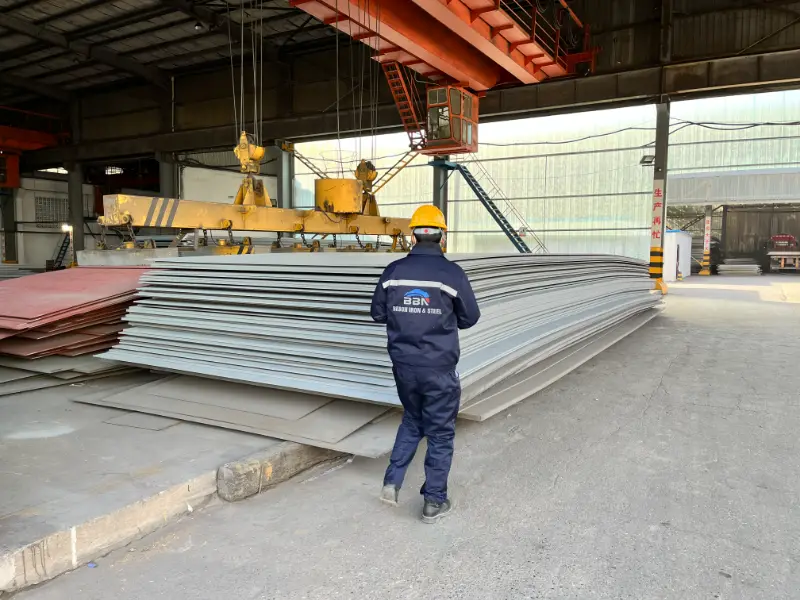
HP295 Welded Gas Cylinder Steel Material
HP295 Welded Gas Cylinder Steel - GB 6653 High-Strength Low-Alloy Plate & Coil
HP295 is a Chinese standard low-alloy steel for welded gas cylinders, offering excellent weldability, formability and reliable mechanical properties for LPG and industrial gas containment.
Hot rolling, cold forming, stamping, deep drawing, welding, machining, normalizing (if required)
- Phone : +8618037372205
- Email : [email protected]
- WhatsApp: Contact via Whtsapp
- WeChat: +8618037372205
HP295 Welded Gas Cylinder Steel Introduction
GB 6653 HP295 is a high-strength low-alloy structural steel specifically designed for the manufacture of welded gas cylinders. Governed by Chinese standard GB 6653, this grade is characterized by a minimum yield strength of 295 MPa and a tensile strength ranging from 440 to 560 MPa, coupled with good ductility and notch toughness. The material is typically supplied in the form of hot-rolled plates or coils, and it is intended for fabrication processes such as drawing, stamping, welding and forming. Its controlled chemical composition, particularly the low carbon and low silicon contents with a balanced manganese range, ensures excellent weldability, resistance to strain ageing and suitability for deep-drawing operations. HP295 is widely used in the production of liquefied petroleum gas (LPG) cylinders, acetylene cylinders and other welded pressure vessels for moderate service conditions. The standard delivery condition is hot-rolled, and the steel may be used in the as-rolled or normalized state depending on thickness and specific customer requirements.
HP295 Welded Gas Cylinder Steel Chemical Composition
The chemical composition of HP295 steel is controlled to ensure optimal weldability, formability and mechanical properties. Carbon is kept low to improve toughness and reduce hardenability in the heat-affected zone. Silicon is limited to avoid surface defects during hot working, while manganese provides solid-solution strengthening without significantly impairing ductility. Phosphorus and sulfur are restricted to low levels to maintain cleanliness and ductility. Total aluminum is specified for deoxidation and grain refinement. Microalloying elements such as niobium, vanadium and titanium may be added by agreement, but they are not required by the standard. The values below are as per GB 6653-2008 (cast analysis).
| Element | Standard Value (wt.%) | Remarks |
|---|---|---|
| Carbon (C) | ≤ 0.18 | Low carbon for good weldability and toughness |
| Silicon (Si) | ≤ 0.10 | Low Si reduces hot shortness and improves surface quality |
| Manganese (Mn) | 0.80 – 1.40 | Provides strength and hardenability control |
| Phosphorus (P) | ≤ 0.025 | Restricted for improved ductility |
| Sulfur (S) | ≤ 0.015 | Low sulfur for cleanliness and formability |
| Aluminum (Alt, total) | ≥ 0.020 | Deoxidizer and grain refiner |
| Others (Nb, V, Ti) | By agreement | Optional microalloying elements if agreed upon |
HP295 Welded Gas Cylinder Steel Thermal and Electrical Physical Properties
The physical properties of HP295 are typical for low-carbon manganese structural steels and are not mandated by the product standard. These values are provided for engineering calculations such as thermal expansion design, heat transfer analysis and electrical conductivity assessment. Density (ρ) is used for weight calculations, elastic modulus (E) and shear modulus (G) for stiffness analyses, and Poisson's ratio (ν) for stress-strain relationships under multiaxial loading. The thermal expansion coefficient (α) enables prediction of dimensional changes with temperature, while thermal conductivity (λ) and specific heat capacity are essential for thermal management simulations. Electrical resistivity (ρₑ) indicates the material's electrical conduction behavior. All values are approximate and representative of a steel with similar composition at room temperature unless a temperature range is specified.
| Property | Typical Value | Unit | Test Conditions |
|---|---|---|---|
| Density (ρ) | 7.85 | g/cm³ | 20 °C |
| Elastic Modulus (E) | 200 – 210 | GPa | 20 °C, tension |
| Shear Modulus (G) | 80 – 81 | GPa | 20 °C, calculated from E and ν |
| Poisson's Ratio (ν) | 0.28 – 0.30 | – | Elastic range |
| Thermal Expansion Coefficient (α) | ~12.2 × 10⁻⁶ | K⁻¹ | 20 – 100 °C |
| Thermal Conductivity (λ) | ~52 | W/(m·K) | 100 °C |
| Specific Heat Capacity | ~480 – 500 | J/(kg·K) | 50 – 100 °C |
| Electrical Resistivity (ρₑ) | ~0.14 – 0.18 | µΩ·m | 20 °C |
HP295 Welded Gas Cylinder Steel Mechanical Properties
The mechanical properties of HP295 are determined in accordance with GB/T 228.1 (tensile test) and GB/T 229 (impact test) on transverse or longitudinal specimens as specified. Yield strength (ReH) and tensile strength (Rm) are the primary strength indicators, while elongation (A) reflects the material's ductility. The bend test with a 180° bend and a mandrel diameter of 2a (where a is the specimen thickness) confirms the steel's formability without cracking. Charpy V-notch impact energy is guaranteed at 0 °C in the longitudinal direction, ensuring adequate toughness for service at moderate low temperatures. The values listed are the minimum requirements for plates and coils in the as-delivered condition, unless otherwise agreed.
| Property | Required Value | Unit | Test Conditions |
|---|---|---|---|
| Yield Strength (ReH) | ≥ 295 | MPa | Lower yield, as rolled condition |
| Tensile Strength (Rm) | 440 – 560 | MPa | Room temperature |
| Elongation (A) | ≥ 26 | % | Longitudinal, gauge length L₀=5.65√S₀ or 50 mm; for thickness 3-6 mm |
| Bend Test | 180° d=2a, no cracks | – | Bend diameter = 2 × thickness (a), test according to GB/T 232 |
| Impact Energy (KV₂) | ≥ 27 (average), ≥ 19 (single) | J | Longitudinal, 0 °C, Charpy V-notch |
HP295 Welded Gas Cylinder Steel Fully Equivalent Material Standards and Substitutable Grades
| Country/Region | Standard | Grade | Remarks |
|---|---|---|---|
| China | GB 6653-2008 | HP295 | Original specification for welded gas cylinder steel |
| Japan | JIS G3116:2013 | SG295 | Hot-rolled steel sheets and coils for gas cylinders; minimum yield 295 MPa, tensile 440~540 MPa, similar chemical and impact requirements |
| International | ISO 4978:2018 | SG295 | Steel flat products for welded gas cylinders; fully compatible chemical composition and mechanical properties |
HP295 Welded Gas Cylinder Steel Application Introduction
HP295 steel is engineered for the safe and efficient fabrication of welded gas cylinders. Its balanced combination of strength, ductility and weldability makes it the material of choice for a wide range of pressurised containers. The steel's low carbon equivalent value ensures minimal hardening in the weld zone, reducing the risk of cold cracking and allowing straightforward welding procedures without preheating in moderate thicknesses. Typical manufacturing steps include:
- Shearing or slitting of hot-rolled coils into blanks
- Cold or hot forming of cylinder halves through deep drawing or stamping
- Trimming and edge preparation
- Welding of longitudinal and circumferential seams using submerged arc welding (SAW) or gas metal arc welding (GMAW)
- Heat treatment (normalizing) if required to restore mechanical properties in the weld area
- Hydrostatic pressure testing and quality inspection
Product Applications: LPG cylinders for domestic and commercial use, Acetylene cylinders for welding and cutting, High-pressure seamless gas cylinder liners (when used as raw strip for billet piercing), Portable compressed air tanks, Refrigerant gas cylinders
Processed into products: Cylinder body shells (upper and lower halves), Cylinder heads and bottoms (dished ends), Valve protection rings and foot rings (when fabricated from parent material), Reinforcement pads for nozzle openings, Longitudinal and circumferential welding seams
Application industries: LPG cylinder manufacturing, Industrial gas cylinder production (oxygen, nitrogen, acetylene, argon), Compressed natural gas (CNG) storage, Fire extinguisher bodies, Pressure vessel fabrication for moderate service
HP295 Welded Gas Cylinder Steel Similar / Alternative Material Recommendations
| Country/Region | Standard | Grade | Remarks |
|---|---|---|---|
| Europe | EN 10120:2008 | P265NB | Welded gas cylinder steel with minimum yield 265 MPa, lower strength than HP295; suitable for less demanding applications or thicker sections when strength reduction is acceptable |
| Europe | EN 10120:2008 | P310NB | Welded gas cylinder steel with minimum yield 310 MPa, slightly higher strength; may require adjusted forming parameters but can be used as a substitute where higher strength is permitted |
| China | GB 6653-2008 | HP325 | Higher strength grade within the same standard (yield ≥325 MPa); can be used when design requires upgraded strength but weldability and toughness must be re-evaluated |
| International | ISO 4978:2018 | SG325 | Higher strength grade equivalent to HP325; suitable alternative for thicker cylinder walls or higher pressure ratings, pending process adaptation |
Notes:
Standard updates and traceability: Conformity assessment should be based on the latest version of GB 6653 (currently 2008 edition). Mill test certificates must include heat number, chemical analysis, and mechanical test results. Supplementary requirements: By agreement, HP295 plates/coils can be supplied with additional Charpy impact tests at lower temperatures (e.g., -20 °C) or with non-destructive examination (ultrasonic testing). Surface condition: The steel is usually delivered with a hot-rolled finish free from excessive scale, laminations, or surface defects that could impair the integrity of the gas cylinder. Protective oiling can be applied to prevent atmospheric corrosion during storage and transportation. Safety regulations: Cylinders manufactured from HP295 must comply with national and international pressure vessel codes (e.g., GB 5100, ISO 4706), and the steel must be re-certified for each design application.
- Share



