
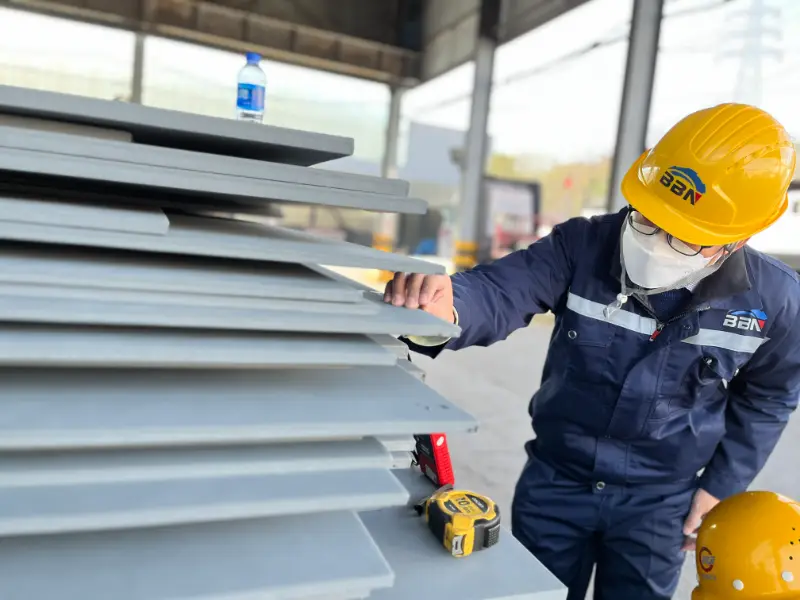
HP265 Gas Cylinder Steel Material
HP265 Gas Cylinder Steel - GB 6653 Hot Rolled Coil and Plate Datasheet
Complete material properties, chemical composition, mechanical and thermal data for HP265 steel coil and plate according to GB 6653, including international equivalents for welded gas cylinder applications.
Cutting, blanking, cold forming, deep drawing, welding, heat treatment (normalizing upon agreement)
- Phone : +8618037372205
- Email : [email protected]
- WhatsApp: Contact via Whtsapp
- WeChat: +8618037372205
HP265 Gas Cylinder Steel Introduction
HP265 is a structural quality hot-rolled steel coil and plate grade defined in Chinese standard GB 6653, specifically developed for the fabrication of welded gas cylinders. It is a low-carbon-manganese steel with excellent cold formability, good weldability, and reliable toughness at moderate low temperatures. The designation 'HP' stands for 'welding gas cylinder', while '265' indicates a minimum lower yield strength of 265 MPa.
Under typical delivery conditions (hot-rolled or controlled-rolled, optionally normalized upon agreement), HP265 demonstrates a ferrite-pearlite microstructure that ensures uniform mechanical properties. The steel is widely used to manufacture liquefied petroleum gas (LPG) cylinders, acetylene cylinders, refrigerant containers, and fire extinguisher bodies. It can be processed by cutting, roll forming, deep drawing, and automated welding lines, satisfying safety-critical pressure vessel regulations. International equivalent grades such as EN 10120 P265NB and JIS G3116 SG295 share similar chemistry and property profiles, making HP265 a globally recognized gas cylinder material.
HP265 Gas Cylinder Steel Chemical Composition
Heat analysis requirements for HP265 hot-rolled steel according to GB/T 6653-2017. The steel is a low-carbon-manganese type. Microalloying elements such as Nb, V and Ti may be added singly or in combination to improve strength and toughness without impairing weldability. Aluminium is used for deoxidation and grain refinement.
| Element | Standard Value | Remarks |
|---|---|---|
| C (Carbon) | ≤ 0.18 | Max |
| Si (Silicon) | ≤ 0.35 | Max |
| Mn (Manganese) | 0.50 – 1.20 | Inclusive range |
| P (Phosphorus) | ≤ 0.025 | Max |
| S (Sulfur) | ≤ 0.015 | Max |
| Alt (Total Aluminium) | ≥ 0.015 | Minimum for grain refinement |
| Nb, V, Ti (Microalloys) | ≤ 0.15 combined | May be added; content to be agreed upon |
HP265 Gas Cylinder Steel Thermal and Electrical Physical Properties
The following physical properties are typical for low-carbon-manganese structural steel similar to HP265 at room temperature, unless otherwise noted. Actual values may vary slightly depending on exact composition and processing history. These data are useful for thermal design, welding simulation, and electrical applications.
| Property | Typical Value | Unit | Test Condition / Remark |
|---|---|---|---|
| Density (ρ) | 7.85 | g/cm³ | 20 °C |
| Modulus of elasticity (E) | 200 – 210 | GPa | Room temperature |
| Shear modulus (G) | 80 – 82 | GPa | Calculated from E and ν |
| Poisson's ratio (ν) | 0.29 – 0.30 | — | Elastic range |
| Thermal expansion coefficient (α) | 11.5 – 12.5 | 10⁻⁶/K | 20 – 100 °C |
| Thermal conductivity (λ) | 45 – 52 | W/(m·K) | At 20 °C |
| Specific heat capacity (cp) | 450 – 480 | J/(kg·K) | At 20 °C |
| Electrical resistivity (ρₑ) | 0.18 – 0.22 | Ω·mm²/m | At 20 °C |
HP265 Gas Cylinder Steel Mechanical Properties
Mechanical properties of HP265 steel taken from GB 6653, applicable to hot-rolled sheets and plates in the delivery condition. The test specimen orientation is transverse. For thicknesses > 12 mm the elongation values may be adopted as minimum. Impact test requirement applies when the product thickness is ≥ 6 mm. The test temperature is 0 °C unless a lower temperature (e.g. -20 °C) is agreed at the time of ordering.
| Property | Required Value | Unit | Test Condition / Remark |
|---|---|---|---|
| Lower yield strength (ReL) | ≥ 265 | MPa | Thickness ≤ 12 mm; transverse specimen |
| Lower yield strength (ReL) | ≥ 255 | MPa | Thickness > 12–20 mm; transverse specimen |
| Tensile strength (Rm) | 410 – 520 | MPa | For all thicknesses |
| Elongation after fracture (A) | ≥ 27 | % | Gauge length 5.65√S₀; thickness > 3 mm |
| Elongation after fracture (A80) | ≥ 23 | % | Gauge length 80 mm; thickness ≤ 3 mm |
| Bend test | 180° bending; d = 2a | — | Bend diameter d; a = specimen thickness; no cracks |
| Impact energy (KV₂) | ≥ 47 | J | Charpy V-notch; 0 °C; applies for thickness ≥ 6 mm |
HP265 Gas Cylinder Steel Fully Equivalent Material Standards and Substitute Grades
| Country/Region | Standard | Grade | Remarks |
|---|---|---|---|
| China | GB/T 6653-2017 | HP265 | Original specification; standard grade for welded gas cylinders |
| Europe | EN 10120:2017 | P265NB | Comparable chemistry and mechanical properties; widely used for gas cylinders |
| Japan | JIS G3116:2020 | SG295 | Equivalent gas cylinder steel; tensile strength range slightly adjusted |
| International | ISO 4978:2018 | E 265 | Internationally recognized grade; consistent with GB and EN requirements |
HP265 Gas Cylinder Steel Application Introduction
HP265 steel is primarily used for welded pressure vessels that require reliable gas tightness, moderate strength, and good impact toughness at low ambient temperatures. It is designed to be easily formed into cylinder bodies and heads, and to be welded with standard processes without preheating. The steel is typically delivered in the as-rolled or controlled-rolled condition, but normalizing can be specified to improve toughness and uniformity for critical service.
Product Applications: Welded LPG steel cylinders (domestic and industrial), Acetylene and medical gas cylinders, Refrigerant bottles (R134a, R410a, etc.), Fire extinguisher bodies and cartridges, Lightweight CNG cylinders for vehicles
Processed into products: Cylinder shell (body) formed from coil or plate, Dished end (head) – cold pressed or spun, Valve boss and neck ring, Foot ring and shroud ring, Welded joints (longitudinal and circumferential seams)
Application industries: Liquefied petroleum gas (LPG) cylinder manufacturing, Industrial gas storage and transport (oxygen, nitrogen, acetylene), Refrigerant and propellant container production, Fire protection equipment (portable fire extinguishers), Automotive compressed natural gas (CNG) cylinder fabrication
HP265 Gas Cylinder Steel Similar or Adjacent Alternative Material Recommendations
| Country/Region | Standard | Grade | Remarks |
|---|---|---|---|
| China | GB/T 6653 | HP245 | Lower yield strength (≥245 MPa), similar formability, for less demanding cylinders |
| China | GB/T 6653 | HP295 | Higher yield strength (≥295 MPa), requires greater forming force but offers weight saving |
| USA | ASTM A414/A414M | Grade C | Similar minimum yield (≥275 MPa) and tensile range; not exclusively a gas cylinder grade but used in comparable pressure vessels |
| Europe | EN 10120 | P245NB | Lower strength variant; suitable for applications where HP265 strength is not required |
Notes:
- Surface condition: Unless otherwise agreed, steel is supplied with a scale finish suitable for subsequent forming and welding.
- Tolerance: Dimensional tolerances comply with GB/T 709 or as agreed at the time of order.
- Testing: Impact test at 0 °C is mandatory for products ≥ 6 mm thickness; lower temperature (-20 °C) or improved toughness values (e.g. KV₂ ≥ 60 J) can be agreed.
- Ultrasonic testing: Can be specified for quality verification of internal soundness.
- The steel can be processed by hot-dip galvanizing when corrosion protection is required for outdoor or marine service.
- Share



