
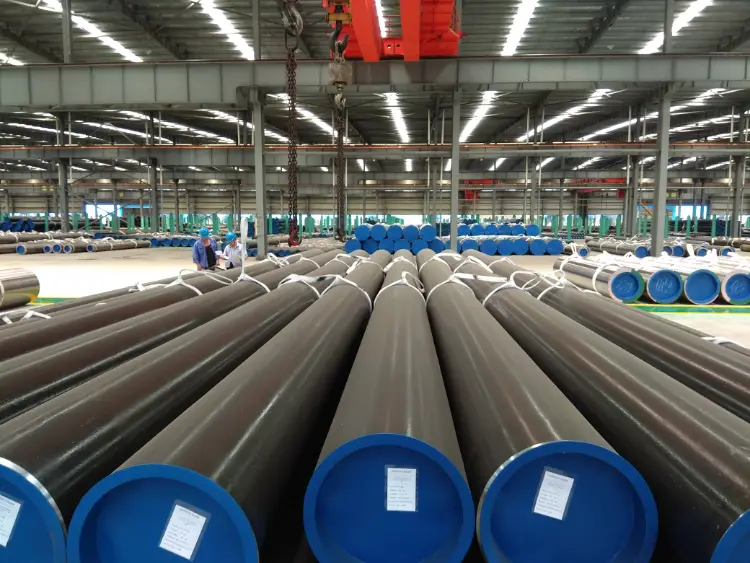
GB/T 9711 L175 PSL1 LSAW Pipe
L175 Steel Pipe per GB/T 9711-2011 PSL1 LSAW: Full Material Data and Global Equivalents
Explore the complete profile of GB/T 9711-2011 PSL1 L175 LSAW line pipe – chemical composition, tensile properties, physical data, international equivalents, and application guidance for pipeline engineering.
Forming by UOE, JCOE or other LSAW processes; welding under submerged arc; optional heat treatment (e.g., normalizing) upon agreement.
- Phone : +8618037372205
- Email : [email protected]
- WhatsApp: Contact via Whtsapp
- WeChat: +8618037372205
GB/T 9711 L175 PSL1 LSAW Pipe Introduction
L175 is a low-carbon steel grade defined in GB/T 9711-2011 (ISO 3183:2007) for petroleum and natural gas pipeline transportation systems. It belongs to Product Specification Level PSL 1, offering basic quality requirements for longitudinal submerged arc welded (LSAW) pipes. The material features a minimum yield strength of 175 MPa and moderate tensile strength, ensuring reliable service under low-pressure fluid transmission conditions. Its chemical composition is straightforward, with controlled carbon and manganese to maintain weldability and formability. L175 is not intended for sour service or extreme temperature applications but provides a cost-effective solution for water, gas, and general liquid pipelines. Equivalent to API 5L A25, this grade is widely used in utility and structural applications where high toughness or strict mechanical limits are not mandatory.
GB/T 9711 L175 PSL1 LSAW Pipe Chemical Composition
The chemical composition of L175 PSL 1 LSAW pipe is restricted to plain carbon-manganese limits according to GB/T 9711-2011, without microalloying requirements. Maximum values for harmful impurities ensure adequate weldability and service performance. The sum of residual elements V+Nb+Ti is also controlled, as noted in the standard, to prevent unintended strengthening.
| Chemical Element | Standard Requirement | Remarks |
|---|---|---|
| C (Carbon) | ≤ 0.21 | Lower carbon improves weldability and toughness |
| Mn (Manganese) | ≤ 0.60 | Enhances strength and deoxidation |
| P (Phosphorus) | ≤ 0.030 | Upper limit for low-temperature ductility control |
| S (Sulfur) | ≤ 0.030 | Sulfur is restricted to avoid hot shortness |
| V+Nb+Ti (sum) | ≤ 0.15 | Combined microalloying element limit (when applicable) |
GB/T 9711 L175 PSL1 LSAW Pipe Thermal and Electrical Physical Properties
The following physical data represent typical values for plain carbon steel similar to L175. These are not specified in GB/T 9711-2011 but are widely accepted for engineering calculations involving density, thermal expansion, conductivity, and elastic constants. Actual values may vary slightly depending on exact chemistry and microstructure.
| Property | Typical Value | Unit | Test Condition / Remark |
|---|---|---|---|
| Density (ρ) | 7.85 | g/cm³ | At 20°C |
| Elastic Modulus (E) | 205 | GPa | Static, ambient temperature |
| Shear Modulus (G) | 80 | GPa | Calculated from E and ν |
| Poisson's Ratio (ν) | 0.30 | — | In elastic range |
| Thermal Expansion Coefficient (α) | 11.7 × 10⁻⁶ | K⁻¹ | Average 20–100°C |
| Thermal Conductivity (λ) | 50.2 | W/(m·K) | At 20°C |
| Specific Heat Capacity (cp) | 486 | J/(kg·K) | At 20°C |
| Electrical Resistivity (ρe) | 0.142 | μΩ·m | At 20°C, typical mild steel |
GB/T 9711 L175 PSL1 LSAW Pipe Mechanical Properties
Tensile testing is mandatory for L175 LSAW pipe per GB/T 9711-2011. No impact or bend tests are required for PSL 1. The minimum elongation is calculated from a standard formula that depends on specimen cross-sectional area and actual tensile strength. Values listed are typical for welded pipe in the as-delivered condition; weld tensile strength must meet the same minimum as the base metal.
| Property | Standard Requirement | Unit | Test Condition / Remark |
|---|---|---|---|
| Yield Strength (ReH / Rt0.5) | ≥ 175 | MPa | Transverse or longitudinal specimen, room temperature |
| Tensile Strength (Rm) | ≥ 310 | MPa | Transverse or longitudinal specimen, room temperature |
| Elongation after fracture (Af) | Calculated: Af = 1950 × A0.2 / Rm0.9 | % | A – specimen cross-section area (mm²); Rm – actual tensile strength (MPa). Minimum depends on specimen size. |
| Yield to tensile ratio (optional) | ≤ not specified | — | PSL 1 does not impose a limit; can be agreed upon purchase. |
GB/T 9711 L175 PSL1 LSAW Pipe Direct Equivalent Standards and Substitutable Grades
| Country/Region | Standard | Designation | Remarks |
|---|---|---|---|
| China | GB/T 9711-2011 | L175 (PSL1) | Original grade for LSAW pipe |
| International | ISO 3183:2007 | L175 (PSL1) | Internationally aligned standard |
| USA | API 5L (45th & 46th ed.) | A25 (PSL1) | Compatible chemical and strength requirements; P and S limits may differ slightly |
| European | EN 10208-1:1998 | L175 | Similar pipeline steel with comparable tensile properties |
| Russia | GOST 10705 | 10 (г/к) | Carbon steel tube for welded structures, approximate equivalent |
GB/T 9711 L175 PSL1 LSAW Pipe Application Introduction
L175 LSAW pipe is intended for low-pressure fluid transmission and general utility applications where stringent toughness or sour service resistance is not needed. Its plain carbon chemistry ensures easy cutting, welding, and forming. Typical uses include water distribution, gravity sewers, industrial effluent lines, and structural members. Below are representative application fields and components:
Product Applications: Buried water mains and service laterals, Firefighting pipeline rings, Compressed air lines (low pressure), Conveyor roller tubes, Structural columns and poles
Processed into products: Plain-end or beveled LSAW pipe segments, Welded elbows and tees (fabricated from L175 pipe), Flanged spools for pipeline tie-ins, Pile sleeves and casing tubes, Manifold piping for low-pressure fluids
Application industries: Water supply and wastewater treatment, Gas distribution (low-pressure mains), Construction and piling, Agricultural irrigation, Mining slurry and dewatering systems
GB/T 9711 L175 PSL1 LSAW Pipe Near Equivalent / Similar Grade Recommendations
| Country/Region | Standard | Designation | Comparability and Notes |
|---|---|---|---|
| China / ISO | GB/T 9711.1 / ISO 3183 | L210 (Grade A) | Higher yield strength (210 MPa min); suitable for slightly higher pressure, good substitute if larger wall thickness allowed. |
| China / ISO | GB/T 9711.1 / ISO 3183 | L245 (Grade B) | Substantially higher strength (245 MPa min); use when upgraded mechanical properties are acceptable. |
| USA | API 5L | A25 (older editions) | Identical strength grade; verify P and S limits per project specification. |
| China | GB/T 3091 | Q235B welded pipe | Low-pressure fluid pipe with similar carbon steel base, but different delivery condition and testing requirements. |
Notes:
PSL 1 requirements for L175 do not include Charpy impact testing, drop weight tear testing, or guided bend tests. Hydrostatic test is mandatory unless non-destructive examination of the weld is substituted by agreement. Typical maximum hydrostatic test pressure is based on 60% of specified minimum yield strength. For sour service or aggressive environments, PSL 2 grades with HIC-resistant designations shall be selected. Weld repair of pipe body is not permitted under GB/T 9711 PSL 1. Users should verify the actual product chemical analysis when welding consumables selection is critical.
- Share



