
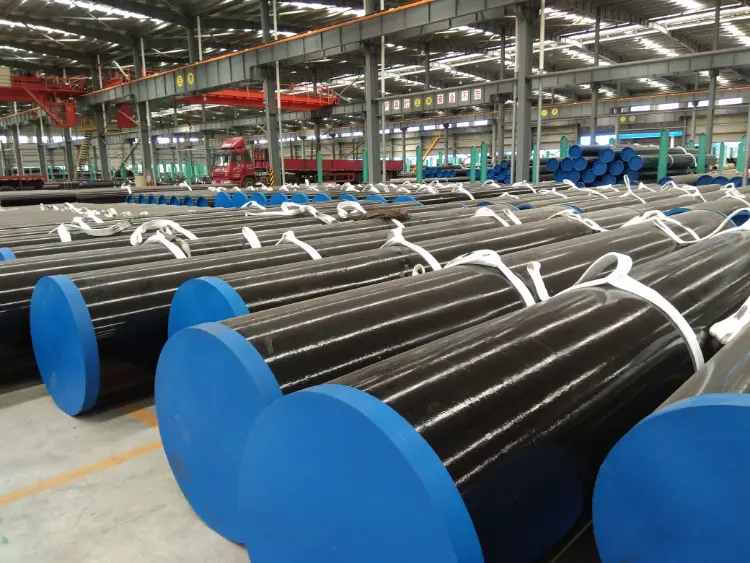
GB/T 9711-2011 PSL1 L485 LSAW Pipe
GB/T 9711-2011 PSL1 L485 LSAW Pipe: Material Properties, Equivalents & Applications
Comprehensive material data for GB/T 9711-2011 PSL1 grade L485 longitudinal submerged arc welded (LSAW) pipe, including chemical, mechanical, thermal and electrical properties, international equivalents, and application guidance.
Thermo-mechanical controlled rolling (TMCR/TMCP), normalizing, submerged arc welding (SAW), pipe forming, cold expansion, non-destructive testing (NDT)
- Phone : +8618037372205
- Email : [email protected]
- WhatsApp: Contact via Whtsapp
- WeChat: +8618037372205
GB/T 9711-2011 PSL1 L485 LSAW Pipe Introduction
GB/T 9711-2011 PSL1 L485 is a high-strength low-alloy steel grade for longitudinal submerged arc welded (LSAW) pipe primarily used in oil and natural gas transportation pipelines. The standard is technically equivalent to ISO 3183:2007. L485 designates a minimum specified yield strength of 485 MPa (70.3 ksi). PSL1 (Product Specification Level 1) defines baseline requirements without mandatory notch toughness testing, making it suitable for moderate-service applications. The material is produced from thermo-mechanically controlled processed (TMCP) or normalized fine-grained steel plates/strips, offering an excellent balance of strength, weldability, and ductility for constructing critical energy infrastructure.
GB/T 9711-2011 PSL1 L485 LSAW Pipe Chemical Composition
For GB/T 9711-2011 PSL1, the exact chemical composition is not mandated by the standard and is agreed between the manufacturer and purchaser. The only mandatory limits are phosphorus ≤0.030% and sulfur ≤0.030%. To consistently achieve the required mechanical properties, fracture toughness, and weldability, manufacturers typically control microalloying elements within the following ranges. These values are not part of the standard specification and serve as industry-typical targets for L485/X70 grade line pipe steel.
| Element | Typical Range (wt%) | Remarks |
|---|---|---|
| C | 0.06 – 0.12 | Controlled for weldability and strength |
| Mn | 1.40 – 1.70 | Strength and sulfide shape control |
| Si | 0.20 – 0.40 | Deoxidation and strength |
| P | ≤0.020 | Standard max 0.030%; lower typical for toughness |
| S | ≤0.010 | Standard max 0.030%; ultra-low for HIC resistance |
| V | 0.04 – 0.10 | Precipitation strengthening |
| Nb | 0.02 – 0.06 | Grain refinement and precipitation strengthening |
| Ti | 0.005 – 0.020 | Grain refinement, nitrogen scavenging |
| Al | 0.020 – 0.050 | Deoxidation and grain refinement |
| N | ≤0.012 | Controlled to minimize strain aging |
| Cu | ≤0.20 | Corrosion resistance, optional |
| Ni | ≤0.15 | Toughness, optional |
| Cr | ≤0.15 | Hardenability control, optional |
| Mo | ≤0.10 | Hardenability and high-temperature strength, optional |
| CE (IIW) | 0.40 – 0.45 | Carbon equivalent, estimated for typical composition |
| Pcm | 0.18 – 0.22 | Battelle parameter, critical for weldability |
GB/T 9711-2011 PSL1 L485 LSAW Pipe Thermal and Electrical Physical Properties
These properties are typical for normalized or TMCP low-alloy steels with similar composition and microstructure. They are not regulated by GB/T 9711-2011 and may vary slightly between different manufacturers and heat treatments. Values are provided for engineering design reference and are based on published data for X70/L485 grade line pipe steel.
| Property | Typical Value | Unit | Remarks |
|---|---|---|---|
| Density (ρ) | 7.85 | g/cm³ | At 20 °C |
| Elastic Modulus (E) | 210 | GPa | In tension, room temperature |
| Shear Modulus (G) | 80 | GPa | Calculated from E and ν |
| Poisson's Ratio (ν) | 0.30 | — | Within elastic range |
| Thermal Expansion Coefficient (α) | 11.7 (20–100 °C), 12.4 (20–200 °C), 13.2 (20–400 °C) | 10⁻⁶/K | Average linear coefficient |
| Thermal Conductivity (λ) | 44 (at 20 °C), 40 (at 200 °C), 35 (at 400 °C) | W/(m·K) | Decreases with temperature |
| Specific Heat Capacity | 460 (at 20 °C), 500 (at 200 °C), 580 (at 400 °C) | J/(kg·K) | Increases with temperature |
| Electrical Resistivity (ρₑ) | 0.18 | 10⁻⁶ Ω·m | At 20 °C; typical for ferritic steel |
GB/T 9711-2011 PSL1 L485 LSAW Pipe Mechanical Properties
Mechanical properties are specified for the pipe body after welding and, if applicable, heat treatment. All values are mandatory for PSL1, except Charpy impact energy, which is not required unless agreed upon (often waived for PSL1). Transverse test specimens are standard for welded pipe. Elongation depends on wall thickness and is calculated using the formula A = 625 * Ae * (U/S) with a minimum of 18% for thickness ≤25 mm. Longitudinal tests may be agreed for seamless pipe but are not typical for LSAW.
| Property | Required Value | Unit | Test Condition |
|---|---|---|---|
| Yield Strength (ReH) | ≥485 (min) | MPa | Transverse, room temperature, 0.2% offset for continuous yielding |
| Tensile Strength (Rm) | ≥570 (min) | MPa | Transverse, room temperature |
| Ratio ReH/Rm | ≤0.93 (max) | — | For strain-based design applications only (if specified) |
| Elongation (A) | ≥18 (min)* | % | Longitudinal, gauge length 50 mm, wall ≤25 mm; *or calculated per standard formula |
| Bend Test (Guided Bend) | No cracks or openings >3 mm | — | 180° bend around a mandrel diameter 3× specimen thickness, for pipe wall <19 mm; flattening test alternative for thinner wall |
| Flattening Test | No cracks or lamination | — | Stepwise flattening for pipe ends, acceptance by agreement |
| Charpy V-notch Impact** | Not mandated | J | Transverse, −10 °C or other agreed temperature; typical required values 27–40 J if specified |
| Hydrostatic Test*** | Proof test pressure ≥1.25 × design | MPa | At mill, each pipe segment, stress ≥90% specified minimum yield strength |
GB/T 9711-2011 PSL1 L485 LSAW Pipe Fully Equivalent Material Standards and Grades
| Country/Region | Standard | Grade/Designation | Remarks |
|---|---|---|---|
| International | ISO 3183:2012 (PSL 1) | L485 or PSL 1 | Equivalent yield strength and chemistry philosophy; GB/T 9711 is identical to this ISO standard |
| USA | API 5L (46th Ed.) PSL 1 | X70 | X70 designates 70 ksi (≈483 MPa) minimum yield, directly interchangeable with L485 |
| Europe | EN 10208-2:2009 | L485MB | Submerged arc welded pipe; 'MB' suffix indicates base material requirements (PSL 2 equivalent with mandatory impact); mechanical identical but stricter chemistry |
| Russia | GOST R 52079-2003 | K70 | Class K70 corresponds to X70/L485; used for trunk pipelines |
| Brazil | ABNT NBR 15186 | L485 / X70 | Equivalent to API 5L and ISO 3183 |
| India | IS 10748 / API 5L Adopted | X70 PSL 1 | National standard mirrors API 5L |
GB/T 9711-2011 PSL1 L485 LSAW Pipe Application Introduction
GB/T 9711 PSL1 L485 LSAW pipe is primarily used in the construction of high-pressure, large-diameter trunk lines for oil, natural gas, and water transmission. Its high strength-to-weight ratio allows thinner wall construction and reduced material costs. Typical wall thicknesses range from 6 mm to 40 mm and diameters from 16″ to 64″. It is also suitable for offshore risers, structural supports, and as feedstock for pipe fittings and pressure vessel shells when welded into sections.
Product Applications: Longitudinally submerged arc welded (LSAW) pipes, Spiral submerged arc welded (SSAW) pipes (hot-rolled coil), Seamless line pipes (for smaller diameters or special applications), Induction bends and hot-formed elbows, Tee joints, reducers, and caps (fabricated from pipe), Pressure vessel shells made from longitudinal pipe sections, Conductor casing for oil/gas wells
Processed into products: Main pipeline sections (land and subsea), Pipe bends (3D/5D bends) for direction changes, Tee connections and wyes for branch lines, Flanges (weld neck, slip-on) of matching material specification, Riser pipes and J-tubes, Anchor flanges and pup pieces, Transition pieces between different grades or wall thicknesses, Valve bodies and welded pressure-containing parts (when qualified)
Application industries: Oil and gas upstream (gathering lines, export lines), Midstream transmission companies (cross-country pipelines), Water and wastewater infrastructure (high-pressure aqueducts), Offshore and marine engineering (jacket structures, decks), Petrochemical plants (process piping, flare systems), Mining and mineral processing (slurry pipelines)
GB/T 9711-2011 PSL1 L485 LSAW Pipe Similar and Alternative Materials
| Country/Region | Standard | Grade/Designation | Remarks |
|---|---|---|---|
| China | GB/T 9711-2011 PSL2 | L485 PSL 2 | Higher product specification level with mandatory fracture toughness, lower S, and carbon equivalent restrictions |
| USA / International | API 5L PSL 2 | X70 PSL 2 | Stricter chemical and mechanical requirements, optional sour service designations (X70S) |
| China | GB/T 21237-2007 | L485 | Line pipe for low-temperature service (down to −45 °C), requires additional low-temperature toughness |
| All | Various | L450 / X65 | Lower yield strength (450 MPa) alternative; may be selected when design pressure or temperature limits permit |
| All | Various | L555 / X80 | Higher strength (555 MPa) line pipe; requires more sophisticated welding and is used in high-pressure transmission |
Notes:
Welding: L485 LSAW pipe is generally welded with cellulosic (SMAW), low-hydrogen, or mechanized GMAW/FCAW processes. Preheat and interpass temperature control (typically 100–150 °C) is recommended to avoid hydrogen cracking. Consumables should produce overmatching weld metal strength. Corrosion: General corrosion resistance is similar to plain carbon steel; for sour service (H₂S containing environments), supplementary HIC/SSC testing per NACE MR0175/ISO 15156 must be agreed, and a PSL2 variant with ultra-low sulfur is necessary. Bendability: Field cold bends can be made using standard bending machines with a radius ≥18D for wall thicknesses ≤19 mm. Induction bending is preferred for thick-wall and hot bends. Coatings: External coatings (3LPE, FBE, coal tar enamel) and internal linings (epoxy, cement mortar) are commonly applied to meet project requirements.
- Share



