
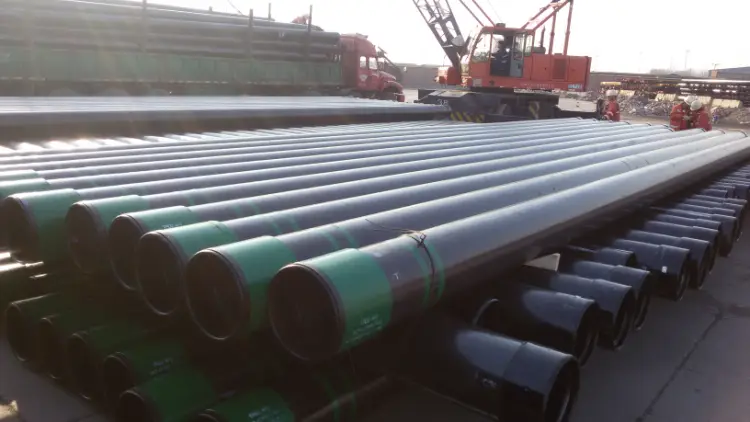
Q345A Seamless Steel Pipe for Fluid Service (GB/T 8163)
GB/T 8163 Q345A Fluid Seamless Pipe – Chemical, Mechanical & Physical Properties
Complete technical data for Q345A fluid seamless steel pipe under GB/T 8163 standard: chemical composition, mechanical properties at varying wall thickness, thermal and electrical physical properties, international equivalents, and application guidance.
Hot rolling, cold drawing, normalising, welding (fabrication), bending, machining
- Phone : +8618037372205
- Email : [email protected]
- WhatsApp: Contact via Whtsapp
- WeChat: +8618037372205
Q345A Seamless Steel Pipe for Fluid Service Introduction
Q345A is a low-alloy high-strength structural steel widely used for seamless pipes intended for conveying fluids such as oil, gas, water, and steam. Under the Chinese standard GB/T 8163 (Seamless Steel Pipes for Liquid Service), this grade offers an excellent combination of strength and formability. The minimum yield strength is 345 MPa for wall thicknesses up to 16 mm, with tensile strength ranging from 470 to 630 MPa. The material exhibits good weldability and can be fabricated into various piping components. Typical delivery condition is hot-rolled or normalised. It is suitable for moderate-temperature and pressure applications, often replacing carbon steel grades where higher load-bearing capacity is required.
Q345A Seamless Steel Pipe for Fluid Service Chemical Composition
The chemical composition of Q345A for fluid seamless pipe complies with GB/T 1591-2018 (High Strength Low Alloy Structural Steels) as referenced by GB/T 8163. Typical values are based on ladle analysis. The steel is silicon-killed and micro-alloyed to achieve the required strength without excessive carbon content, ensuring good weldability.
| Element | Standard Value (max, unless range) | Remarks |
|---|---|---|
| Carbon (C) | ≤0.20% | |
| Silicon (Si) | ≤0.50% | |
| Manganese (Mn) | ≤1.70% | |
| Phosphorus (P) | ≤0.035% | |
| Sulfur (S) | ≤0.035% | |
| Nitrogen (N) | ≤0.012% | Only if aluminium is added (as grain refiner) |
| Aluminium (Al) | ≥0.020% (or other grain-refining element) | Required if using grain refinement |
| Chromium (Cr) | ≤0.30% | Residual |
| Nickel (Ni) | ≤0.50% | Residual |
| Copper (Cu) | ≤0.30% | Residual |
| Molybdenum (Mo) | ≤0.10% | Residual |
| Niobium (Nb) | ≤0.07% | Optional microalloying; may be added to meet strength |
| Vanadium (V) | ≤0.20% | Optional microalloying |
| Titanium (Ti) | ≤0.20% | Optional microalloying |
Q345A Seamless Steel Pipe for Fluid Service Thermal & Electrical Physical Properties
The values below are typical for low‑carbon, low‑alloy steels in the hot‑rolled condition and are provided for engineering calculations. They are not mandatory requirements of the material standard but are commonly accepted reference data for Q345 class steels.
| Property | Typical Value | Unit | Test Condition |
|---|---|---|---|
| Density (ρ) | 7.85 | g/cm³ | at 20 °C |
| Modulus of Elasticity (E) | 206 | GPa | at 20 °C |
| Shear Modulus (G) | 79.4 | GPa | at 20 °C |
| Poisson's Ratio (ν) | 0.30 | – | at 20 °C |
| Thermal Expansion Coefficient (α) | 12.0 | 10⁻⁶/K | between 20 °C and 100 °C |
| Thermal Expansion Coefficient (α) | 13.1 | 10⁻⁶/K | between 20 °C and 200 °C |
| Thermal Expansion Coefficient (α) | 14.0 | 10⁻⁶/K | between 20 °C and 400 °C |
| Thermal Conductivity (λ) | 53 | W/(m·K) | at 20 °C |
| Thermal Conductivity (λ) | 47 | W/(m·K) | at 200 °C |
| Thermal Conductivity (λ) | 38 | W/(m·K) | at 400 °C |
| Specific Heat Capacity | 460 | J/(kg·K) | at 20 °C |
| Electrical Resistivity (ρ_e) | 0.23 | 10⁻⁶ Ω·m | at 20 °C |
Q345A Seamless Steel Pipe for Fluid Service Mechanical Properties
Mechanical properties are in accordance with GB/T 8163-2018 and the base material standard GB/T 1591. The yield strength depends on wall thickness, as indicated. The tensile test is performed on longitudinal strip specimens. Impact tests are not mandatory for Q345A unless agreed upon at the time of order; therefore they are omitted here. The pipe may also be subjected to a flattening test (for D>22 mm) per the product standard.
| Property | Required Value | Unit | Test Condition |
|---|---|---|---|
| Yield Strength (ReH) | ≥345 | MPa | Wall thickness ≤ 16 mm |
| Yield Strength (ReH) | ≥335 | MPa | Wall thickness 16 mm < t ≤ 40 mm |
| Yield Strength (ReH) | ≥325 | MPa | Wall thickness 40 mm < t ≤ 63 mm |
| Yield Strength (ReH) | ≥315 | MPa | Wall thickness 63 mm < t ≤ 80 mm |
| Tensile Strength (Rm) | 470 – 630 | MPa | All thicknesses |
| Elongation (A, longitudinal) | ≥20 | % | Wall thickness ≤ 16 mm |
| Elongation (A, longitudinal) | ≥19 | % | Wall thickness 16 mm < t ≤ 40 mm |
| Elongation (A, longitudinal) | ≥19 | % | Wall thickness 40 mm < t ≤ 63 mm |
| Elongation (A, longitudinal) | ≥18 | % | Wall thickness 63 mm < t ≤ 80 mm |
Q345A Seamless Steel Pipe for Fluid Service Fully Equivalent Material Standards & Substitutable Grades
A direct international equivalent for GB/T 8163 Q345A as a fluid‑service seamless pipe does not exist because most foreign fluid‑pipe standards are based on carbon steels with lower strength. The closest structural steel equivalents are listed below, but they are not covered under the same fluid‑pipe product specifications. For fluid service, similar substitutes must be verified for pressure containment and regulatory compliance.
| Country/Region | Standard | Grade | Remarks |
|---|---|---|---|
| – | No exact fluid‑pipe standard equivalent | – | No international fluid‑pipe grade matches both strength level and service designation of Q345A under GB/T 8163. |
Q345A Seamless Steel Pipe for Fluid Service Application Introduction
Q345A seamless pipe according to GB/T 8163 is extensively employed in industries requiring dependable fluid transport at elevated strengths. It provides an optimal blend of toughness, weldability, and cost efficiency.
- Suitable for oil and gas transmission pipelines, including gathering lines and distribution networks.
- Used in steam and hot‑water pipelines for power generation and district heating.
- Applied in chemical plants for process piping carrying non‑aggressive media.
- Structural applications where the same pipe simultaneously conveys fluid and bears structural loads.
- Frequently delivered with mill test certificates (MTCs) and can be ordered with additional impact testing for low‑temperature conditions.
Product Applications: Transmission pipelines, Flow lines, Steam piping, Pressure vessel connections, Structural columns/piles (fluid‑filled), Heat exchanger shells, Compressed air lines
Processed into products: Flanges (weld neck, slip‑on), Butt‑welded fittings (elbows, tees, reducers), Pipe bends, Capillary tubes, Nozzles, Valve bodies, Pump casings, Manifolds
Application industries: Oil & Gas, Petrochemical, Power Generation, District Heating, Water Treatment, Construction & Infrastructure, Shipbuilding
Q345A Seamless Steel Pipe for Fluid Service Similar / Substitute Material Recommendations
| Country/Region | Standard | Grade | Remarks |
|---|---|---|---|
| Europe | EN 10216-3 | P355N | Seamless steel tubes for pressure purposes; yield ≥355 MPa (t≤16 mm), similar strength, suitable for moderate‑temperature fluid service; verify impact requirements. |
| Europe | EN 10217-1 / EN 10216-1 | P355TR1 / P355TR2 | Welded or seamless tubes for pressure purposes with comparable tensile range; primarily for general fluid use. |
| USA | ASTM A572 / A572M | Grade 50 [345] | Structural steel with min. yield 345 MPa, similar chemistry; not a pipe product standard, can be processed into pipe. |
| Japan | JIS G3106 | SM490A | Rolled structural steel with min. yield 325‑335 MPa (thickness dependent); close in composition, welding compatibility. |
| International (Pipeline) | API 5L | Grade X42 or X46 | Line pipe with higher strength (X42 yield ≥290 MPa, X46 ≥320 MPa); Q345A may approach X52 (yield ≥360 MPa) but requires validation. |
Notes:
- Chemical composition and mechanical properties are traceable to the applicable Chinese national standards.
- Physical properties are typical values and may vary slightly with actual production and heat treatment.
- For sour service (H₂S environment) or low‑temperature applications, additional requirements such as HIC/SSC testing and impact toughness at sub‑zero temperatures must be agreed upon and are not covered by the base Q345A specification.
- CEV (Carbon Equivalent Value) typically around 0.40–0.43%, ensuring good field weldability.
- Share



