
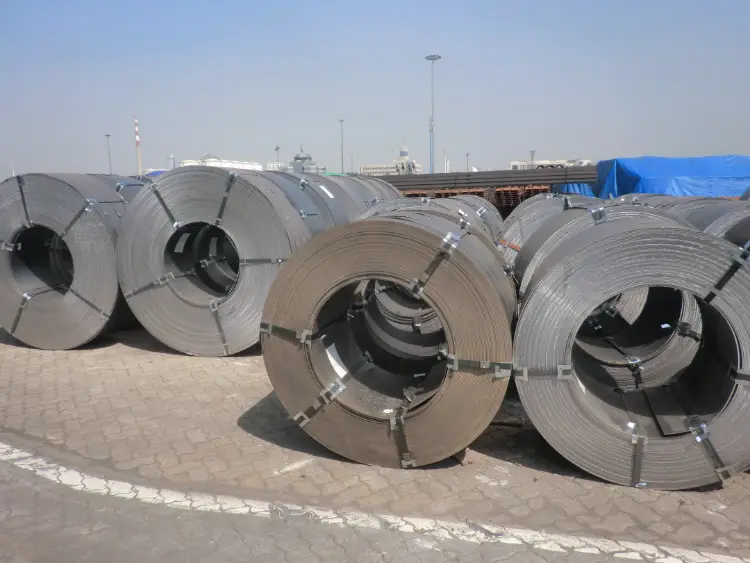
GB/T 4171 Q355GNH Weather Resistant Steel Coil
GB/T 4171 Q355GNH Weather Resistant Steel Coil - Composition & Properties
Complete material data for Q355GNH weather resistant steel coil according to GB/T 4171, including chemical composition, mechanical properties, physical properties, equivalent grades, and application suggestions.
Hot rolling, normalizing rolling, quenching and tempering (upon agreement), cold forming, welding, cutting, and machining
- Phone : +8618037372205
- Email : [email protected]
- WhatsApp: Contact via Whtsapp
- WeChat: +8618037372205
GB/T 4171 Q355GNH Weather Resistant Steel Coil Introduction
Q355GNH is a high-strength, high atmospheric corrosion resistant structural steel grade specified in Chinese standard GB/T 4171. It belongs to the group of weather resistant steels, designed to form a stable, protective rust layer (patina) when exposed to the atmosphere, eliminating the need for painting in many environments.
- Key attributes: minimum yield strength of 355 MPa, enhanced corrosion resistance via alloying with Cu, Cr, Ni and a controlled phosphorus content, good weldability, and excellent toughness at low temperatures.
- Available as hot‑rolled coils, plates, strips and sections, Q355GNH is widely used in outdoor structures like bridges, railway vehicles, containers, and transmission towers.
- The steel combines economic efficiency with long service life under atmospheric exposure.
GB/T 4171 Q355GNH Weather Resistant Steel Coil Chemical Composition
The chemical composition of Q355GNH is designed to promote the formation of a dense, adherent rust layer that slows further corrosion. Copper, chromium, and nickel are the primary alloying elements that enhance weather resistance. Phosphorus (0.07–0.15 %) is intentionally added to improve atmospheric corrosion performance, which also requires strict control of sulfur to ensure toughness. Carbon is kept low for good weldability. The values below are in accordance with GB/T 4171-2008.
| Chemical Element | Standard Value (%) | Remarks |
|---|---|---|
| C | ≤ 0.12 | Increases strength; kept low for weldability |
| Si | 0.20 – 0.75 | Deoxidizer, contributes to strength |
| Mn | ≤ 1.00 | Enhances strength and hardenability |
| P | 0.07 – 0.15 | Essential for atmospheric corrosion resistance |
| S | ≤ 0.020 | Harmful impurity; minimized for ductility and toughness |
| Cu | 0.25 – 0.55 | Key element for weather resistance; promotes protective rust |
| Cr | 0.30 – 1.25 | Improves corrosion resistance and hardenability |
| Ni | ≤ 0.65 | Enhances weather resistance and low‑temperature toughness |
GB/T 4171 Q355GNH Weather Resistant Steel Coil Thermal and Electrical Physical Properties
The following physical properties are typical for low‑alloy weather resistant steels like Q355GNH. Density is similar to ordinary carbon steel; thermal expansion is linear over the indicated temperature range, and thermal conductivity decreases with temperature. Electrical resistivity is slightly higher than pure iron due to alloying. These values are not specified in GB/T 4171 and are provided as engineering reference.
| Property | Typical Value | Unit | Test Condition |
|---|---|---|---|
| Density (ρ) | 7.85 | g/cm³ | Room temperature |
| Modulus of elasticity (E) | 200 – 210 | GPa | Room temperature |
| Shear modulus (G) | 78 – 81 | GPa | Room temperature (calculated from E and ν) |
| Poisson's ratio (ν) | 0.27 – 0.30 | – | Room temperature |
| Thermal expansion coefficient (α) | 10.8 – 12.2 | 10⁻⁶/K | 20 – 100 °C |
| Thermal expansion coefficient (α) | 11.5 – 13.0 | 10⁻⁶/K | 20 – 200 °C |
| Thermal expansion coefficient (α) | 12.5 – 13.6 | 10⁻⁶/K | 20 – 300 °C |
| Thermal conductivity (λ) | 42 – 50 | W/(m·K) | 20 °C |
| Thermal conductivity (λ) | 39 – 46 | W/(m·K) | 100 °C |
| Specific heat capacity (cp) | 460 – 500 | J/(kg·K) | 20 – 100 °C |
| Electrical resistivity (ρₑ) | 0.20 – 0.30 | μΩ·m | 20 °C |
GB/T 4171 Q355GNH Weather Resistant Steel Coil Mechanical Properties
Mechanical properties depend on product thickness. For Q355GNH hot‑rolled coil and sheet/plate, minimum yield strength, tensile strength, elongation, bending, and impact energy are specified. Yield and tensile strengths are tested in the transverse direction for strip and plate, and impact tests are longitudinal. Bending is performed at room temperature. All values comply with GB/T 4171-2008.
| Property | Standard Required Value | Unit | Test Condition |
|---|---|---|---|
| Yield Strength (ReH) – t ≤ 16 mm | ≥ 355 | MPa | Room temperature, transverse |
| Yield Strength (ReH) – 16 mm < t ≤ 40 mm | ≥ 345 | MPa | Room temperature, transverse |
| Yield Strength (ReH) – 40 mm < t ≤ 60 mm | ≥ 335 | MPa | Room temperature, transverse |
| Tensile Strength (Rm) – all thicknesses | 490 – 630 | MPa | Room temperature, transverse |
| Elongation after fracture (A) – t ≤ 16 mm | ≥ 22 | % | Gauge length 5.65√S₀, transverse |
| Elongation after fracture (A) – 16 mm < t ≤ 40 mm | ≥ 22 | % | Gauge length 5.65√S₀, transverse |
| Elongation after fracture (A) – 40 mm < t ≤ 60 mm | ≥ 22 | % | Gauge length 5.65√S₀, transverse |
| Bending test (180°) – t ≤ 6 mm | d = 1a | – | No cracks, room temperature |
| Bending test (180°) – 6 mm < t ≤ 16 mm | d = 2a | – | No cracks, room temperature |
| Bending test (180°) – t > 16 mm | d = 3a | – | No cracks, room temperature |
| Impact energy (KV₂) – longitudinal | ≥ 34 | J | Test temperature -20 °C, V‑notch |
GB/T 4171 Q355GNH Weather Resistant Steel Coil Equivalent Standards and Replaceable Grades
| Country/Region | Standard | Grade | Remarks |
|---|---|---|---|
| China | GB/T 4171-2008 | Q355GNH | Original grade; high weather resistant structural steel |
| Japan | JIS G3125:2015 | SPA-H | High weatherability rolled steel (Cu–Cr–Ni), ≥355 MPa, equivalent in composition and performance |
| Europe | EN 10025-5:2019 | S355J0WP (1.8946) | Steel for improved atmospheric corrosion resistance, minimum yield 355 MPa, similar alloy concept |
| International | ISO 4952:2006 | E355WP | Steel specified for atmospheric corrosion resistance, compatible with 355 MPa class |
GB/T 4171 Q355GNH Weather Resistant Steel Coil Application Introduction
Q355GNH steel coil is designed for structural applications where long‑term atmospheric exposure is expected and painting or coating is either uneconomical or undesirable. It is widely used in civil engineering, transportation, and energy sectors. Typical industries and products include:
Product Applications: Welded H-beams, I-beams, and box girders for bridge building, Cold‑formed profiles (C/Z purlins, guardrail components) from hot‑rolled strips, Corrugated roofing and siding sheets, Stackable and fold‑flat containers, High‑mast lighting poles and communication towers
Processed into products: Railway wagon side walls, roof panels, and bolster beams, Bridge deck plates and stiffeners, Transmission tower legs and crossarms, Container corrugated walls and floor bearers, Architectural exposed structural frames and sunshades
Application industries: Civil infrastructure (bridges, pedestrian overpasses, sound barriers), Railway and rolling stock (car bodies, underframes, hoppers), Container manufacturing (dry cargo containers, swap bodies), Building and construction (exposed facades, roofing, cladding), Energy and utilities (transmission poles, wind turbine towers, solar support structures), Outdoor art and landscaping (sculptures, canopies, pergolas)
GB/T 4171 Q355GNH Weather Resistant Steel Coil Similar and Alternative Materials
| Country/Region | Standard | Grade | Remarks |
|---|---|---|---|
| China | GB/T 4171-2008 | Q345GNH | Slightly lower minimum yield (345 MPa) but similar corrosion resistance; may be used when strength requirements are relaxed |
| USA | ASTM A588/A588M-19 | Grade B | Cu–V weather resistant steel, yield 345 MPa; close in performance but not a direct match for 355 MPa |
| USA | ASTM A606/A606M-18 | Type 4 | High‑atmospheric corrosion resistance; yield typically 340 MPa, suitable for lighter structural applications |
| Europe | EN 10025-5:2019 | S355J2WP (1.8946) | Same strength class but with better low‑temperature toughness (J2) compared to J0; may be substituted if impact requirements are higher |
Notes:
- Welding: Q355GNH has good weldability with conventional methods (SMAW, GMAW, SAW). Preheating is generally not required for plates up to 50 mm when using low‑hydrogen electrodes. Post‑weld mechanical properties of the welded joint should be verified by procedure qualification.
- Corrosion behavior: The protective patina develops after alternating wet and dry cycles. In marine or aggressive industrial atmospheres, supplementary coating may be recommended. Direct contact with dissimilar metals should be avoided to prevent galvanic corrosion.
- Forming: The steel can be cold‑formed with radii as per ordinary structural steel, but spring‑back is slightly higher due to the increased yield strength. Hot forming is preferred for thick sections.
- Delivery condition: Unless otherwise agreed, coils are supplied in the as‑rolled condition, pickled and oiled for surface protection. Normalizing rolling can be applied to improve toughness.
- Share



