
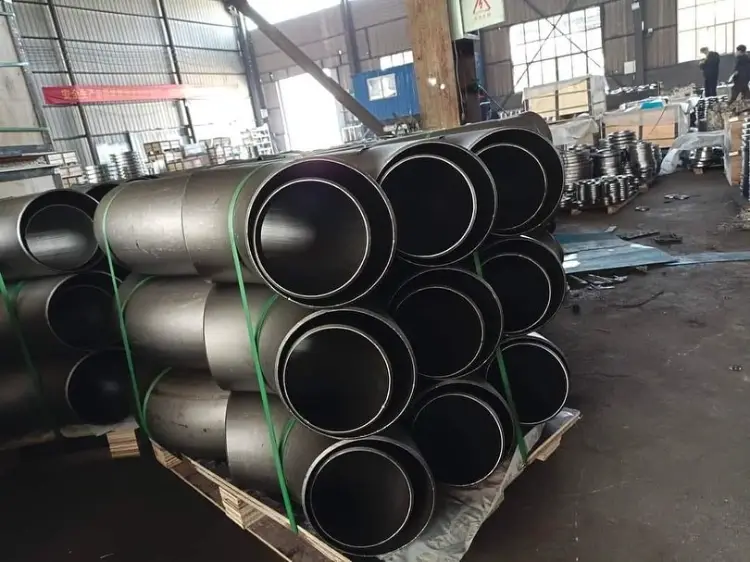
GB/T 3094 20# SHS/RSH Pipe
GB/T 3094 20# SHS/RSH Pipe: Cold Drawn Carbon Steel Hollow Section
Explore the comprehensive data for 20# carbon steel square and rectangular hollow sections manufactured per GB/T 3094. Includes chemical composition, mechanical properties, physical properties, equivalent grades, and application guide.
Cold drawing; can be supplied in hard (+Y), stress-relieved (+Q), or annealed (+T) condition. Suitable for cutting, bending, welding, and machining.
- Phone : +8618037372205
- Email : [email protected]
- WhatsApp: Contact via Whtsapp
- WeChat: +8618037372205
GB/T 3094 20# SHS/RSH Pipe Introduction
The GB/T 3094 20# SHS/RSH pipe is a cold-drawn carbon steel structural hollow section (Square Hollow Section/Rectangular Hollow Section) produced from high-quality 20# steel (a low-carbon steel with approximately 0.20% carbon). This material offers a good combination of strength, ductility, and weldability. The cold-drawing process imparts a smooth surface finish and precise dimensional tolerances, making it ideal for structural frameworks, mechanical components, and general engineering applications. It belongs to the carbon structural steel category and is commonly supplied in the hard (as-drawn) or annealed condition, allowing a balance between high tensile strength and ease of further fabrication.
GB/T 3094 20# SHS/RSH Pipe Chemical Composition
The chemical composition of 20# steel for cold-drawn shaped tubes according to GB/T 3094 shall conform to the requirements of GB/T 699-2015 for 20# steel. These limits guarantee a low-carbon, weldable grade with a balance of strength and ductility.
- Carbon (C) provides hardenability and strength.
- Manganese (Mn) acts as a deoxidizer and strengthens the ferrite.
- Silicon (Si) also serves as a deoxidizer.
- Phosphorus (P) and Sulfur (S) are tightly controlled as residual elements to avoid brittleness.
| Element | Standard Value (wt%) | Remarks |
|---|---|---|
| Carbon (C) | 0.17–0.23 | Key strengthening element; lean side preferred for welding. |
| Silicon (Si) | 0.17–0.37 | Deoxidizer; typical range for rimming or killed steel. |
| Manganese (Mn) | 0.35–0.65 | Improves hardenability and tensile strength. |
| Phosphorus (P) | ≤ 0.035 | Maximum limit to avoid cold shortness. |
| Sulfur (S) | ≤ 0.035 | Maximum limit to avoid hot shortness. |
| Chromium (Cr) | ≤ 0.25 | Residual element; not intentionally added. |
| Nickel (Ni) | ≤ 0.30 | Residual element. |
| Copper (Cu) | ≤ 0.25 | Residual element. |
GB/T 3094 20# SHS/RSH Pipe Thermal and Electrical Physical Properties
The following physical properties are typical for 20# carbon steel at room temperature (20°C) and near ambient conditions. These values are not specified in GB/T 3094 but are generic reference data for the 20# grade. They may vary slightly depending on exact microstructure and manufacturing route.
- Density is important for weight calculations in structural members.
- Modulus of elasticity is used in deflection and buckling analysis.
- Thermal expansion and conductivity guide compatibility in thermal environments.
| Property | Typical Value | Unit | Test Condition |
|---|---|---|---|
| Density (ρ) | 7.85 | g/cm³ | At 20°C |
| Modulus of Elasticity (E) | 210 | GPa | At 20°C, typical for low-carbon steel |
| Shear Modulus (G) | 81 | GPa | At 20°C |
| Poisson's Ratio (ν) | 0.30 | - | At 20°C |
| Coefficient of Thermal Expansion (α) | 11.1 | 10⁻⁶/K | Between 20°C and 100°C |
| Thermal Conductivity (λ) | 50.7 | W/(m·K) | At 20°C |
| Specific Heat Capacity (cp) | 460 | J/(kg·K) | At 20°C |
| Electrical Resistivity (ρe) | 0.169 | Ω·mm²/m | At 20°C |
GB/T 3094 20# SHS/RSH Pipe Mechanical Properties
Mechanical properties for cold-drawn 20# steel shaped tubes differ depending on the delivery condition. The standard GB/T 3094-2012 specifies minimum tensile strength and elongation values for three conditions. No impact or bending test is mandatory unless specially agreed.
- Hard (+Y): high strength, limited ductility, suitable for structural use where no further deformation is required.
- Stress-relieved (+Q): moderate strength, improved ductility over hard condition.
- Annealed (+T): maximum ductility, lower strength, ideal for subsequent cold working or bending.
| Property | Minimum Required Value | Unit | Test Condition |
|---|---|---|---|
| Tensile Strength (Rm) | 510 | MPa | Cold-drawn hard (+Y) condition |
| Elongation after fracture (A) | 8 (for wall thickness ≤ 7 mm) 10 (for wall thickness > 7 mm) | % | Cold-drawn hard (+Y) condition, gauge length 5.65√S0 |
| Tensile Strength (Rm) | 450 | MPa | Stress-relieved (+Q) condition |
| Elongation after fracture (A) | 12 (for wall thickness ≤ 7 mm) 14 (for wall thickness > 7 mm) | % | Stress-relieved (+Q) condition, gauge length 5.65√S0 |
| Tensile Strength (Rm) | 390 | MPa | Annealed (+T) condition |
| Elongation after fracture (A) | 20 (for wall thickness ≤ 7 mm) 22 (for wall thickness > 7 mm) | % | Annealed (+T) condition, gauge length 5.65√S0 |
GB/T 3094 20# SHS/RSH Pipe Completely Equivalent Material Standards and Recommended Substitutes
| Country/Region | Standard & Grade | Designation | Remarks |
|---|---|---|---|
| China | GB/T 699-2015 20# | Grade 20 | Base steel grade for tube; same chemical composition. |
| China | GB/T 8162-2018 20# | Grade 20 seamless tube | For circular hollow sections, chemical and mechanical properties comparable (annealed condition). |
| International | ISO 683-11: C20E4C | C20E4C | Case-hardening steel with similar carbon content; not specifically tube shape. |
| European Union | EN 10277-3: C20E | 1.1151 | Bright steel product, chemistry close to 20#. Tube usage needs confirmation. |
| Japan | JIS G 4051: S20C | S20C | Machine structural carbon steel, similar chemistry. Suitable for mechanical tubes. |
| United States | ASTM A108: Grade 1020 | 1020 | Cold-finished carbon steel bars; chemistry matches, but shape differs. Used for comparison. |
GB/T 3094 20# SHS/RSH Pipe Application Introduction
GB/T 3094 20# SHS/RSH pipe serves a wide range of structural and mechanical applications where good strength-to-weight ratio, dimensional accuracy, and weldability are needed. The cold-drawn surface allows for smooth coating or painting. Typical industries and products include:
Product Applications: Building structural frames, trusses, and columns, Chassis and roll cages in vehicles, Agricultural equipment frames (ploughs, trailers), Pallet racking systems and shelving, Furniture frames (tables, chairs, bed bases), Conveyor systems and safety barriers
Processed into products: Hollow section-based joints and nodes, Bicycle frames or motorcycle sub-frames, Gate and fence posts, Brackets, supports, and mounting arms, Hydraulic cylinder bodies (after honing) – if internal quality permitted, Exhaust system hangers and brackets
Application industries: Construction & Infrastructure, Automotive and Transport, Agricultural Machinery, Material Handling & Storage, Furniture Manufacturing, General Mechanical Engineering
GB/T 3094 20# SHS/RSH Pipe Similar/Approximate Substitute Material Recommendations
| Country/Region | Standard & Grade | Designation | Remarks |
|---|---|---|---|
| China | GB/T 3094 Q355B (formerly Q345B) | Q355B SHS/RHS | Higher strength low-alloy steel; can replace 20# when weight reduction is required. Weldability similar. |
| China | GB/T 6728 20# | 20# cold-formed hollow section | Similar chemistry, but produced by cold forming of strip; mechanical properties may differ. |
| European Union | EN 10210-1 S235JRH | 1.0039 | Hot-finished structural hollow section; slightly lower strength, but widely equivalent for general construction. |
| European Union | EN 10219-1 S235JRH | 1.0039 | Cold-formed structural hollow section; similar applications, lower carbon content, slightly lower tensile strength. |
| International | ISO 12633-1 S235JRH | S235JRH | Comparable structural tube for static use; composition less rich in carbon. |
Notes:
For cold-drawn +Y condition tubes, welding heat input may reduce local strength; stress-relieved or annealed conditions are recommended when extensive bending or welding is required. Surface defects and internal seams are not permitted per GB/T 3094. The standard requires tight tolerances on outside dimensions, wall thickness, and corner radii. The tube is typically supplied in straight lengths up to 6–12 meters. Alternative surface treatments like galvanizing or phosphating can be applied by agreement.
- Share



