
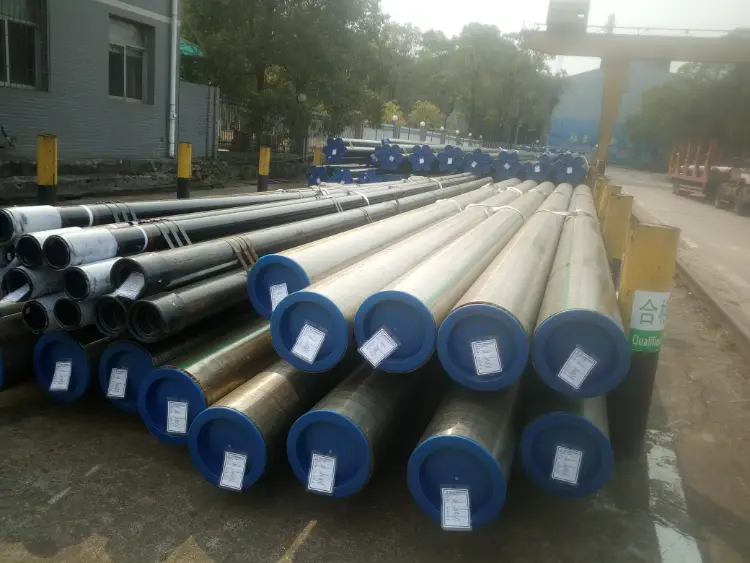
GB/T 1591 Q420D SSAW Pipe Material HSLA Steel
Q420D High-Strength Low-Alloy Steel for SSAW Pipes – GB/T 1591 Grade Analysis
Comprehensive analysis of Q420D steel according to GB/T 1591, widely used in spiral submerged arc welded (SSAW) pipes. Includes chemical composition, mechanical properties, physical data, international equivalents, and application guidance for pipeline and structural projects.
Hot rolling, controlled rolling, normalizing; SSAW pipe production by forming and submerged arc welding
- Phone : +8618037372205
- Email : [email protected]
- WhatsApp: Contact via Whtsapp
- WeChat: +8618037372205
GB/T 1591 Q420D SSAW Pipe Material HSLA Steel Introduction
Q420D is a high-strength low-alloy structural steel defined in Chinese standard GB/T 1591-2018. It offers a minimum yield strength of 420 MPa and good low-temperature impact toughness at -20°C, making it suitable for demanding welded structures such as SSAW (spiral submerged arc welded) pipes. Key characteristics:
- Fine-grain killed steel with controlled rolling or normalizing delivery condition
- Excellent weldability and formability for pipe manufacturing
- Used extensively in oil and gas transmission pipelines, offshore structures, and heavy-duty civil engineering
GB/T 1591 Q420D SSAW Pipe Material HSLA Steel Chemical Composition
The chemical composition of Q420D steel according to GB/T 1591-2018 ensures adequate strength, toughness, and weldability. All values are ladle analysis maxima unless a range is given. Microalloying elements such as Nb, V, and Ti are used for grain refinement and precipitation strengthening, while aluminium is added as a deoxidizer and grain refiner.
- Carbon equivalent (CEV) is typically controlled to guarantee weldability.
| Chemical Element | Specified Value (wt%) | Remarks |
|---|---|---|
| Carbon (C) | ≤0.20 | Ladle analysis |
| Silicon (Si) | ≤0.50 | |
| Manganese (Mn) | ≤1.70 | |
| Phosphorus (P) | ≤0.030 | |
| Sulfur (S) | ≤0.025 | |
| Niobium (Nb) | ≤0.07 | |
| Vanadium (V) | ≤0.20 | |
| Titanium (Ti) | ≤0.20 | |
| Chromium (Cr) | ≤0.30 | |
| Nickel (Ni) | ≤0.80 | |
| Copper (Cu) | ≤0.30 | |
| Molybdenum (Mo) | ≤0.20 | |
| Nitrogen (N) | ≤0.015 | |
| Aluminium (Als) | ≥0.015 | Acid-soluble aluminium |
| Carbon Equivalent (CEV) | Generally ≤0.45 | For typical thickness; dependent on actual composition |
GB/T 1591 Q420D SSAW Pipe Material HSLA Steel Thermal and Electrical Physical Properties
The following physical properties are typical for Q420D carbon-manganese low-alloy steel at room temperature unless otherwise indicated. These values are useful for design calculations involving thermal loading, heat transfer, and electrical conductivity.
- Density is standard for low-alloy steels. Elastic and shear moduli are typical for structural steel.
- Thermal expansion and conductivity vary with temperature; representative values are given for the range 20–200°C.
| Property | Typical Value | Unit | Test Condition / Temperature |
|---|---|---|---|
| Density (ρ) | 7.85 | g/cm³ | 20°C |
| Modulus of Elasticity (E) | 206 | GPa | 20°C, tensile |
| Shear Modulus (G) | 79 | GPa | 20°C |
| Poisson's Ratio (ν) | 0.3 | – | 20°C |
| Thermal Expansion Coeff. (α) | 12.0 × 10⁻⁶ | K⁻¹ | 20–100°C |
| Thermal Expansion Coeff. (α) | 12.5 × 10⁻⁶ | K⁻¹ | 20–200°C |
| Thermal Conductivity (λ) | 42 | W/(m·K) | 20°C |
| Specific Heat Capacity (c) | 460 | J/(kg·K) | 20°C |
| Electrical Resistivity (ρe) | 0.2 × 10⁻⁶ | Ω·m | 20°C |
GB/T 1591 Q420D SSAW Pipe Material HSLA Steel Mechanical Properties
Mechanical properties are specified for flat products before forming into pipe. Requirements depend on nominal thickness. For SSAW pipes, the pipe body mechanical properties shall meet the base material values after manufacturing, although slight variations may occur. Impact toughness is guaranteed at -20°C for D-grade.
- Bend test requires no cracks on the outer surface after 180° bending.
| Property | Specified Requirement | Unit | Test Condition |
|---|---|---|---|
| Yield Strength (ReH) | ≥420 | MPa | Thickness ≤16 mm |
| Yield Strength (ReH) | ≥400 | MPa | Thickness 16–40 mm |
| Yield Strength (ReH) | ≥380 | MPa | Thickness 40–63 mm |
| Yield Strength (ReH) | ≥360 | MPa | Thickness 63–80 mm |
| Yield Strength (ReH) | ≥340 | MPa | Thickness 80–100 mm |
| Yield Strength (ReH) | ≥320 | MPa | Thickness 100–150 mm |
| Tensile Strength (Rm) | 520–680 | MPa | All thicknesses |
| Elongation (A) | ≥19 | % | Thickness ≤40 mm, gauge 50 mm |
| Elongation (A) | ≥18 | % | Thickness 40–63 mm, gauge 50 mm |
| Elongation (A) | ≥18 | % | Thickness 63–100 mm, gauge 50 mm |
| Elongation (A) | ≥17 | % | Thickness 100–150 mm, gauge 50 mm |
| Elongation (A) | ≥17 | % | Thickness 150–250 mm, gauge 50 mm |
| Impact Energy (KV2) | ≥47 | J | Longitudinal, -20°C, V-notch |
| Bend Test (180°) – bend diameter | d = 3a | – | Thickness ≤16 mm, a = specimen thickness |
| Bend Test (180°) – bend diameter | d = 4a | – | Thickness >16–100 mm, a = specimen thickness |
GB/T 1591 Q420D SSAW Pipe Material HSLA Steel Completely Equivalent Materials – Standards and Replaceable Grades
| Country/Region | Standard | Grade | Remarks |
|---|---|---|---|
| Europe | EN 10025-3:2004 | S420NL | Fine-grain structural steel, impact temperature -20°C, identical yield/tensile class, fully equivalent for pipe applications. |
| International | ISO 4950-2:1995 | S420NL | High yield strength flat products – thermomechanically rolled, -20°C impact quality, directly interchangeable with Q420D. |
GB/T 1591 Q420D SSAW Pipe Material HSLA Steel Application Introduction
Q420D steel is primarily employed in the form of SSaw (spiral submerged arc welded) pipes for fluid transmission and structural applications. The combination of high strength, excellent toughness at sub-zero temperatures, and reliable weldability makes it ideal for large-diameter pipelines. Additional applications include structural hollow sections and heavy-duty construction.
Product Applications: Spiral submerged arc welded (SSAW) steel pipes, Longitudinally submerged arc welded (LSAW) pipes (alternative pipe type), Structural pipe piles, Casings and conductor pipes for offshore platforms, Penstocks for hydropower stations, High-pressure gas transmission mains
Processed into products: Pipeline main sections and fittings, Pile connectors and couplings, Reinforcement rings and stull rings for tunnels, Jacket legs and braces for offshore structures, Wind turbine tower tubular sections, Bridge arch ribs and truss tubes, Heavy machinery structural frame members
Application industries: Oil and gas transportation, Water supply and drainage engineering, Offshore and marine engineering, Bridge and infrastructure construction, Piling and foundation works, Power generation (penstocks, intake pipes), Mining slurry pipelines
GB/T 1591 Q420D SSAW Pipe Material HSLA Steel Near/Similar Alternative Materials
| Country/Region | Standard | Grade | Remarks |
|---|---|---|---|
| China | GB/T 1591-2018 | Q420C | 0°C impact toughness instead of -20°C; otherwise same strength. Suitable where low-temperature toughness is less critical. |
| China | GB/T 1591-2018 | Q420E | Impact at -40°C; superior to Q420D; can be used if more stringent low-temperature ductility is required. |
| Europe | EN 10025-3 | S420N | Normalized fine-grain steel with -20°C impact; very similar, but S420N may have slightly tighter chemistry. |
| USA | ASTM A572/A572M | Grade 60 | Yield strength 415 MPa (60 ksi), comparable but 5 MPa lower; may be used with adjustment in design. |
| USA | ASTM A572/A572M | Grade 65 | Yield strength 450 MPa (65 ksi), higher strength; suitable when higher load capacity is needed. |
| Japan | JIS G3106 | SM490YA | Yield 365 MPa for thickness ≤16 mm; lower than Q420D; welding structural steel with good toughness. |
Notes:
When producing SSAW pipes from Q420D coils, the manufacturing process should follow applicable pipe standards such as GB/T 9711, API 5L PSL1/PSL2, or ISO 3183. Attention to heat input during welding and the carbon equivalent value is essential to maintain heat-affected zone toughness. Post-weld heat treatment is normally not required for thicknesses up to 25 mm, but stress relieving may be applied for thicker wall pipes or specific service conditions. The typical SSAW pipe outside diameter ranges from 219 mm to over 3500 mm, and wall thickness from 5 mm to 25 mm commonly, utilizing Q420D hot-rolled coils.
- Share



