
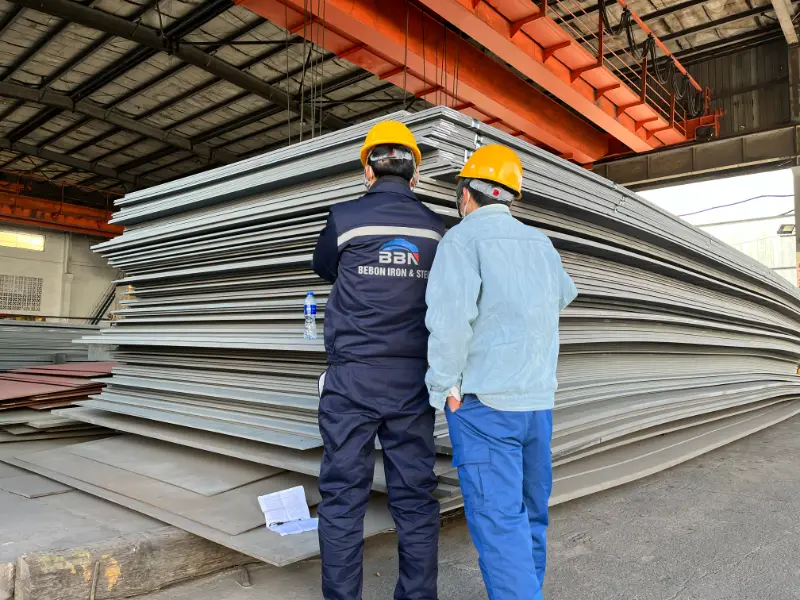
GB/T 1591 Q420B Low Alloy Structural Steel Material
GB/T 1591 Q420B Low Alloy Structural Steel for SSAW Pipe Applications
Detailed material data for Q420B high-strength low-alloy structural steel per GB/T 1591, optimized for spiral submerged arc welded (SSAW) pipes, covering chemical composition, mechanical, thermal, and electrical properties, international equivalents, and application guidance.
Hot rolling, cold forming, welding (SSAW), normalizing, TMCP
- Phone : +8618037372205
- Email : [email protected]
- WhatsApp: Contact via Whtsapp
- WeChat: +8618037372205
GB/T 1591 Q420B Low Alloy Structural Steel Introduction
Q420B is a high-strength low-alloy (HSLA) structural steel grade defined by Chinese standard GB/T 1591. It features a minimum yield strength of 420 MPa and is intended for welded structures where weight reduction and high load-bearing capacity are critical. The 'B' suffix indicates a quality level with guaranteed impact toughness at +20°C.
- Excellent weldability and cold formability, making it suitable for spiral submerged arc welded (SSAW) pipe production.
- Controlled chemical composition with microalloying elements (Nb, V, Ti) to achieve fine grain structure and enhanced mechanical properties.
- Commonly supplied as hot-rolled plates, strips, or coils in the as-rolled, normalized, or thermomechanical controlled process (TMCP) condition.
- Widely used in oil and gas transmission pipelines, building structures, bridge components, and offshore engineering.
GB/T 1591 Q420B Low Alloy Structural Steel Chemical Composition per GB/T 1591-2018 for Q420B
The chemical composition of Q420B is designed to ensure high strength and good toughness through controlled rolling and microalloying. Elements like Nb, V, Ti are added singly or in combination to refine grain size and precipitate strengthening.
- Carbon equivalent (CEV) typically ≤0.45% to ensure good weldability.
- Residual elements Cr, Ni, Cu are limited to prevent harmful effects.
- Aluminum is used for deoxidation, with a minimum acid-soluble Al content.
| Element | Standard Value (≤ unless noted) | Remarks |
|---|---|---|
| C | 0.20 | Cast analysis |
| Si | 0.50 | Cast analysis |
| Mn | 1.70 | Cast analysis |
| P | 0.030 | Cast analysis |
| S | 0.030 | Cast analysis |
| Nb | 0.07 | Cast analysis; microalloying |
| V | 0.20 | Cast analysis; microalloying |
| Ti | 0.20 | Cast analysis; microalloying |
| Cr | 0.30 | Cast analysis; residual |
| Ni | 0.80 | Cast analysis; residual |
| Cu | 0.30 | Cast analysis; residual |
| Mo | 0.10 | Cast analysis; residual |
| N | 0.012 | Cast analysis; maximum |
| Al (acid-soluble) | ≥0.020 | Cast analysis; deoxidation |
GB/T 1591 Q420B Low Alloy Structural Steel Thermal and Electrical Physical Properties for Q420B
Typical physical properties at room temperature are provided to aid in design calculations involving thermal expansion, heat transfer, and electrical resistance.
- Values are approximate and may vary slightly depending on exact composition and heat treatment.
- Density is assumed for carbon/low-alloy steel; elastic modulus is standard for steel.
| Property | Standard Required Value (Typical) | Unit | Test Condition |
|---|---|---|---|
| Density (ρ) | 7.85 | g/cm³ | 20°C |
| Elastic Modulus (E) | 206 | GPa | 20°C |
| Shear Modulus (G) | 79.3 | GPa | 20°C, calculated from E and ν |
| Poisson's Ratio (ν) | 0.3 | – | 20°C |
| Thermal Expansion Coefficient (α) | 12.0 | 10⁻⁶/K | 20-100°C |
| Thermal Conductivity (λ) | 45 | W/(m·K) | 20°C |
| Specific Heat Capacity (cp) | 460 | J/(kg·K) | 20°C |
| Electrical Resistivity (ρe) | 0.20 | 10⁻⁶ Ω·m | 20°C |
GB/T 1591 Q420B Low Alloy Structural Steel Mechanical Properties per GB/T 1591-2018 for Q420B
Mechanical properties are determined from standard test specimens taken in the longitudinal direction. Values vary with product thickness.
- Yield strength (ReH) and tensile strength (Rm) are guaranteed; elongation (A) and impact energy (KV2) ensure ductility and toughness.
- Impact test is mandatory for B quality at +20°C with minimum 34 J.
- Bending test (180°) is performed to assess formability, with mandrel diameter depending on thickness.
| Property | Standard Required Value | Unit | Test Condition / Remarks |
|---|---|---|---|
| Yield Strength (ReH) | ≥420 | MPa | Thickness ≤16 mm |
| Yield Strength (ReH) | ≥400 | MPa | Thickness >16 mm, ≤40 mm |
| Yield Strength (ReH) | ≥380 | MPa | Thickness >40 mm, ≤63 mm |
| Yield Strength (ReH) | ≥360 | MPa | Thickness >63 mm, ≤80 mm |
| Yield Strength (ReH) | ≥340 | MPa | Thickness >80 mm, ≤100 mm |
| Yield Strength (ReH) | ≥330 | MPa | Thickness >100 mm, ≤150 mm |
| Tensile Strength (Rm) | 520-680 | MPa | All thicknesses |
| Elongation (A) | ≥18 | % | Thickness ≤16 mm, gauge length 5.65√S0 |
| Elongation (A) | ≥17 | % | Thickness >16 mm, ≤40 mm |
| Elongation (A) | ≥16 | % | Thickness >40 mm, ≤63 mm |
| Elongation (A) | ≥15 | % | Thickness >63 mm, ≤80 mm |
| Elongation (A) | ≥14 | % | Thickness >80 mm, ≤100 mm |
| Elongation (A) | ≥13 | % | Thickness >100 mm, ≤150 mm |
| Impact Energy (KV2) | ≥34 | J | Longitudinal, +20°C, B quality |
| Bending Test (180°) | d = 3a | – | Thickness ≤16 mm |
| Bending Test (180°) | d = 4a | – | Thickness >16 mm, ≤100 mm |
GB/T 1591 Q420B Low Alloy Structural Steel Completely Equivalent Material Standards and Replaceable Grades
| Country/Region | Standard | Grade | Remarks |
|---|---|---|---|
| International (ISO) | ISO 630-2 | E420 | Similar yield strength, quality group to be negotiated for impact level. |
| Europe | EN 10025-3 | S420N | NCE: S420N requires impact at -20°C, which exceeds Q420B (+20°C). Chemistry and strength comparable. |
| USA | ASTM A572/A572M | Grade 60 | Minimum yield 415 MPa, close to 420; impact requirements depend on supplementary specification. |
| Japan | JIS G3136 | SN400C | Yield 235-325 MPa, lower strength; not direct equivalent but sometimes substituted for mild applications. |
GB/T 1591 Q420B Low Alloy Structural Steel Application Introduction
Q420B SSAW pipes are designed for efficient fluid transportation and structural support in various industries. The high strength-to-weight ratio reduces material usage and construction costs while maintaining safety margins.
Product Applications: Spiral submerged arc welded (SSAW) pipes in diameters up to 3000 mm and wall thicknesses 6–25.4 mm, Straight seam welded (LSAW) pipes for similar applications, Structural hollow sections, Piling pipes and foundation tubes, Penstock pipes for hydroelectric projects
Processed into products: Pipe segments and fittings (elbows, tees, reducers), Flanges and connectors, Pipeline manifolds and flow lines, Structural members (columns, beams, braces) fabricated from pipes, Jacket and deck structural nodes in offshore platforms
Application industries: Oil and gas transmission (long-distance pipelines, gathering lines), Petrochemical and chemical processing plants, Civil engineering and construction (high-rise buildings, bridge piers, stadium frames), Offshore and marine structures (jacket legs, platforms, piling), Water supply and sewage systems (large-diameter mains), Wind energy structures (tower sections, transition pieces)
GB/T 1591 Q420B Low Alloy Structural Steel Similar / Alternative Material Recommendations
| Country/Region | Standard | Grade | Remarks |
|---|---|---|---|
| China | GB/T 1591 | Q390B/C/D | Lower strength grade, minimum yield 390 MPa, may suffice for less demanding structures. |
| China | GB/T 1591 | Q460C/D | Higher strength alternative, yield ≥460 MPa, requires stricter process control. |
| Europe | EN 10025-4 | S420ML | Thermomechanical rolled steel with improved weldability and low temperature toughness; yield 420 MPa, impact at -50°C. |
| USA | ASTM A913/A913M | Grade 415 (60) | High-strength low-alloy structural steel, yield 415 MPa, good weldability, similar to A572 but with microalloying. |
Notes:
- For SSAW pipe production, the base metal must meet GB/T 1591 Q420B requirements; the weld metal and HAZ properties are influenced by welding procedures and consumables.
- Supplemental requirements (e.g., through-thickness property, ultrasonic testing) may be specified in accordance with GB/T 19879 or project specifications.
- Carbon equivalent (CEV) should be limited to ≤0.45% (typical) to ensure good field weldability.
- For low-temperature service, consider specifying impact at lower temperatures (e.g., Q420D for -20°C, Q420E for -40°C).
- Material may be ordered with additional testing such as CTOD or NACE MR0175 for sour service.
- Share



