
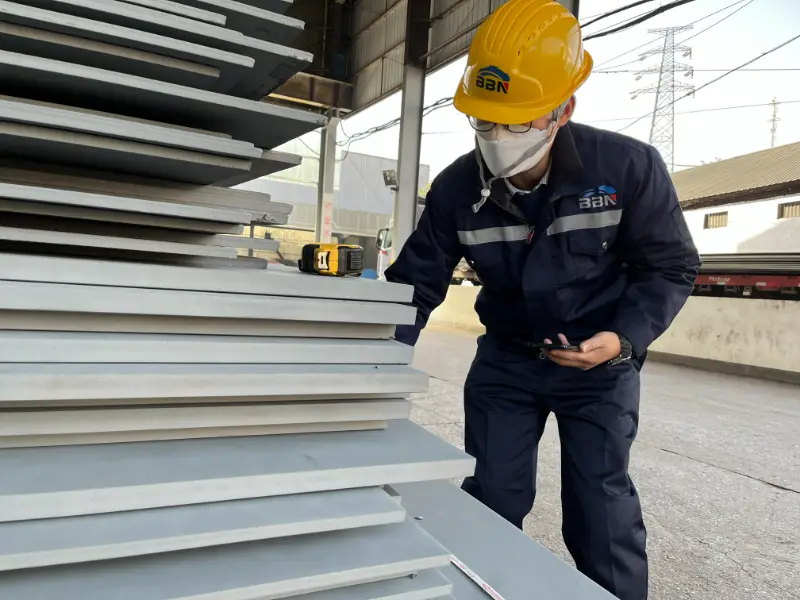
FH36 High-Strength Shipbuilding Steel Material
FH36 High-Strength Shipbuilding Steel for SSAW Pipe Applications
Complete material data for FH36 steel including chemical composition, mechanical properties under various thicknesses, typical physical properties, international equivalents, and processing applications for spiral submerged arc welded pipes.
Controlled rolling, thermo-mechanical controlled processing (TMCP), normalizing; pipe forming by spiral submerged arc welding (SSAW)
- Phone : +8618037372205
- Email : [email protected]
- WhatsApp: Contact via Whtsapp
- WeChat: +8618037372205
FH36 High-Strength Shipbuilding Steel Introduction
FH36 is a high-strength hull structural steel grade defined under the International Association of Classification Societies (IACS) Unified Requirement W11. It provides a minimum yield strength of 355 MPa and is specifically designed for critical ship and offshore structures operating at very low temperatures. The designation 'F' indicates guaranteed impact toughness at -60 °C, making it suitable for Arctic and harsh marine environments. When processed into SSAW (Spiral Submerged Arc Welded) pipes, FH36 delivers excellent combination of strength, weldability and low-temperature crack arrest capability. The steel is typically produced by controlled rolling or thermo-mechanical controlled processing (TMCP) and delivered in normalized or TMCP condition. It is widely used in manufacturing large-diameter line pipes, piling pipes, structural pipes, and legs of offshore platforms. Due to its balanced chemistry with microalloying elements (Nb, V, Ti), FH36 achieves fine grain refinement and high toughness while maintaining good formability and weldability for heavy-walled coiled pipe production.
FH36 High-Strength Shipbuilding Steel Chemical Composition
The chemical composition of FH36 is specified in accordance with IACS UR W11 and corresponding classification society rules. The analysis is determined on heat (ladle) analysis. Microalloying elements (Nb, V, Ti) are added singly or in combination to achieve fine grain size and improved toughness.
- All values are maximum unless a range is given.
- Aluminum contains soluble (acid-soluble) Al, provided as a grain-refining element; if other grain-refining elements are used, the minimum may differ.
- Carbon equivalent (CE) is often limited to ensure weldability.
| Element | Standard Value (wt%) | Remarks |
|---|---|---|
| C (Carbon) | ≤0.16 | |
| Mn (Manganese) | 0.90 - 1.60 | |
| Si (Silicon) | 0.10 - 0.50 | |
| P (Phosphorus) | ≤0.025 | |
| S (Sulfur) | ≤0.025 | |
| Al (Aluminum, acid-soluble) | ≥0.015 | When used as grain refiner |
| Nb (Niobium) | 0.02 - 0.05 | Optional microalloying element |
| V (Vanadium) | 0.05 - 0.10 | Optional microalloying element |
| Ti (Titanium) | ≤0.02 | Optional microalloying element |
| Cu (Copper) | ≤0.35 | Residual element |
| Cr (Chromium) | ≤0.20 | Residual element |
| Ni (Nickel) | ≤0.40 | Residual element |
| Mo (Molybdenum) | ≤0.08 | Residual element |
| N (Nitrogen) | ≤0.009 | If nitrogen-binding elements are present |
FH36 High-Strength Shipbuilding Steel Thermal and Electrical Physical Properties
Physical properties provided are typical for FH36 type low-carbon, high-manganese structural steels. These values are not normative requirements but are representative for engineering calculations. They are derived from standard carbon-manganese steel data at room temperature unless indicated otherwise.
- Values may vary slightly with exact composition and manufacturing process.
- For precise values, specific product data sheets should be consulted.
| Property | Typical Value | Unit | Test Condition / Temperature |
|---|---|---|---|
| Density (ρ) | 7850 | kg/m³ | Room temperature |
| Modulus of elasticity (E) | 205 | GPa | Room temperature |
| Shear modulus (G) | 80 | GPa | Calculated from E and ν |
| Poisson's ratio (ν) | 0.3 | — | Room temperature |
| Thermal expansion coefficient (α) | 11.5 | ×10⁻⁶ /K | 20–100 °C |
| Thermal conductivity (λ) | 45 | W/(m·K) | At 20 °C |
| Specific heat capacity (cp) | 460 | J/(kg·K) | Room temperature |
| Electrical resistivity (ρ_e) | 0.2 | ×10⁻⁶ Ω·m | Room temperature |
FH36 High-Strength Shipbuilding Steel Mechanical Properties
Mechanical properties are based on tensile and Charpy V-notch impact tests according to IACS UR W11. Values are minimum requirements for transverse specimens (full-thickness) unless otherwise noted. The impact energy applies to longitudinal specimens. Thickness ranges influence elongation and impact requirements.
- Tensile testing at room temperature.
- Charpy test temperature: -60 °C.
- Individual impact values must not fall below 70% of the specified average.
| Property | Required Value | Unit | Test Condition |
|---|---|---|---|
| Yield strength (ReH) | ≥355 | MPa | Thickness ≤100 mm (all thickness range) |
| Tensile strength (Rm) | 490 – 620 | MPa | Thickness ≤100 mm |
| Elongation (A) | ≥21 | % | Thickness ≤50 mm, gauge length 5.65√So |
| Elongation (A) | ≥21 | % | Thickness 50-70 mm |
| Elongation (A) | ≥21 | % | Thickness 70-100 mm |
| Charpy V-notch impact energy (KV) | ≥34 (avg) / ≥24 (single) | J | -60 °C, longitudinal, thickness ≤50 mm |
| Charpy V-notch impact energy (KV) | ≥27 (avg) / ≥19 (single) | J | -60 °C, longitudinal, thickness 50-70 mm |
| Charpy V-notch impact energy (KV) | ≥27 (avg) / ≥19 (single) | J | -60 °C, longitudinal, thickness 70-100 mm |
FH36 High-Strength Shipbuilding Steel Exact Equivalent Material Standards and Substitutable Grades
| Country / Region | Standard | Grade | Remarks |
|---|---|---|---|
| International | IACS UR W11 | FH36 | Unified requirement for all IACS members |
| USA | ABS Rules – Materials and Welding | ABS FH36 | Identical chemical and mechanical requirements |
| Norway / Germany | DNV GL Rules – Pt.2 Ch.2 (now DNV) | DNV FH36 | Material class equivalent |
| United Kingdom | Lloyd's Register (LR) Rules | LR FH36 | LR FH36 fully corresponds |
| France | Bureau Veritas (BV) Rules | BV FH36 | Same specification |
| China | China Classification Society (CCS) Rules | CCS FH36 | Same as IACS FH36 |
| South Korea | Korean Register (KR) Rules | KR FH36 | Recognised equivalent |
| Japan | Nippon Kaiji Kyokai (ClassNK) Rules | NK FH36 | Equivalent grade |
| Italy | RINA Rules | RINA FH36 | Conforms to IACS FH36 |
| Russia | Russian Maritime Register of Shipping (RS) | RS FH36 | Equivalent according to RS requirements |
FH36 High-Strength Shipbuilding Steel Application Introduction
FH36 in the form of SSAW (spiral submerged arc welded) pipe is extensively used in marine and offshore structural applications. Its ability to maintain high toughness at -60 °C makes it an excellent choice for Arctic offshore platforms, ice-going vessels, and cold-climate piling. The SSAW process allows efficient production of large-diameter, long-length pipes from coiled skelp, providing cost-effective solutions for structural members subjected to high loads and low temperatures.
Product Applications: SSAW (spiral welded) steel pipes, Heavy-wall structural pipes for offshore legs, Piling pipes (marine and foundation piles), Caissons and conductor pipes, Welded tubular joints and transition pieces
Processed into products: Spiral submerged arc welded line pipes, Cans and tubular nodes for jacket structures, Flanges and end connectors for SSAW pipes, Stiffened cylindrical shells, Helical pipe piles and driven piles, Pressure housings and structural tubulars
Application industries: Shipbuilding (hull structures, deck plating in cold regions), Offshore oil and gas (jacket platforms, topsides, risers), Marine civil engineering (dock gates, breakwaters, quay walls), Piling and foundation (port structures, wind turbine monopiles, dock piles), Water and subsea pipelines (structural supporting pipes)
FH36 High-Strength Shipbuilding Steel Closely Related / Similar Alternative Materials
| Country / Region | Standard | Grade | Remarks |
|---|---|---|---|
| International | IACS UR W11 | EH36 | Similar strength (355 MPa) but impact at -40 °C instead of -60 °C; slightly reduced low-temperature toughness |
| International | IACS UR W11 | DH36 | Same strength, impact at -20 °C; suitable for less severe cold environments |
| International | IACS UR W11 | AH36 | Same strength, impact at 0 °C; general shipbuilding use |
| International | IACS UR W11 | FH32 | Lower yield strength (315 MPa) but same -60°C impact; used where lower strength is acceptable |
| International | IACS UR W11 | EH40 | Higher strength (390 MPa) with -40°C toughness; alternative for weight reduction in warmer waters |
| International | EN 10025-4 / EN 10225 | S355ML | Thermo-mechanically rolled structural steel, -50°C impact; comparable but not ship-class certified |
Notes:
FH36 is typically supplied in a thermo-mechanically controlled processed (TMCP) condition, which optimizes strength and toughness while maintaining good weldability. When ordering SSAW pipes, the pipe manufacturer must ensure that the base metal and heat-affected zone (HAZ) after spiral welding still meet the -60 °C Charpy requirements. Supplementary testing, such as CTOD (crack tip opening displacement), may be specified for critical offshore applications. Preheating and post-weld heat treatment (PWHT) requirements depend on thickness and applicable construction codes. FH36 SSAW pipes are often coated with anti-corrosion systems, including three-layer polyethylene (3LPE) or fusion bonded epoxy (FBE), for long-term service in marine environments.
- Share



