
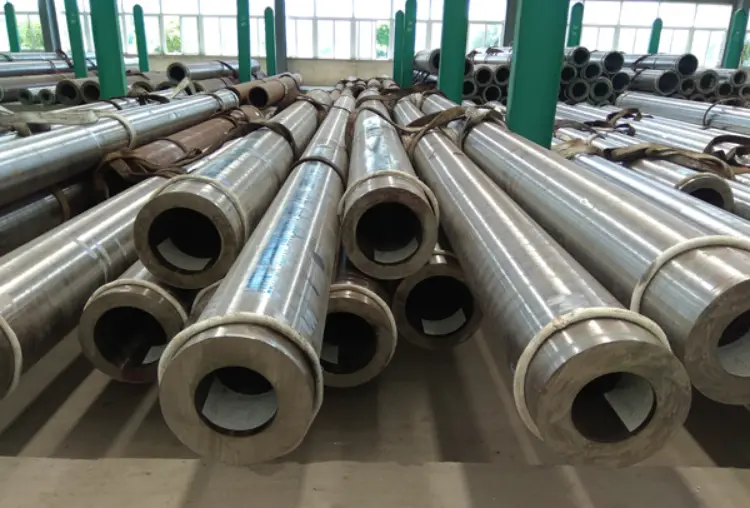
EN10219 S460NLH SHS/RSH Pipe
EN10219 S460NLH SHS/RSH Pipe: High-Strength Cold-Formed Hollow Section for Low Temperature
Detailed material data for S460NLH cold-formed welded structural hollow sections to EN 10219-1, including chemical composition, mechanical and physical properties, international equivalents, and application guidance.
Cold forming (roll forming, press braking), high-frequency welding (HFW) or submerged arc welding (SAW), cutting, drilling, bending, machining, galvanizing
- Phone : +8618037372205
- Email : [email protected]
- WhatsApp: Contact via Whtsapp
- WeChat: +8618037372205
EN10219 S460NLH SHS/RSH Pipe Introduction
S460NLH is a high-strength fine-grain structural steel for cold-formed welded hollow sections, specified in EN 10219-1. The designation 'S' stands for structural steel, '460' indicates a minimum yield strength of 460 MPa for wall thicknesses up to 16 mm, 'N' denotes a normalised or normalised rolled delivery condition, 'L' guarantees Charpy V-notch impact energy at -50 °C, and 'H' refers to hollow sections. Typical products include square (SHS), rectangular (RSH) and circular hollow sections. This steel offers an excellent combination of high strength, good weldability, and low-temperature toughness, making it suitable for heavy structural engineering, offshore structures, bridges, cranes and wind turbine towers. The fine-grain microstructure is achieved through normalising or normalised rolling, ensuring consistent properties. The steel can be supplied as-welded, stress-relieved, or with anti-corrosion coatings such as hot-dip galvanizing.
EN10219 S460NLH SHS/RSH Pipe Chemical Composition
The chemical composition conforms to EN 10219-1 referencing the base steel requirements of EN 10025-3 for S460N. The steel is fully killed and fine-grained, with additions of niobium, vanadium and titanium for grain refinement and precipitation strengthening. Carbon equivalent values (CEV) are controlled to ensure good weldability. The CEV should be calculated according to the standard formula.
| Element | Standard Value (wt%) | Remarks |
|---|---|---|
| C | ≤ 0.20 | |
| Si | ≤ 0.60 | |
| Mn | 1.00 – 1.70 | |
| P | ≤ 0.025 | |
| S | ≤ 0.020 | |
| Al (total) | ≥ 0.020 | Minimum soluble aluminium or aluminium equivalent |
| Nb | ≤ 0.05 | |
| V | ≤ 0.12 | |
| Ti | ≤ 0.05 | |
| Cr | ≤ 0.30 | |
| Ni | ≤ 0.80 | |
| Mo | ≤ 0.10 | |
| Cu | ≤ 0.55 | |
| N | ≤ 0.015 | |
| CEV (typical) | ≤ 0.53 (t ≤ 40 mm); ≤ 0.55 (40 < t ≤ 63 mm) | Carbon equivalent based on ladle analysis |
EN10219 S460NLH SHS/RSH Pipe Thermal and Electrical Physical Properties
The following values are typical for fine-grain structural steels of the S460NL type and applicable as approximate data for design calculations when exact measured values are not available. Density, thermal expansion, and thermal conductivity are similar to those of other carbon-manganese structural steels. These properties are not specified in EN 10219-1 and are provided for general guidance.
| Property | Standard Typical Value | Unit | Test Condition / Remarks |
|---|---|---|---|
| Density (ρ) | 7850 | kg/m³ | At 20 °C |
| Modulus of elasticity (E) | 210 | GPa | At 20 °C |
| Shear modulus (G) | ≈ 81 | GPa | At 20 °C |
| Poisson's ratio (ν) | 0.3 | – | At 20 °C |
| Thermal expansion coefficient (α) | 12.0 | 10⁻⁶/K | 20 – 100 °C |
| Thermal expansion coefficient (α) | 12.5 | 10⁻⁶/K | 20 – 200 °C |
| Thermal expansion coefficient (α) | 13.0 | 10⁻⁶/K | 20 – 300 °C |
| Thermal conductivity (λ) | ≈ 50 | W/(m·K) | At 20 °C |
| Specific heat capacity | ≈ 460 | J/(kg·K) | At 20 °C |
| Electrical resistivity (ρ_e) | ≈ 0.22 | µΩ·m | At 20 °C |
EN10219 S460NLH SHS/RSH Pipe Mechanical Properties
The mechanical properties are determined on longitudinal test specimens taken from the finished hollow sections. Yield strength (ReH) and tensile strength (Rm) depend on wall thickness. Excellent ductility is reflected in the minimum elongation values. The steel guarantees Charpy V-notch impact toughness at -50 °C, making it suitable for low-temperature applications. For sub-size impact specimens, the minimum absorbed energy is reduced proportionally to the specimen width.
| Property | Standard Requirement Value | Unit | Test Condition / Remarks |
|---|---|---|---|
| Upper yield strength (ReH) | 460 | MPa | Nominal wall thickness t ≤ 16 mm |
| Upper yield strength (ReH) | 440 | MPa | 16 mm < t ≤ 40 mm |
| Upper yield strength (ReH) | 410 | MPa | 40 mm < t ≤ 63 mm |
| Upper yield strength (ReH) | 400 | MPa | 63 mm < t ≤ 80 mm |
| Upper yield strength (ReH) | 400 | MPa | 80 mm < t ≤ 100 mm |
| Upper yield strength (ReH) | 390 | MPa | 100 mm < t ≤ 120 mm |
| Tensile strength (Rm) | 530 – 720 | MPa | All wall thicknesses |
| Elongation (A), longitudinal | ≥ 17 | % | t ≤ 40 mm, L0 = 5.65√S0 |
| Elongation (A), longitudinal | ≥ 17 | % | 40 mm < t ≤ 63 mm |
| Elongation (A), longitudinal | ≥ 17 | % | 63 mm < t ≤ 100 mm |
| Charpy V-notch impact energy (KV) | ≥ 27 | J | -50 °C, longitudinal, full-size 10×10 mm specimen |
| Charpy V-notch impact energy (KV) | ≥ 20 | J | -50 °C, longitudinal, 10×7.5 mm sub-size specimen |
| Charpy V-notch impact energy (KV) | ≥ 16 | J | -50 °C, longitudinal, 10×5 mm sub-size specimen |
EN10219 S460NLH SHS/RSH Pipe Fully Equivalent Material Standards and Substitute Grades
| Country/Region | Standard | Grade | Remarks |
|---|---|---|---|
| European Union | EN 10219-1 | S460NLH | Cold-formed welded structural hollow section; the reference standard |
| International | ISO 10799-2 | S460NLH | Cold-formed welded structural hollow sections – identical technical requirements |
EN10219 S460NLH SHS/RSH Pipe Application Introduction
S460NLH hollow sections are designed for high-strength, low-temperature structural applications. Their excellent toughness at -50 °C allows use in extreme climates. The high yield-to-tensile ratio enables weight reduction in welded structures. Typical applications are found in heavy engineering sectors where both static and dynamic loads are present.
Product Applications: Structural frameworks of high-rise buildings and stadia, Offshore platform legs and braces, Long-span bridge girders and arches, Wind turbine tubular towers and transition pieces, Lattice towers and guyed masts, Crane booms and heavy-duty machine frames, Structures for arctic and cold-region service
Processed into products: Columns, beams, truss chords and diagonals, Hollow section welded joints (K, Y, T connections), Bearing stiffeners and load transfer elements, Pile sleeves and foundation piles, Welded tubular frames for mobile cranes, Transport frames and heavy-duty roller supports, Custom built-up sections manufactured by welding hollow sections
Application industries: Civil engineering and construction, Offshore and marine engineering, Bridge building, Wind energy (tower and foundation structures), Heavy machinery and equipment manufacturing, Shipbuilding and harbour installations, Mining and material handling
EN10219 S460NLH SHS/RSH Pipe Similar or Alternative Material Recommendations
| Country/Region | Standard | Grade | Remarks |
|---|---|---|---|
| European Union | EN 10210-1 | S460NH | Hot-finished hollow section; same strength and toughness level but different manufacturing process, comparable design properties |
| European Union | EN 10025-3 | S460NL | Flat and long products; same chemical basis and mechanical properties; suitable for welded components where hollow shape is not required |
| European Union | EN 10025-4 | S460ML | Thermomechanical rolled steel; similar strength and low-temperature toughness; can be used as an alternative for plates but requires adjustment in design |
| China | GB/T 1591-2018 | Q460D | High-strength low-alloy structural steel; comparable yield strength and -20 °C impact (D-quality); not a direct substitute for critical -50 °C applications without low-temperature verification |
| USA | ASTM A572/A572M | Grade 65 [450] | High-strength low-alloy steel; yield strength 450 MPa; not fully equivalent in strength and lacks guaranteed low-temperature toughness; use only after re-engineering |
Notes:
Special requirements may be agreed upon at the time of order, including: tighter thickness tolerances, improved surface quality, notch toughness testing on the weld seam, ultrasonic testing of the weld (in accordance with EN 10219-2), and specific corrosion protection like hot-dip galvanizing or paint systems. For welded hollow sections, the weld factor is typically 1.0, meaning full strength of the base material is achieved. It is recommended to follow EN 1993-1-8 (Eurocode 3) for design of welded joints in these hollow sections.
- Share



