
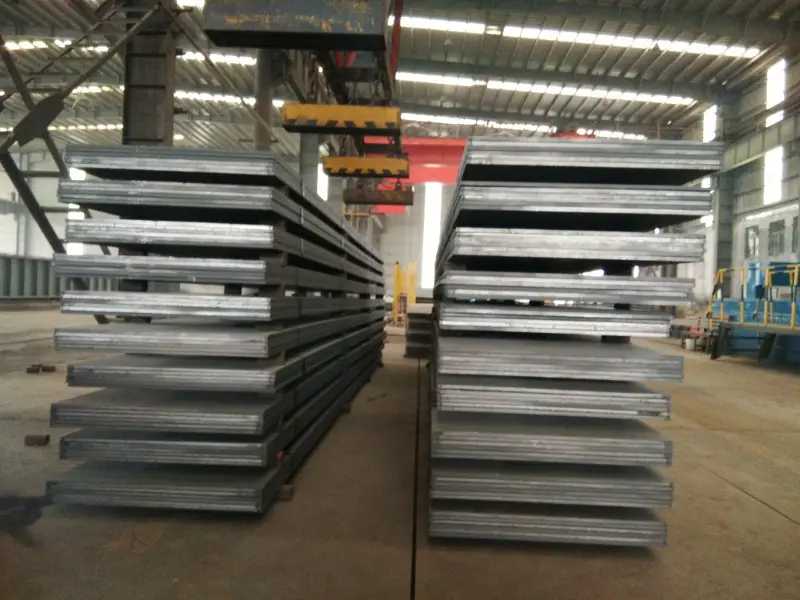
CCS DQ56 Shipbuilding Steel
CCS Q550D (DQ56) Shipbuilding Steel Coil – High Strength Marine Plate
Detailed material data for CCS grade Q550D (commonly named DQ56) shipbuilding steel coil: chemical composition, mechanical properties, thermophysical characteristics, international equivalents, and application guidance.
Thermo-mechanical controlled processing (TMCP), normalizing rolling, welding, cutting, forming
- Phone : +8618037372205
- Email : [email protected]
- WhatsApp: Contact via Whtsapp
- WeChat: +8618037372205
CCS DQ56 Shipbuilding Steel Introduction
Q550D is a high-strength shipbuilding and offshore structural steel grade specified in GB 712-2011 and approved by China Classification Society (CCS). Often referred to by the shorthand DQ56 in industry (D for low-temperature toughness class, Q for yield, 56 for minimum yield strength of 560 MPa in legacy naming), the standardized designation is Q550D. It offers a minimum yield strength of 550 MPa, excellent weldability, and guaranteed Charpy impact energy at -20 °C. The steel is produced via thermo-mechanical controlled processing (TMCP) or normalizing rolling, and is widely used in the construction of ship hulls, offshore platforms, and marine engineering structures. Its combination of high strength and good low-temperature toughness makes it suitable for critical load-bearing components in harsh marine environments.
CCS DQ56 Shipbuilding Steel Chemical Composition
Chemical composition according to GB 712-2011 for Q550D. Microalloying elements such as Nb, V, Ti are used to refine grains and improve strength and toughness.
- All values are maximum unless a range is given.
- Carbon equivalent (CEV) typically ≤ 0.45% for weldability.
- Optional additions of Ni, Cr, Mo improve hardenability and toughness.
| Element | Specification (max, %) | Remarks |
|---|---|---|
| Carbon (C) | 0.18 | |
| Silicon (Si) | 0.50 | |
| Manganese (Mn) | 1.60 | |
| Phosphorus (P) | 0.020 | |
| Sulfur (S) | 0.020 | |
| Niobium (Nb) | 0.05 | |
| Vanadium (V) | 0.10 | |
| Titanium (Ti) | 0.020 | |
| Aluminum (Al) | ≥ 0.020 | Total aluminum |
| Chromium (Cr) | 0.30 | |
| Nickel (Ni) | 0.40 | |
| Molybdenum (Mo) | 0.08 | |
| Copper (Cu) | 0.35 | |
| Nitrogen (N) | 0.012 | If not fixed by titanium or aluminum |
CCS DQ56 Shipbuilding Steel Thermal and Electrical Physical Properties
Thermal and electrical properties are typical for low-alloy high-strength structural steel. They may vary slightly depending on exact chemical composition and processing route.
- Values are for reference at room temperature unless otherwise noted.
- Heat treatment condition: TMCP or normalized.
| Property | Typical Value | Unit | Test Condition |
|---|---|---|---|
| Density (ρ) | 7.85 | g/cm³ | 20 °C |
| Modulus of elasticity (E) | 206 | GPa | Room temperature |
| Shear modulus (G) | 79.2 | GPa | Calculated from E and ν |
| Poisson's ratio (ν) | 0.3 | Room temperature | |
| Thermal expansion coefficient (α) | ~12.0 × 10⁻⁶ | 1/K | 20–300 °C |
| Thermal conductivity (λ) | ~45 | W/(m·K) | Room temperature |
| Specific heat capacity (cp) | ~460 | J/(kg·K) | Room temperature |
| Electrical resistivity (ρe) | ~0.20 × 10⁻⁶ | Ω·m | Room temperature |
CCS DQ56 Shipbuilding Steel Mechanical Properties
Mechanical properties for plates/coils with thickness ≤ 50 mm, tested in transverse direction according to GB/T 228.1. Impact test on standard Charpy V-notch specimens at -20 °C.
- Yield strength is specified as upper yield (ReH).
- Tensile testing performed at room temperature.
- Bending test on flat specimens using d = 3a (a = specimen thickness).
| Property | Required Value | Unit | Test Condition |
|---|---|---|---|
| Upper yield strength (ReH) | ≥ 550 | MPa | Room temperature, t ≤ 50 mm |
| Tensile strength (Rm) | 670 – 830 | MPa | Room temperature, t ≤ 50 mm |
| Elongation after fracture (A) | ≥ 16 | % | Gauge length 5.65√So, room temperature |
| Bend test (bending angle 180°) | d = 3a | Bend diameter d, specimen thickness a; no cracks | |
| Charpy impact energy (KV2) | ≥ 34 (longitudinal) | J | -20 °C, V-notch |
| Charpy impact energy (KV2) | ≥ 24 (transverse) | J | -20 °C, V-notch |
CCS DQ56 Shipbuilding Steel Fully Equivalent Material Standards and Substitutable Grades
| Country/Region | Standard/Grade | Designation | Remarks |
|---|---|---|---|
| China | GB 712-2011 | Q550D | Original grade, CCS approved |
| International | CCS Rules | Q550D | CCS grade D high strength steel |
| USA | ABS Rules | DH550 | D grade, -20°C, 550 MPa min yield |
| Norway/Germany | DNV GL Rules | NV E550 | E grade (-40°C) but similar strength; DNV E550 can be ordered for D (-20°C) |
| UK | Lloyd's Register | EH550 | E grade; D grade available as DH550 equivalent |
| France | Bureau Veritas | EH550 | Similar, D quality can be agreed |
| Japan | ClassNK | KE550 | K grade (equivalent to D) |
| South Korea | Korean Register | REH550 | D quality available |
| Italy | RINA | E550 | E grade; D grade can be agreed |
| Russia | RMRS | E550 | E grade; D grade option |
CCS DQ56 Shipbuilding Steel Application Introduction
Q550D (DQ56) shipbuilding steel is engineered for heavy structural parts that require high strength, excellent low-temperature toughness, and good weldability. Its fine grain structure and low carbon equivalent enable reliable performance in dynamic loading and cold climate conditions. The material is commonly delivered as coils or cut-to-length plates, and can be fabricated using conventional shipyard processes.
Product Applications: Ship hulls and superstructures, Deck plates and bottom shells, Bulkheads and stiffeners, Offshore platform legs and bracings, Flare booms and helidecks, Arctic-class vessel hulls (ice-strengthened)
Processed into products: Main deck stringer plates, Shear strakes, Bilge keels, Rudder horns, Foundation plates for engines and thrusters, Lifting lugs and pad-eyes, Heavy brackets and chocks
Application industries: Shipbuilding (merchant ships, naval vessels, icebreakers), Offshore oil and gas (jacket platforms, topside modules, FPSO hulls), Marine engineering (harbor cranes, docks, lock gates), Renewable energy (offshore wind turbine foundations, transition pieces), Heavy machinery (pressure vessels for low temperature)
CCS DQ56 Shipbuilding Steel Similar / Near-Equivalent Steel Grades
| Country/Region | Standard/Grade | Designation | Remarks |
|---|---|---|---|
| China | GB 712-2011 | Q500D | Slightly lower strength (min 500 MPa yield), similar toughness |
| China | GB 712-2011 | Q620D | Higher strength (620 MPa yield), higher alloy content |
| Europe | EN 10225 | S460G2+M/Q | Lower strength, used for offshore structures, good weldability |
| International | API 2W | Grade 50 (345 MPa) | Lower strength, but corrosion resistant; different application |
Notes:
- Ultrasonic testing to CCS or EN 10160 Class S1/E1 is typical for plates ≥ 6 mm.
- Z-direction (through-thickness) properties per GB/T 5313 are available upon order as Z25 or Z35 to resist lamellar tearing.
- Carbon equivalent (CE) and weldability parameter (Pcm) are controlled to preheat-free welding conditions.
- Low temperature impact test temperature can be adjusted to -40°C (E grade) or -60°C (F) by agreement.
- The designation 'DQ56' is a legacy abbreviation and is not an official grade in GB 712; always specify Q550D for orders.
- Share



