
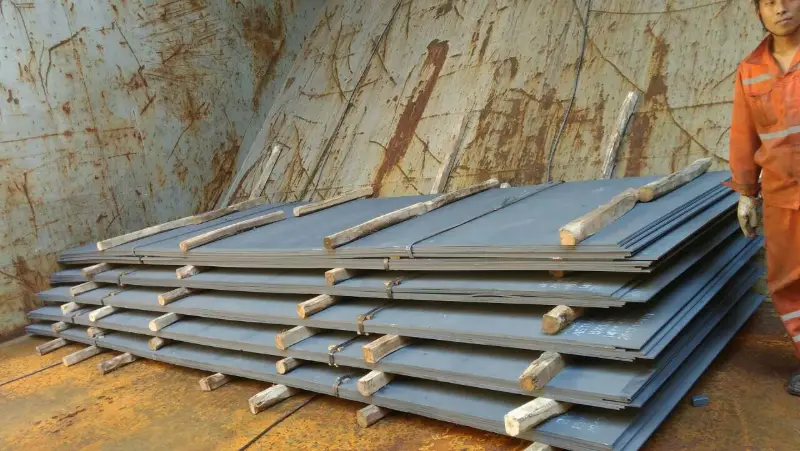
EN10219 S420MH Cold
EN10219 S420MH Cold-Formed Welded Structural Hollow Section Steel
Comprehensive technical data for EN10219 S420MH steel, a thermomechanically rolled fine-grain structural steel for cold-formed welded hollow sections including chemical composition, mechanical properties, and processing guidelines.
Cold forming followed by welding. The base metal is produced via thermomechanical rolling. Suitable for cutting, drilling, welding, and hot-dip galvanizing.
- Phone : +8618037372205
- Email : [email protected]
- WhatsApp: Contact via Whtsapp
- WeChat: +8618037372205
EN10219 S420MH Cold Introduction
EN10219 S420MH is a thermomechanically rolled weldable fine-grain structural steel grade specified in the European standard EN 10219-1. It is designated for the manufacture of cold-formed welded structural hollow sections (SHS, RHS, and CHS). The 'MH' suffix indicates a thermomechanical rolling process, which provides a high minimum yield strength of 420 MPa combined with excellent toughness and weldability. Key characteristics include low carbon equivalent values, superior formability for cold forming, and consistent mechanical properties across a wide thickness range. This steel grade is designed for demanding structural applications where high load-bearing capacity, excellent strength-to-weight ratio, and reliable performance under dynamic loading are critical requirements.
EN10219 S420MH Cold Chemical Composition of EN10219 S420MH
The chemical composition for S420MH steel is strictly controlled to ensure weldability and mechanical properties. The maximum carbon equivalent (CEV) is defined to guarantee cold cracking resistance during welding. The following table specifies the maximum allowable limits for elements according to EN 10219-1, unless a range is shown.
- Thermomechanical rolling allows for a leaner chemical composition while achieving high strength.
- Niobium (Nb), Vanadium (V), and Titanium (Ti) are micro-alloying elements that contribute to grain refinement and precipitation strengthening.
| Chemical Element | Standard Value (Max, %) | Remarks |
|---|---|---|
| Carbon (C) | 0.12 | Maximum for ladle analysis |
| Silicon (Si) | 0.50 | Maximum for ladle analysis |
| Manganese (Mn) | 1.60 | Maximum for ladle analysis |
| Phosphorus (P) | 0.030 | Maximum for ladle analysis |
| Sulfur (S) | 0.025 | Maximum for ladle analysis |
| Aluminum (Al) total | 0.020 | Minimum for ladle analysis |
| Niobium (Nb) | 0.05 | Maximum for ladle analysis |
| Vanadium (V) | 0.12 | Maximum for ladle analysis |
| Titanium (Ti) | 0.05 | Maximum for ladle analysis |
| Nitrogen (N) | - | Not specified as a limit, but typically bound by Al, V, Nb, and Ti |
| Carbon Equivalent (CEV) | Varies by thickness (e.g., ≤0.43) | Calculated using formula: CEV = C + Mn/6 + (Cr+Mo+V)/5 + (Ni+Cu)/15 |
EN10219 S420MH Cold Thermal and Electrical Physical Properties of S420MH Steel
Physical properties are essential for design calculations involving thermal loads or electrical applications. These values are typical for fine-grain structural steels and do not vary significantly with the S420MH grade designation. The values are primarily dependent on temperature.
- Thermal expansion data is critical for structures exposed to temperature fluctuations.
- Density is a standard value used for dead load calculations.
| Physical Property | Standard Typical Value | Unit | Test Condition / Remarks |
|---|---|---|---|
| Density (ρ) | 7850 | kg/m³ | At 20°C |
| Modulus of Elasticity (E) | 210,000 | MPa | At 20°C |
| Shear Modulus (G) | 81,000 | MPa | Approximate value at 20°C |
| Poisson's Ratio (ν) | 0.3 | - | In the elastic range |
| Thermal Expansion Coefficient (α) | 11.1 x 10⁻⁶ | K⁻¹ | Between 20°C and 100°C |
| Thermal Expansion Coefficient (α) | 12.5 x 10⁻⁶ | K⁻¹ | Between 20°C and 300°C |
| Thermal Conductivity (λ) | 50 | W/(m·K) | At 20°C |
| Thermal Conductivity (λ) | 45 | W/(m·K) | At 300°C |
| Specific Heat Capacity (cp) | 460 | J/(kg·K) | At 20°C |
| Specific Heat Capacity (cp) | 560 | J/(kg·K) | At 300°C |
| Electrical Resistivity (ρe) | 0.21 | Ω·mm²/m | At 20°C (typical for structural steel) |
EN10219 S420MH Cold Mechanical Properties of EN10219 S420MH Hollow Sections
The mechanical properties are verified on test pieces taken from the finished hollow section. The values depend on the nominal thickness (t) of the product. The minimum yield strength and tensile strength are guaranteed at room temperature. Charpy impact testing is mandatory and demonstrates the steel's toughness.
- Elevated yield strength at high proof levels ensures structural safety.
- Excellent ductility allows for plastic design in accordance with structural codes.
| Property | Standard Required Value | Unit | Test Condition / Thickness Range |
|---|---|---|---|
| Minimum Yield Strength (ReH) | 420 | MPa | Nominal thickness t ≤ 16 mm |
| Minimum Yield Strength (ReH) | 400 | MPa | Nominal thickness 16 mm < t ≤ 40 mm |
| Minimum Yield Strength (ReH) | 390 | MPa | Nominal thickness 40 mm < t ≤ 63 mm |
| Tensile Strength (Rm) | 520 to 680 | MPa | Nominal thickness t ≤ 40 mm |
| Tensile Strength (Rm) | 500 to 660 | MPa | Nominal thickness 40 mm < t ≤ 63 mm |
| Minimum Elongation after Fracture (A) | 19 | % | Longitudinal, proportional test piece (L0=5.65√S0) for t ≤ 40 mm |
| Minimum Elongation after Fracture (A) | 18 | % | Longitudinal, proportional test piece for 40 mm < t ≤ 63 mm |
| Minimum Impact Energy (KV2) at -20°C | 40 | Joules | Charpy V-notch, longitudinal, for t ≥ 6 mm |
EN10219 S420MH Cold Completely Equivalent Material Standards and Replaceable Grades
| Country/Region | Standard | Grade | Remarks |
|---|---|---|---|
| European Union | EN 10025-4 | S420M | Base material for hot-rolled products. Identical chemical and mechanical requirements for flat and long products. |
| International | ISO 4950/2 | S420M | High yield strength flat steel products. Chemically and mechanically equivalent. |
| Germany | DIN EN 10219-1 | S420MH | Adopts the EN standard directly; S420MH is the official grade designation. |
| United Kingdom | BS EN 10219-1 | S420MH | British adoption of the European standard; S420MH is the recognized grade. |
EN10219 S420MH Cold Application Introduction
S420MH hollow sections are engineered for superior structural performance in severe environments and demanding loading scenarios. The high strength-to-weight ratio enables lighter and more economical designs. Excellent weldability and guaranteed toughness at low temperatures (-20°C) make it a primary choice for dynamically loaded structures.
- Pre-fabricated components reduce on-site construction time.
- Ideal for architecturally exposed structural steel (AESS) due to smooth finish and tight corner radii.
- Fully recyclable, contributing to green building certifications.
Product Applications: Structural frameworks for high-rise buildings and industrial plants, Offshore platform topside structures and subsea bracing, Vehicular and pedestrian bridge trusses and girders, Crane booms, lifting beams, and heavy equipment chassis, Wind turbine towers, solar panel support structures, and transmission line masts, Bollards, piles, and dock fendering systems, Roll cages and roll-over protective structures (ROPS)
Processed into products: Welded main chords and columns in space frames, Truss web members for long-span roofs, Compression struts and tension braces in high-rise buildings, Fatigue-loaded beams in crane runway girders, Jack-up rig legs and spudcans, Monopile transition pieces for wind turbines, Articulated lorry trailer frames and chassis rails
Application industries: Civil Engineering and Infrastructure Construction, Bridge Building, Offshore and Marine Engineering, Heavy-Duty Machinery Manufacturing, Power Transmission and Telecommunications Towers, Sports Stadiums and Large Venue Roof Structures, Shipbuilding (Decks and Superstructure)
EN10219 S420MH Cold Similar or Proximate Substitute Material Recommendations
| Country/Region | Standard | Grade | Remarks |
|---|---|---|---|
| European Union | EN 10219-1 | S460MH | Higher strength option with a minimum yield strength of 460 MPa. Provides better weight savings but may require stricter processing controls. |
| European Union | EN 10219-1 | S355MH | Lower strength grade with a minimum yield strength of 355 MPa. Suitable for applications where the full strength of S420MH is not required, offering potentially better availability. |
| USA | ASTM A1085 | Grade 42 or 50 | American standard for cold-formed welded hollow sections. While chemical requirements differ, these grades provide comparable structural performance. |
| Japan | JIS G 3466 | STKR490 | Japanese standard for carbon steel square and rectangular tubes. It has a similar minimum tensile strength of 490 MPa but differs in compositional and impact test requirements. |
Notes:
Precautions for Welding: Low hydrogen welding processes are mandatory to prevent cold cracking. Filler metal selection should be based on the strength level, typically matching the "M" classification. Post-weld heat treatment (PWHT) is generally not required for this thermomechanically rolled steel and can degrade its mechanical properties. Always consult the steel manufacturer's rolling and welding guidelines for specific heat input and interpass temperature controls. For hot-dip galvanizing, the silicon content below 0.05% ensures a high-quality finish without excessive zinc layer growth.
- Share



